

Thousands of supporters of Hezbollah’s slain leader Nasrallah fly into Beirut for his funeral

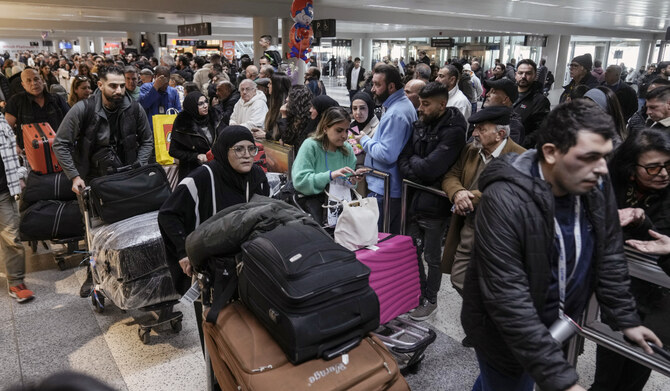
Travelers push their luggage as they arrive at the Rafik Hariri International Airport, in Beirut, Lebanon, Friday, Feb. 21, 2025. (AP)
Short Url
Updated 22 February 2025
Follow

Thousands of supporters of Hezbollah’s slain leader Nasrallah fly into Beirut for his funeral

  • Crowds are expected to gather on Sunday at Beirut’s main sports stadium for a funeral ceremony before Nasrallah’s interment

BEIRUT: Nearly five months after he was killed in an Israeli airstrike, thousands of supporters of the longtime leader of Lebanon’s militant Hezbollah group have flown into Beirut for Hassan Nasrallah’s funeral on Sunday.
Nasrallah was killed on Sept. 27 when Israel’s air force dropped more than 80 bombs on Hezbollah’s main operations room in southern Beirut. It was the biggest and most consequential of Israel’s targeted killings in years.
The death of Nasrallah, one of the Iran-backed Shiite group’s founders and Hezbollah’s leader of more than 30 years, was a huge blow to the group he had transformed into a potent force in the Middle East.
Hezbollah, which the US and some of its allies has designated a terrorist organization, has suffered significant losses in the latest war with Israel, including the killing of several of its most senior military and political figures.
His cousin and successor Hashem Safieddine, who was killed in an Israeli airstrike on a Beirut suburb a few days later, will be laid to rest in his hometown in southern Lebanon. The two had temporarily been buried in secret locations. Hezbollah earlier this month announced plans for their official funerals.
Crowds are expected to gather on Sunday at Beirut’s main sports stadium for a funeral ceremony before Nasrallah’s interment.
Flights from Iraq, where Hezbollah has a huge following among Iraqi Shiites, have been full for days on end. According to an Iraqi transportation ministry official, who spoke on condition of anonymity to discuss the flights, up to 6,000 people have flown to Beirut over the past days.
Among those who arrived from overseas was also American commentator Jackson Hinkle, who regularly spreads false information on social media, especially in support of Russia and its war on Ukraine.
“I am honored to be attending the funeral,” Hinkle posted on the social media platform X after arriving this week in Beirut.
Hinkle posted a photo of himself visiting a war-wrecked southern Lebanese border village, waving a Hezbollah flag.
Nasrallah, idolized by his supporters and with large followings among the Shiites and the Islamic world, also held the title of sayyid, an honorific meant to signify the Shiite cleric’s lineage dating back to the Prophet Muhammad, the founder of Islam.
However, Lebanese authorities have revoked permission for a passenger plane from Iran, leaving dozens who had wanted to attend the funeral stranded in Tehran and triggering protests by Hezbollah supporters in Lebanon.
The ban came after the Israeli army accused Iran of smuggling cash to Hezbollah by way of civilian flights, leading some in Lebanon to allege that their government had caved in the face of a threat from Israel.
Some of those who were expected to fly in from Iran were now coming to Lebanon via Iraq. Also, members of Iran-backed groups in the region also were traveling to Beirut to attend Nasrallah’s funeral.
Kazim Al-Fartousi, spokesman for the Iran-backed Kataib Sayyid Al-Shuhada group in Iraq, arrived on Friday. He said Nasrallah was “the father, commander and the book that we read every day to learn about freedom.”
US Republican Rep. Joe Wilson criticized Lebanese politicians who were planning to attend the funeral.
“Any Lebanese politician who attends the funeral of the murderous terrorist Hasan Nasrallah is standing with the Iranian Regime,” Wilson said on X.


Syrian government and SDF agree to de-escalate after Aleppo violence

Updated 28 min 16 sec ago
Follow

Syrian government and SDF agree to de-escalate after Aleppo violence

  • Turkiye views the US-backed SDF, which controls swathes of northeastern Syria, as a ⁠terrorist organization and has warned of military action if the group does not honor the agreement

DAMASCUS: Syrian government forces and the Kurdish-led Syrian Democratic Forces agreed to de-escalate on Monday evening in the northern city of Aleppo, after a wave of attacks that both sides blamed on each other left at least two civilians dead and several wounded.
Syria’s state news agency SANA, citing the defense ministry, said the army’s general command issued an order to stop targeting the SDF’s fire sources. The SDF said in a statement later that it had issued instructions to stop responding ‌to attacks ‌by Syrian government forces following de-escalation contacts.

HIGHLIGHTS

• SDF and Syrian government forces blame each other for Aleppo violence

• Turkiye threatens military action if SDF fails integration deadline

• Aleppo schools and offices closed on Tuesday following the violence

The Syrian health ministry ‌said ⁠two ​people ‌were killed and several were wounded in shelling by the SDF on residential neighborhoods in the city. The injuries included two children and two civil defense workers. The violence erupted hours after Turkish Foreign Minister Hakan Fidan said during a visit to Damascus that the SDF appeared to have no intention of honoring a commitment to integrate into the state’s armed forces by an agreed year-end deadline.
Turkiye views the US-backed SDF, which controls swathes of northeastern Syria, as a ⁠terrorist organization and has warned of military action if the group does not honor the agreement.
Integrating the SDF would ‌mend Syria’s deepest remaining fracture, but failing to do ‍so risks an armed clash that ‍could derail the country’s emergence from 14 years of war and potentially draw in Turkiye, ‍which has threatened an incursion against Kurdish fighters it views as terrorists.
Both sides have accused the other of stalling and acting in bad faith. The SDF is reluctant to give up autonomy it won as the main US ally during the war, which left it with control of Daesh prisons and rich oil resources.
SANA, citing the defense ministry, reported earlier that the SDF had launched a sudden attack on security forces ⁠and the army in the Sheikh Maqsoud and Ashrafiyah neighborhoods of Aleppo, resulting in injuries.
The SDF denied this and said the attack was carried out by factions affiliated with the Syrian government. It said those factions were using tanks and artillery against residential neighborhoods in the city.
The defense ministry denied the SDF’s statements, saying the army was responding to sources of fire from Kurdish forces. “We’re hearing the sounds of artillery and mortar shells, and there is a heavy army presence in most areas of Aleppo,” an eyewitness in Aleppo told Reuters earlier on Monday. Another eyewitness said the sound of strikes had been very strong and described the situation as “terrifying.”
Aleppo’s governor announced a temporary suspension of attendance in all public and private schools ‌and universities on Tuesday, as well as government offices within the city center.