
ALKHOBAR: A decade after Kalimat House first began its journey in the heart of Alkhobar, the initiative has returned with a writing workshop to capture the evolving essence of the city and its people.
“We’re remaking the new narrative of Saudi Arabia,” Haifa Al-Owain, co-founder of Kalimat House, told Arab News.
Founded in 2014 by cultural visionaries Anfal Al-Hammad and Al-Owain, Kalimat House was born with a mission to foster literature, arts and social impact.

Haifa Al-Owain, Kalimat House co-founder. (Supplied)
Initially centered on creating a safe space for women to engage in storytelling and creative expression, Kalimat has evolved over the years, expanding its reach to embrace all genders and a broader community, while retaining its commitment to promoting intellectual exchange and fostering creativity.
The Alkhobar workshop marked a symbolic return to where it all began for Kalimat — which has since evolved toward Riyadh and online — by providing an opportunity to reflect on the past while looking toward the future.
FASTFACT
Founded in 2014 by cultural visionaries Anfal Al-Hammad and Haifa Al-Owain, Kalimat House was born with a mission to foster literature, arts and social impact.
Hosted at the new permanent Tanafs Cultural Experiences’ space in northern Alkhobar, the ticketed workshop invited participants, some of whom were visiting from other cities, to explore their relationship with the city of Alkhobar, using writing and photography to uncover personal histories and collective memories.

The Kalimat workshop invited participants to explore their relationship with the city of Alkhobar, using writing and photography to uncover personal histories and collective memories. (Supplied)
Through a unique blend of creative exercises and prompts led by Al-Owain, participants were encouraged to reflect on how their personal stories were woven into the fabric of the city.
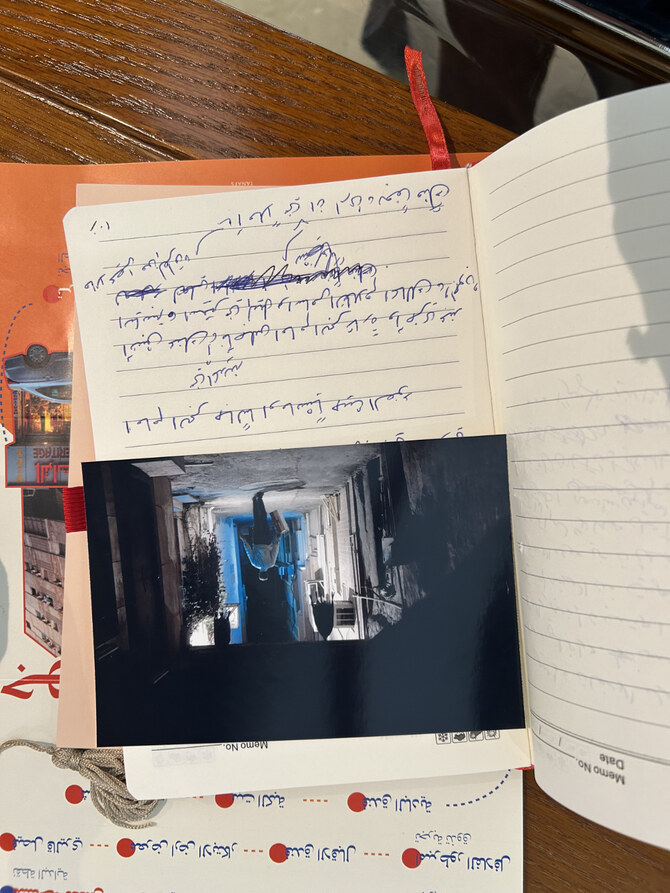
Participants shared images of Alkhobar, including the corniche and spaces like hospital rooms, taken with both old film cameras and modern smartphones. All photos were printed to provide a tangible memory connected to Alkhobar.
Red notebooks were provided for participants to write on, but a few opted to write on their laptops or phones.

The experience of writing in front of mostly unfamiliar faces was an opportunity to reconnect with the city and the people who live in it. (Supplied)
People were encouraged to read aloud their snippets to be discussed among the group.
For many, these images and the writings they inspired were more than just pictures; they were windows into the past, evoking nostalgia for familiar streets, once-bustling markets.
The ever-present Alkhobar cats and the corniche made cameos in nearly every narrative.
Even if it’s the same city, we see it in different ways.
Haifa Al-Owain, Kalimat House co-founder
“Even if it’s the same city, we see it in different ways,” Al-Owain said.
For some, the workshop was a way to reestablish a connection with a city that, depending on who you ask, had either changed too much or not enough over the years.

Co-founders of ‘Kalimat’ Haifa AlOwain, Anfal AlHammad along with the host of the writing workshop space Khaled Almsaad, Founder of Tanafs Cultural Experiences. (Supplied)
“The Dammam I was born in is not the Dammam I live in right now,” Al-Owain said.
Dammam, a vital port located in the Eastern Province, is a prime example of urbanization, with new developments reshaping its skyline and identity.
Now mostly residing in Riyadh where she grew up, Al-Owain sees the change that has shifted over time in each city as personal to each of us.

All photos were printed to provide a tangible memory connected to Alkhobar. (Supplied)
She said: “I think it’s funny how some people found it to be a relief for a city to be the same and others found that to be disappointing. So it just depends on their ideas.”
The tension between progress and preservation became a central topic during the discussions. Participants pondered what aspects of their cities they felt should remain the same and what should evolve with time — a conversation that spoke to the larger cultural shifts happening across Saudi Arabia.
One of the workshop’s most poignant moments came through the reflections of Hussah Al-Yahya, a past participant who returned to Alkhobar four months ago after three years in London.

The Kalimat workshop invited participants to explore their relationship with the city of Alkhobar, using writing and photography to uncover personal histories and collective memories. (Supplied)
“I was born and raised in Alkhobar; this is my hometown,” she told Arab News. “I attended some Kalimat workshops in the past. My experience today was different from the earlier workshops that I attended. It’s different because I’m a different person.”
The workshop for Al-Yahya was not just a chance to reflect on the city; it was a journey of self-discovery and reconnection with a place that held memories of both joy and struggle.
“I have so many experiences in the city, good and bad,” she said. “But for the most part I do remember or I am grateful that even my bad experiences were amongst people and a place that is like this. I was lucky that my family had built a community here that was very loving and supporting and kind.”
For Al-Yahya, the workshop held another particular significance. “Today’s workshop was the first time that I shared something I wrote. And it was the first time that I wrote with intention,” she explained.
Writing in a room full of mostly unfamiliar faces became a way to reconnect with both the city and the people who share it.
Kalimat House’s evolution over the years also mirrors the changes in Saudi society.
“We started Kalimat 10 years ago, and now we’ve transformed into a company that deals with both business-to-customer and business-to-business experiences,” said Al-Hammad.
Al-Hammad stressed that, from the very beginning, the goal was to create a platform that welcomed people, regardless of their language or background.
“We didn’t want to feel like we were excluding a community or someone because they didn’t speak the language,” she explained. Kalimat’s bilingual approach (Arabic and English) has played a vital role in fostering a diverse and inclusive community.
Khaled Almsaad, founder of Tanafs Cultural Experiences, a community-centered initiative, was present during the workshop, offering invaluable insights and showcasing updated old maps on the big screen. His street photography was hung all over the space, offering more visual guidance to the participants.
Al-Hammad said that the goal of the workshops was to create spaces for creative exploration and human connection.
“We don’t want to do any academic or systematic workshops because people are more chilled and relaxed these days,” she said, adding that the workshops had become a vital part of the cultural scene in which participants could engage in art, literature and storytelling in an informal and inclusive setting.
For Kalimat, it is not just about the writing but fostering connections and providing a space for individuals to explore their identities and narratives.
“There won’t be a Kalimat activity without networking or socializing because they go together,” said Al-Hammad.
“Honestly, this is what has helped Kalimat survive all these years.”