

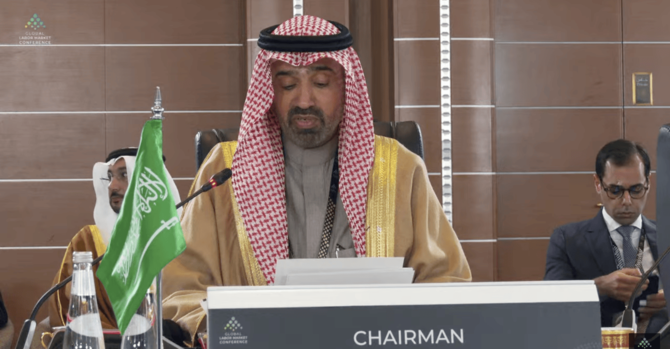

RIYADH: Stronger working between governments, the private sector, and international organizations is needed to address the global unemployment crisis, according to a top Saudi official.
During the opening remarks of the Global Labor Market Conference taking place in Riyadh from Jan. 29 – 30, the Kingdom’s Minister of Human Resources and Social Development Ahmad bin Sulaiman Al-Rajhi highlighted that with 67 million young people unemployed across the world — and over 20 percent of youth in some regions outside of education, employment, or training — targeted policies are urgently needed to tap into this labor market potential.
Global employment grew in 2024, along with the expanding labor force, keeping the unemployment rate steady at 5 percent, the same as in 2023. However, the growth in employment was too weak to address the ongoing global shortage of decent work, according to the International Labor Organization.
“While the challenges may vary, the solutions require collaboration between governments, the private sector, and international organizations. By working together, we develop strategies that benefit everyone,” Al-Rajhi said.
“The numbers are concerning, and the urgency is clear. These figures are not just statistics, they represent untapped potential in all of our labor markets,” the official added, stressing that addressing youth unemployment with the right strategies is essential for driving economic growth and social progress worldwide.
The minister went on to note that freelance work has become a growing opportunity in Saudi Arabia.
“Registered freelancers increased from 400,000 in 2020 to 2.2 million this year. This growing industry now contributes almost SR72.5 billion ($19.33 billion) to the economy. The majority of these freelancers are young people,” Al-Rajhi said.
He concluded his opening remarks by saying: “The following critical questions will guide our efforts to shape effective policies that can transform our labor markets at home while also shaping the global labor market. What innovative policies for strengthening youth employment have been applied and with what results? What new initiatives our trials can help us better to understand how to quickly get job seekers into jobs? How is technology impacting youth employability?”
The minister added that the GLMC is a platform for discussion and a space for action. It exists to identify policies and strategies that can be adapted and scaled across countries, with a clear focus on the young people who will quickly form the core of the global labor market.
Vice Minister for Labor Sector in Saudi Arabia Abdulla Nasser Abuthnain highlighted that empowering young people with skills, opportunities, and support is vital to achieving Saudi Vision 2030.
“Our approach focuses in creating pathways to quality jobs that drive productivity and innovation,” Abuthnain said.
“Here in Saudi Arabia, the Ministry of Human Resources and Social Development has introduced a comprehensive youth development strategy designed to address the most pressing challenges facing young Saudis. As a result, the need rate for youth aged 15 to 24 has decreased from 17.8 percent in 2022 to 13.7 in the second quarter of 2024,” he added.
The minister continued to stress that with regard to the freelance market, Saudi Arabia is working on enhancing workforce flexibility by offering 690 contracts under flexible work arrangements and more than 204,000 remote work contracts.
“Finally, we are enhancing job matching through digital platforms. Our unified national employment platform Edarat integrated AI (artificial intelligence) to connect to job seekers with employees, ensuring more efficient and tailored matching process,” Abuthnain said.
“In closing, Saudi Arabia remains committed to fostering dynamic labor market that empowers its youth, equip them for future and position them as a key contributor to global economy,” he added.
The Kingdom is emerging as an international leader in addressing labor market challenges, skill development, and workforce requalification, according to a report released by GLMC in December.
The inaugural report, issued by the conference hosted by Saudi Arabia’s Ministry of Human Resources and Social Development, emphasized the government’s initiatives to bridge the gap between academic qualifications and market demands.
These efforts include enhancing education and training programs and preparing young job seekers for the rapidly evolving global labor landscape.


