

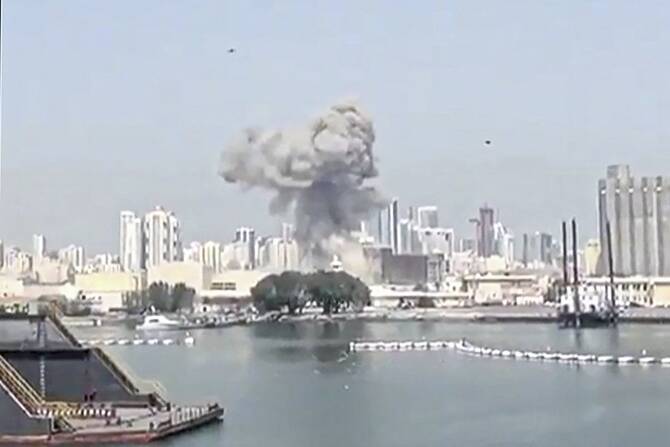

DUBAI: Iran fired missiles and drones at several Arab Gulf cities on Saturday, causing waves of blasts, shaking windows and sending people rushing for cover in rare attacks on a region that prides itself on its security.
Falling debris killed a Pakistani civilian in Abu Dhabi, UAE authorities said. Later smoke and flames rose from Dubai's Palm Jumeirah development after a building was damaged there.
Saudi Arabia said attacks had taken place in Riyadh and the Eastern Region, while Qatar, Bahrain and Kuwait were all targeted in Iran's retaliation to a US-Israeli air assault launched earlier in the day.
The US has military bases spread throughout Gulf countries and has repeatedly threatened to attack them.
Missiles streaked across the sky around the GCC, many of them intercepted, as civilians, who would normally be enjoying Ramadan, were forced to take cover.
The region's leaders condemned the attacks and held a flurry of high-level phone calls.
Iran’s Revolutionary Guards said all the US bases in the region have been struck by the "powerful blows of Iranian missiles" and warned that the operation would continue.
UAE's famous landmarks
In Dubai, five large blasts were heard late in the afternoon as witnesses described seeing missiles streak across the sky.
“It was a big explosion and it made the windows shake,” one resident told AFP.
Another resident said she saw three missiles heading across the sky before disappearing into the distance, describing them as “fireballs” followed by a trail of smoke.
Four people were wounded in the incident on Palm Jumeirah, one of the emirate's most famous landmarks, Dubai's media office said.
While normal life carried on in some areas, some grocery delivery apps showed heavily delayed services. Some users appeared to be ordering in bulk.
Loud booms were heard across Abu Dhabi, and smoke billowed from a point offshore opposite the city.
Some residents received a phone alert telling them to shelter in the closest secure building and stay away from windows because of missile threats.
One witness told Reuters she heard five booms in rapid succession that caused windows in a house near Abu Dhabi's Corniche to vibrate. Other witnesses in the Al Dhafra and Bateen areas heard loud booms as well.
Fighter jets flew above the Yas Island area of Abu Dhabi on Saturday afternoon.
A second wave of Iranian strikes were later intercepted with missile fragments faling across the capital Abu Dhabi without causing injuries.
“The Ministry of Defense announced that UAE air defenses successfully intercepted a new wave of Iranian missiles,” it said in a statement.
“Fragments of the intercepted missiles fell in various areas of Abu Dhabi, including Saadiyat Island, Khalifa City, Bani Yas, Mohamed bin Zayed City and Al Falah,” it added, confirming “there were no injuries in these locations.”
The UAE government said food supplies and essential goods remained plentiful, with imports and supply chains operating normally and strategic reserves strong enough to last for extended periods. Authorities urged the public not to panic-buy.
The Abu Dhabi Media Office said the internal security situation remained stable and that vital sectors were operating at full readiness.
Bahrain: Home of the US's Fifth Fleet
Bahrain confirmed attacks inside its territory and said a service center of the US Fifth Fleet had been struck. Video from a Reuters witness showed a plume of grey smoke rising near the coast as sirens wailed.
"The sound of the first explosion terrified me," said a 50-year-old retiree living near the US base in Manama's Juffair area, where residents were quickly evacuated.
Three residential buildings in and around the capital Manama were damaged by drone strikes and debris from an intercepted missile, the interior ministry said.
"Several residential buildings in Manama were targeted. Civil Defence continues with firefighting and rescue operations at the affected sites," the ministry said in a statement.
In another statement it reported "damage in three buildings in Manama and Muharraq as a result of drone attacks and falling debris from an intercepted missile."
The US embassy in Bahrain said it would close on Sunday, and the government announced all schools and universities would switch to long-distance learning until further notice following the Iranian attacks.
Qatar intercepts missiles in 'joint coordination
In Qatar, the military said it had intercepted incoming Iranian missiles before they reached Qatari territory after “joint coordination.” Several successive waves of blasts were heard in the Qatari capital Doha.
After the US Embassy issued a warning to take shelter in Doha, many residents carried on their usual activities. Shoppers were in supermarkets, beachgoers headed to the seaside and a yellow double-decker tour bus filled with tourists drove through the city’s West Bay district. Later, when the government pushed a shelter-in-place warning to mobile phones, fewer people were seen out in the streets and traffic thinned.
Doha shook under several salvos of missiles, with authorities saying they were suspending maritime transport. An AFP journalist in Qatar saw one missile destroyed in a puff of white smoke.
Al-Udeid base in Qatar houses CENTCOM, the region's American military command, as well as its air and special operations forces.
Iran fired missiles at Al Udeid last June after US strikes targeted Iranian nuclear facilities during a brief war with Israel.
Kuwaiti soldiers injured at airbase
Three Kuwaiti soldiers were injured by shrapnel when the Ali Al-Salem Air Base was targeted, a Kuwait defence ministry spokesman said.
Earlier, the health ministry said 12 people had been injured during and in the aftermath of the strikes. It was unclear if the three soldiers were among the toll.
"Shrapnel fell at Ali Al Salem Air Base after air defence forces engaged ballistic missiles and drones, resulting in minor injuries to three members of the armed forces and some material damage," said Colonel Saud Al-Atwan.
The strikes also hit Kuwait's international airport, the civil aviation authority said, causing minor injuries.
Mediator Oman urges ‘immediate cease’
Oman called on all parties to stop fighting on Saturday, warning of “dire consequences” as the United States and Israel launched attacks on Iran, which has retaliated with wide-ranging missile attacks.
The foreign ministry of Oman, a mediator in recent US-Iran talks, expressed “deep regret over the military operations launched by Israel and the United States against the Islamic Republic of Iran, warning of the danger of the conflict escalating into something with dire consequences for the region.”
Oman said it calls “on all parties to immediately cease military operations and urges the United Nations Security Council to convene an emergency meeting to impose a ceasefire.”
Jordan will defend its interests ‘with all its might’
Jordan’s government called for a halt Saturday to the military escalation in the Middle East but said it would defend the kingdom’s interests “with all its might,” after the US and Israel launched strikes on Iran.
“Jordan is not part of the conflict in the region and will not allow anyone to violate its sovereignty and will defend its interests with all its might,” government spokesman Mohammad Momani told Jordan’s official Al-Mamlaka TV.
“Jordan’s position is clear on the need to stop the escalation in the region,” he added.
Jordan's armed forces said they had successfully intercepted 13 ballistic missiles since Saturday morning in an operation that resulted in damage but no casualties.
“The armed forces engaged 49 drones and ballistic missiles targeting Jordanian territory today,” a military source said in a statement, adding that “13 ballistic missiles were successfully intercepted by Jordanian air defence systems, while drones were shot down.”
The statement said "the interception operation resulted in material damage but no casualties.”
“Civil defenses and police personnel had responded to 12 reports of falling objects and debris in the governorates of the capital Amman, Zarqa, Jerash, Madaba and Irbid between this morning and 2 p.m. (1100 GMT),” it added.


