LONDON: London police said Saturday a man had been charged with criminal damage for defacing a statue of Britain’s World War II prime minister Winston Churchill with pro-Palestinian slogans.
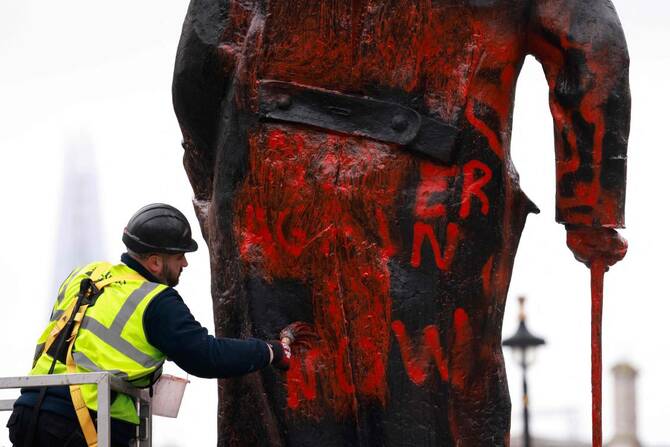
The monument in the central Parliament Square was smeared with red paint early on Friday and “Zionist war criminal” among the slogans written on it.
The Metropolitan Police said Caspar San Giorgio, 38, of no fixed address, was charged early Saturday, some 24 hours after his arrest.
He had been detained within minutes of officers being alerted to the incident, according to the force.
He was due to appear at a London magistrates’ court later Saturday.
The words “free Palestine” and “stop the genocide” were also sprayed on the statue, which workers cleaned off Friday.
The incident prompted Prime Minister Keir Starmer’s office to call the damage “completely abhorrent” and commend police for the swift arrest.
“Churchill was a great Briton,” a spokesman said.
The 3.6 meter (12-foot) Churchill statue has been vandalized a number of times in recent years, including during Black Lives Matter and Extinction Rebellion climate demonstrations in 2020.

Man charged after defacing Churchill statue in central London
https://arab.news/2gtet
Man charged after defacing Churchill statue in central London
- Metropolitan Police said Caspar San Giorgio was charged early Saturday, some 24 hours after his arrest
- He had been detained within minutes of officers being alerted to the incident
Briton fights for tech justice after daughter’s suicide in 2017
- Molly Russell took her own life after viewing pro-suicide content online
- The inquest heard that, of the 16,300 posts Molly saved, shared or liked on Instagram in the six-month period before her death, 2,100 related to depression, self-harm or suicide
LONDON: The father of British teenager Molly Russell, who took her own life after viewing pro-suicide content online, hopes a documentary about her death will inspire change.
The film — “Molly vs. the Machines” — about his 14-year-old daughter will “bring back some of the grief,” Ian Russell acknowledged.
He said it will highlight how the tragedy was not isolated, and “there’s a real hope that it will become part of a conversation that might help bring about change.”
The documentary, which premieres in British cinemas from March 1 and airs on the UK’s Channel 4 on March 5, recounts his quest to hold “digital systems designed for profit” accountable for his loss, according to Russell.
Perhaps surprisingly, he opposes an outright social media ban for children, arguing “getting the platforms to change is actually much more effective.”
The bereaved father is also seeking an end to impunity for big tech, which he says purposefully targets vulnerable people with addictive algorithms feeding them harmful content for monetary gain.
Molly took her own life in 2017, with a coroner concluding five years later that she had died from an act of self-harm while suffering from the “negative effects of online content.”
The inquest into her death heard that, of the 16,300 posts Molly saved, shared or liked on Instagram in the six-month period before her death, 2,100 related to depression, self-harm or suicide.
Her engagement with pro-suicide content increased toward the end of her life, until “this intelligent, caring, beautiful person had been persuaded she was worthless,” her father said.
“How Molly of all people could ever have been convinced of that, for those of us lucky enough to have known her, is just baffling,” he added.
Research published in October by the Molly Rose Foundation, a suicide prevention charity founded and chaired by Russell, showed 37 percent of children aged 13-17 had seen at least one type of high-risk content relating to suicide, self-harm, depression or eating disorders during the week they were surveyed.
According to the data, which was collected before child safety obligations of the UK’s landmark Online Safety Act became law, 27 percent of those children said they had viewed such content at least 10 times that week.
The foundation has welcomed legislation put forward by UK Prime Minister Keir Starmer’s government. It called a decision to ban AI chatbots from generating illegal or harmful content — a loophole exposed by sexualized deepfakes created by X’s AI chatbot Grok — a “welcome downpayment.”
But it said the Online Safety Act, which legally obliges tech companies to better safeguard children and adults online, could go further.
The law should require greater transparency from platforms and use separate age limits for different tools — such as AI chatbots.
The foundation argues that would push companies to offer fewer high-risk services and make platforms safer. It is also calling for “fundamentally repurposed” algorithms that promote healthy content from trusted sources instead of “harmful and toxic material.”
And it advocates for better digital education at schools to enable young people to “critically reflect” on online content.
Russell favors this two-pronged approach over a social media ban for children, pointing out that Australia’s under-16s block only covers 10 platforms and might push minors to more dangerous fringe sites. Youngsters might find ways to bypass the rules, he added, while those turning 16 will enter an “unregulated” space.


