

PLO is the ‘only legitimate representative’ of Palestinians, minister tells UN Security Council

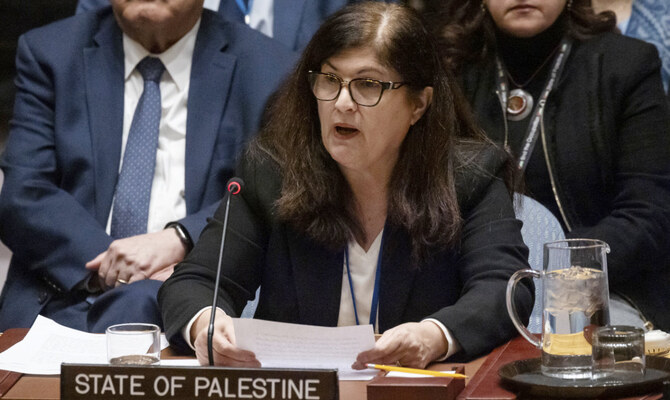
Palestine's Minister of State for Foreign Affairs and Expatriates Varsen Aghabekian speaks during a Security Council meeting at the United Nations headquarters, Monday, Jan. 20, 2025. (AP)
Short Url
Updated 21 January 2025
Follow

PLO is the ‘only legitimate representative’ of Palestinians, minister tells UN Security Council

  • Foreign Minister Varsen Aghabekian calls for all Palestinians to work ‘under one regime, one law and a single armed forces’
  • Israeli representative calls on council members to condemn Hamas and designate it as a terror group

NEW YORK CITY: Palestine’s foreign minister on Monday said that the State of Palestine has “legal and political” jurisdiction over the Gaza Strip and all occupied territories, including East Jerusalem, and warned that any attempt to annex the West Bank would be a violation of international law.

Varsen Aghabekian told a meeting of the UN Security Council in New York that the “imperative” to uphold the legitimate rights of Palestinians requires “unity of our land and our people under the umbrella of the Palestine Liberation Organization, which is the only legitimate representative of the Palestinian people.”

She added: “It also requires everyone to commit to the PLO political program and international commitments, and to work under one regime, one law and a single armed forces.”

Her statement came as debates continue about the future role of Hamas in Gaza. Israel and several other countries believe the group, which was responsible for the Oct. 7 attacks against Israel in which about 1,200 people were killed and hundreds taken hostage, should be disqualified from playing any part in the future of the battered territory.

Aghabekian called for the ceasefire agreement between Israel and Hamas that came into effect on Sunday to be fully implemented, in order to allow the Palestinian Authority “to shoulder its full responsibilities in Gaza,” and for the reunification of the Strip with the West Bank “under the management of the Palestinian Authority.”

She also called for a return to a political process that would end Israel’s illegal occupation of Palestinian territories, and lead to the implementation of a two-state solution.

The high-level meeting of the Security Council was convened as the signature event of Algeria’s presidency of the council for the month of January. More 70 countries attended, including Saudi Arabia.

Aghabekian said the Palestinian government stands ready to govern Gaza and the West Bank in cooperation with “friendly and sisterly” countries and international organizations.

“The Palestinian government is ready to provide basic services, including health, education, water and electricity; to guarantee the return of the displaced to their homes; and to prepare for the reconstruction phase,” the minister told the council.

“We are also committed to managing the (border) crossing points, in collaboration with the EU and Egypt.”

Aghabekian also underscored the important role of the UN Relief and Works Agency, the largest aid agency for Palestinians, describing it as “indispensable and irreplaceable.” A ban by the Knesset that would prevent the agency from working in Israel and the territories it occupies is due to take effect at the end of this month.

“The Israeli occupation powers do not have the right to prevent UNRWA from working,” Aghabekian said.

Reut Shapir Ben Naftaly, the political coordinator at Israel’s UN mission in New York, told the Security Council: “The families of the hostages and the people of Israel know that this moment is only the beginning. This war will not end until every hostage is returned and Hamas’ ability to terrorize is dismantled.”

She said Hamas has turned Gaza into “a fortress of terror, sacrificing their own civilians to shield their operations. It has weaponized schools, hospitals and mosques, transforming them into instruments of war.

“This barbarity demands a resolute and united response from the international community.”

Ben Naftaly added: “Failing to act decisively against Hamas sends a dangerous message to other terrorist organizations that such tactics are permissible.

“It is a test of our collective will to uphold international law and human dignity.”

The diplomat called on the Security Council to take “the most basic, moral step” and “unequivocally condemn Hamas and designate it as the terrorist organization it is.”


Israeli military raids in Syria raise tensions as they carve out a buffer zone

Updated 15 December 2025
Follow

Israeli military raids in Syria raise tensions as they carve out a buffer zone

  • Syria’s interim president, Ahmad Al-Sharaa, who led the rebels who took over the country, said he has no desire for a conflict with Israel
  • Damascus has struggled to push Israel diplomatically to stop its attacks and pull its troops out of a formerly United Nations-patrolled buffer zone

BEIRUT: Qassim Hamadeh woke to the sounds of gunfire and explosions in his village of Beit Jin in southwestern Syria last month. Within hours, he had lost two sons, a daughter-in-law and his 4-year-old and 10-year-old grandsons. The five were among 13 villagers killed that day by Israeli forces.
Israeli troops had raided the village — not for the first time — seeking to capture, as they said, members of a militant group planning attacks into Israel. Israel said militants opened fire at the troops, wounding six, and that troops returned fire and brought in air support.
Hamadeh, like others in Beit Jin, dismissed Israel’s claims of militants operating in the village. The residents said armed villagers confronted Israeli soldiers they saw as invaders, only to be met with Israeli tank and artillery fire, followed by a drone strike. The government in Damascus called it a “massacre.”
The raid and similar recent Israeli actions inside Syria have increased tensions, frustrated locals and also scuttled chances — despite US pressure — of any imminent thaw in relations between the two neighbors.
An expanding Israeli presence
An Israeli-Syria rapprochement seemed possible last December, after Sunni Islamist-led rebels overthrew autocratic Syrian President Bashar Assad, a close ally of Iran, Israel’s archenemy.
Syria’s interim president, Ahmad Al-Sharaa, who led the rebels who took over the country, said he has no desire for a conflict with Israel. But Israel was suspicious, mistrusting Al-Sharaa because of his militant past and his group’s history of aligning with Al-Qaeda.
Israeli forces quickly moved to impose a new reality on the ground. They mobilized into the UN-mandated buffer zone in southern Syria next to the Golan Heights, which Israel captured from Syria during the 1967 Mideast war and later annexed — a move not recognized by most of the international community.
Israeli forces erected checkpoints and military installations, including on a hilltop that overlooks wide swaths of Syria. They set up landing pads on strategic Mt. Hermon nearby. Israeli reconnaissance drones frequently fly over surrounding Syrian towns, with residents often sighting Israeli tanks and Humvee vehicles patrolling those areas.
Israel has said its presence is temporary to clear out pro-Assad remnants and militants — to protect Israel from attacks. But it has given no indication its forces would leave anytime soon. Talks between the two countries to reach a security agreement have so far yielded no result.
Ghosts of Lebanon and Gaza
The events in neighboring Lebanon, which shares a border with both Israel and Syria, and the two-year war in Gaza between Israel and the militant Palestinian group Hamas have also raised concerns among Syrians that Israel plans a permanent land grab in southern Syria.
Israeli forces still have a presence in southern Lebanon, over a year since a US-brokered ceasefire halted the latest Israel-Hezbollah war. That war began a day after Hamas attacked southern Israel on Oct. 7, 2023, with Hezbollah firing rockets into Israel in solidarity with its ally Hamas.
Israel’s operations in Lebanon, which included bombardment across the tiny country and a ground incursion last year, have severely weakened Hezbollah.
Today, Israel still controls five hilltop points in southern Lebanon, launches near-daily airstrikes against alleged Hezbollah targets and flies reconnaissance drones over the country, sometimes also carrying out overnight ground incursions.
In Gaza, where US President Donald Trump’s 20-point ceasefire deal has brought about a truce between Israel and Hamas, similar buffer zones under Israeli control are planned even after Israel eventually withdraws from the more than half of the territory it still controls.
At a meeting of regional leaders and international figures earlier this month in Doha, Qatar, Al-Sharaa accused Israel of using imagined threats to justify aggressive actions.
“All countries support an Israeli withdrawal” from Syria to the lines prior to Assad’s ouster, he said, adding that it was the only way for both Syria and Israel to “emerge in a state of safety.”
Syria’s myriad problems
The new leadership in Damascus has had a multitude of challenges since ousting Assad.
Al-Sharaa’s government has been unable to implement a deal with local Kurdish-led authorities in northeast Syria, and large areas of southern Sweida province are now under a de facto administration led by the Druze religious minority, following sectarian clashes there in mid-July with local Bedouin clans.
Syrian government forces intervened, effectively siding with the Bedouins. Hundreds of civilians, mostly Druze, were killed, many by government fighters. Over half of the roughly 1 million Druze worldwide live in Syria. Most other Druze live in Lebanon and Israel, including in the Golan Heights.
Israel, which has cast itself as a defender of the Druze, though many of them in Syria are critical of its intentions, has also made overtures to Kurds in Syria.
“The Israelis here are pursuing a very dangerous strategy,” said Michael Young, Senior Editor at the Beirut-based Malcolm H. Kerr Carnegie Middle East Center.
It contradicts, he added, the positions of Saudi Arabia, Turkiye, Egypt — and even the United States — which are “all in agreement that what has to come out of this today is a Syrian state that is unified and fairly strong,” he added.
Israel and the US at odds over Syria
In a video released from his office after visiting Israeli troops wounded in Beit Jin, barely 5 kilometers (3 miles) from the edge of the UN buffer zone, Israeli Prime Minister Benjamin Netanyahu said Israel seeks a “demilitarized buffer zone from Damascus to the (UN) buffer zone,” including Mt. Hermon.
“It is also possible to reach an agreement with the Syrians, but we will stand by our principles in any case,” Netanyahu said.
His strategy has proven to be largely unpopular with the international community, including with Washington, which has backed Al-Sharaa’s efforts to consolidate his control across Syria.
Israel’s operations in southern Syria have drawn rare public criticism from Trump, who has taken Al-Sharaa, once on Washington’s terror list, under his wing.
“It is very important that Israel maintain a strong and true dialogue with Syria, and that nothing takes place that will interfere with Syria’s evolution into a prosperous State,” Trump said in a post on Truth Social after the Beit Jin clashes.
Syria is also expected to be on the agenda when Netanyahu visits the US and meets with Trump later this month.
Experts doubt Israel will withdraw from Syria anytime soon — and the new government in Damascus has little leverage or power against Israel’s much stronger military.
“If you set up landing pads, then you are not here for short-term,” Issam Al-Reiss, a military adviser with the Syrian research group ETANA, said of Israeli actions.
Hamadeh, the laborer from Beit Jin, said he can “no longer bear the situation” after losing five of his family.
Israel, he said, “strikes wherever it wants, it destroys whatever it wants, and kills whoever it wants, and no one holds it accountable.”