
ISLAMABAD: The Sindh provincial government on Monday announced compensation for families of victims of a deadly fire at a major shopping plaza in Karachi, as rescue officials said more than 20 bodies had now been recovered.
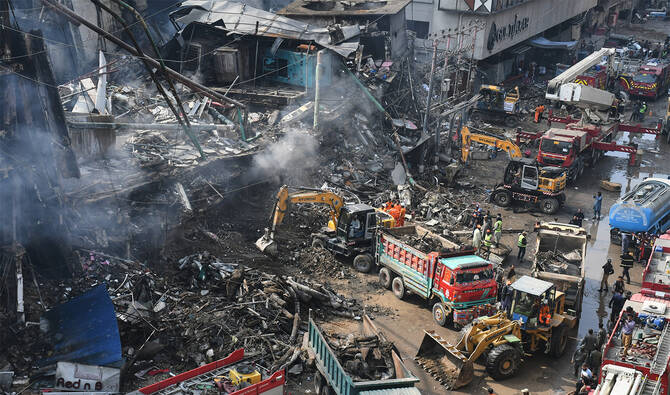
The blaze at Gul Plaza in Karachi’s Saddar business district broke out late Saturday and lasted until Monday morning, spreading rapidly through multiple floors and trapping shoppers and workers inside the densely packed commercial building. Earlier on Monday, Sindh Chief Minister Murad Ali Shah said 15 deaths had been confirmed, including a firefighter, while 65 people were reported missing as search and recovery operations continued. Rescue 1122 said over 20 bodies had been recovered.
Deadly fires in commercial buildings are a recurring problem in Karachi, a city of more than 20 million people, where overcrowding, outdated infrastructure and weak enforcement of fire safety regulations have repeatedly resulted in mass casualties and heavy economic losses.
Announcing relief measures, Shah said the provincial government would provide Rs10 million ($36,000) in compensation to the family of each person killed in the fire, which has destroyed more than 1,200 shops in one of Karachi’s busiest trading hubs.
“On behalf of the government of Sindh, we will give one crore rupees to every person who has lost his life,” Shah said at a press conference, adding that payments would begin once documentation was completed.
Providing an update later in the day, Rescue 1122 officials said more than 20 bodies had been recovered from the building so far, but stressed that an exact figure could not yet be confirmed because some remains were found in fragments and required forensic verification to determine whether they belonged to the same individuals.
Rescue officials said the operation remained highly technical and dangerous, as the fire-damaged structure was severely weakened and at risk of collapse, forcing teams to proceed in phases under strict safety protocols while debris removal and cooling continued.
2,000 SHOPS AFFECTED
CM Shah announced the formation of a joint committee involving provincial officials and the Karachi Chamber of Commerce and Industry (KCCI) to assess losses and oversee rehabilitation of affected traders. He said authorities were exploring temporary arrangements to relocate 1,000 to 1,200 shops so businesses could resume operations as quickly as possible.
Citing past precedents such as the Bolton Market arson and the Cooperative Market fire, Shah said similar compensation and recovery mechanisms had previously helped traders rebuild their livelihoods and would guide the current response.
Karachi has previously suffered devastating commercial fires that prompted large-scale compensation and rehabilitation efforts by both provincial and federal authorities. In 2009, an arson attack at Bolton Market, one of the city’s oldest wholesale trading hubs, destroyed hundreds of shops and disrupted supply chains across Karachi. Following appeals from trader bodies, the federal government approved billions of rupees in compensation, while the Sindh government oversaw reconstruction and the rehabilitation of nearly 2,000 affected shopkeepers, a process often cited by officials as a benchmark for post-disaster recovery.
More recently, fires at Cooperative Market and the adjacent Victoria Building in 2021 wiped out clusters of small traders dealing in garments, footwear and household goods. Authorities reused unspent funds from earlier relief schemes to compensate affected businesses, working with trader associations to verify losses and disburse payments. Provincial officials say these past responses shaped the current model of pairing government funding with trader-led assessments to restore livelihoods after large-scale commercial disasters.
KCCI said preliminary assessments showed more than 1,000 small and medium-sized businesses were completely destroyed in the fire, leaving thousands of families without incomes. Traders have urged both provincial and federal authorities to announce a comprehensive rehabilitation package.
Authorities have ordered a formal inquiry into the incident, with Shah stressing that the investigation would focus on identifying systemic failures rather than assigning blame.
He said a fire safety audit covering 145 buildings, conducted in 2024, would now be enforced immediately, alongside mandatory installation of fire alarms in commercial markets across the city.
Prime Minister Shehbaz Sharif has also offered full federal support, calling for a “coordinated and effective system” to control fires quickly in densely populated urban areas and prevent similar tragedies in the future.
Battling large fires in Karachi’s congested commercial districts remains notoriously difficult. Many markets and plazas are built with narrow access points, encroachments and illegal extensions that block fire tenders, while buildings often lack functioning fire exits, alarms or sprinkler systems.
Although safety regulations exist, inspections are sporadic and penalties rarely enforced, allowing hazardous wiring and flammable materials to go unchecked - conditions that enable fires to spread rapidly and magnify human and economic losses.