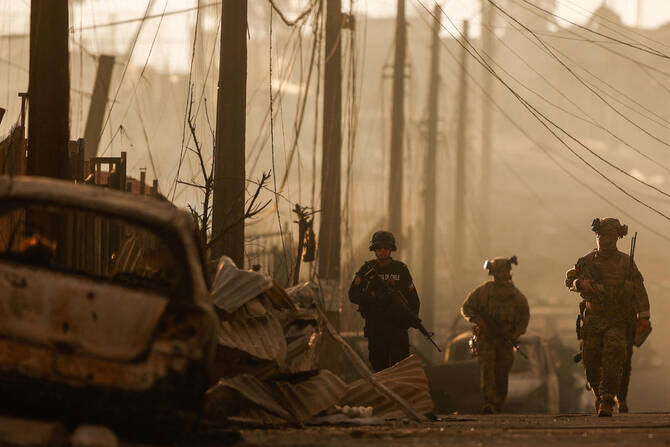
CONCEPCION, Chile: Wildfires in Chile have left at least 19 people dead, authorities said on Monday, as the government carried out mass evacuations and fought nearly two dozen blazes exacerbated by intense heat and high winds.
While weather conditions overnight helped control some fires, the largest were still active, with adverse conditions expected throughout the day, security minister, Luis Cordero, said at a news briefing on Monday.
“The projection we have today is of high temperatures,” Cordero said, and the main worry was that new fires would be triggered throughout the region.
Parts of central and southern Chile were under extreme heat warnings with temperatures expected to reach up to 37 Celsius (99 Fahrenheit).
STATE OF EMERGENCY DECLARED IN NUBLE, BIO BIO
As of late Sunday, Chile’s CONAF forestry agency said firefighters were combating 23 fires across the country, the largest of which were in regions of Ñuble and Bío Bío, where President Gabriel Boric declared a state of catastrophe.
Over 20,000 hectares (77 square miles) have been razed so far, an area about the size of Seattle, with the largest fire surpassing 14,000 hectares on the outskirts of the coastal city Concepcion.
The fast-moving blaze tore through the towns of Penco and Lirquen over the weekend, destroying hundreds of homes and killing several people, with authorities still assessing the damage.
HEAT, BLAZES ALSO IMPACT ARGENTINA
Authorities are currently battling the fire as it threatened Manzano prison on the edge of Concepcion and the town of Tome to the north.
Both Chile and Argentina rang in the new year with heat waves which have continued into January. Earlier this month, wildfires broke out in Argentina’s Patagonia, burning around 15,000 hectares.

Chile wildfires leave 19 dead amid extreme heat as scores evacuated
https://arab.news/njwc8
Chile wildfires leave 19 dead amid extreme heat as scores evacuated
- Fast-moving wildfires being worsened by intense heat, winds
- Firefighters battling 23 active blazes spreading toward cities
94 million need cataract surgery, but access lacking: WHO
- Of the 94 million affected, fewer than 20 percent are blind, while the rest suffer from impaired vision
GENEVA: More than 94 million people suffer from cataracts, but half of them do not have access to the surgery needed to fix it, the World Health Organization said Wednesday.
Cataracts — the clouding of the eye’s lens that causes blurred vision and can lead to blindness — are on the rise as populations get older, with age being the main risk factor.
“Cataract surgery — a simple, 15-minute procedure — is one of the most cost-effective medical procedures, providing immediate and lasting restoration of sight,” the WHO said.
It is one of the most frequently performed surgeries undertaken in high-income countries.
However, “half of the world’s population in need of cataract surgery don’t have access to it,” said Stuart Keel, the UN health agency’s technical lead for eye care.
The situation is worst in the WHO’s Africa region, where three in four people needing cataract surgery remain untreated.
In Kenya, at the current rate, 77 percent of people needing cataract surgery are likely to die with their cataract blindness or vision impairment, said Keel.
Across all regions, women consistently experience lower access to care than men.
Of the 94 million affected, fewer than 20 percent are blind, while the rest suffer from impaired vision.
- 2030 vision -
The WHO said that over the past two decades, global cataract surgery coverage had increased by 15 percent.
In 2021, WHO member states set a target of a 30-percent increase by 2030.
However, current modelling predicts that cataract surgery coverage will rise by only about 8.4 percent this decade.
To close the gap, the WHO urged countries to integrate eye examinations into primary health care and invest in the required surgical equipment.
States should also expand the eye-care workforce, training surgeons in a standardised manner and then distributing them throughout the country, notably outside major cities.
The WHO was on Wednesday launching new guidance for countries on how to provide quality cataract surgery services.
It will also issue guidance to help support workforce development.
Keel said the main issue was capacity and financing.
“We do need money invested to get rid of this backlog, which is nearly 100 million people,” he told a press conference.
While age is the primary risk factor for cataracts, others include prolonged UV-B light exposure, tobacco use, prolonged corticosteroid use and diabetes.
Keel urged people to keep up regular eye checks as they get older, with most problems able to be either prevented or diagnosed and treated.
The cost of the new lens that goes inside the eye can be under $100.
However, out-of-pocket costs can be higher when not covered by health insurance.
“Cataract surgery is one of the most powerful tools we have to restore vision and transform lives,” said Devora Kestel, head of the WHO’s noncommunicable diseases and mental health department.
“When people regain their sight, they regain independence, dignity, and opportunity.”


