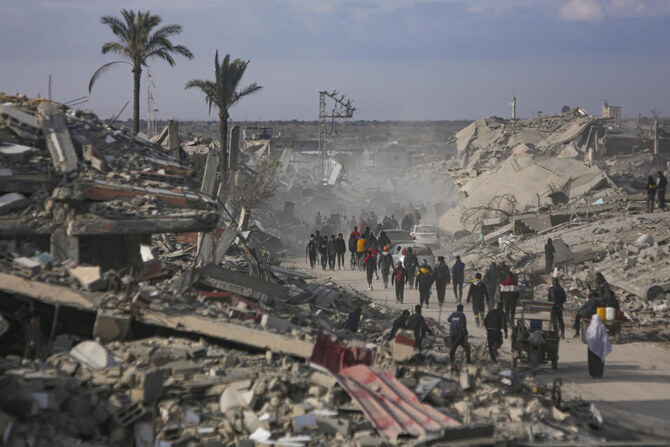
KHAN YOUNIS, Gaza Strip: Even before the ceasefire deal between Israel and Hamas was fully in place Sunday, Palestinians in the war-battered Gaza Strip began to return to the remains of the homes they had evacuated during the 15-month war.
Majida Abu Jarad made quick work of packing the contents of her family’s tent in the sprawling tent city of Muwasi, just north of the strip’s southern border with Egypt.
At the start of the war, they were forced to flee their house in Gaza’s northern town of Beit Hanoun, where they used to gather around the kitchen table or on the roof on summer evenings amid the scent of roses and jasmine.
The house from those fond memories is gone, and for the past year, Abu Jarad, her husband and their six daughters have trekked the length of the Gaza Strip, following one evacuation order after another by the Israeli military.
Seven times they fled, she said, and each time, their lives became more unrecognizable to them as they crowded with strangers to sleep in a school classroom, searching for water in a vast tent camp or sleeping on the street.
Now the family is preparing to begin the trek home — or to whatever remains of it — and to reunite with relatives who remained in the north.
“As soon as they said that the truce would start on Sunday, we started packing our bags and deciding what we would take, not caring that we would still be living in tents,” Abu Jarad said.
The war in Gaza began when Hamas-led militants attacked southern Israel on Oct. 7, 2023, killing some 1,200 people, mostly civilians, and abducting around 250 people. Some 100 hostages are still inside Gaza, at least a third of whom are believed to be dead.
Israel’s offensive has killed more than 46,000 Palestinians in Gaza, more than half of them women and children, according to the Gaza Health Ministry, which does not say how many were combatants. Over 110,000 Palestinians have been wounded, it said. The Israeli military says it has killed over 17,000 militants, without providing evidence.
The Israeli military’s bombardment has flattened large swaths of Gaza and displaced 1.9 million of its 2.3 million residents.
Even before the ceasefire officially took effect — and as tank shelling continued overnight and into the morning — many Palestinians began trekking through the wreckage to reach their homes, some on foot and others hauling their belongings on donkey carts.
“They’re returning to retrieve their loved ones under the rubble,” said Mohamed Mahdi, a displaced Palestinian and father of two. He was forced to leave his three-story home in Gaza City’s southeastern Zaytoun neighborhood a few months ago,
Mahdi managed to reach his home Sunday morning, walking amid the rubble from western Gaza. On the road he said he saw the Hamas-run police force being deployed to the streets in Gaza City, helping people returning to their homes.
Despite the vast scale of the destruction and uncertain prospects for rebuilding, “people were celebrating,” he said. “They are happy. They started clearing the streets and removing the rubble of their homes. It’s a moment they’ve waited for 15 months.”
Um Saber, a 48-year-old widow and mother of six children, returned to her hometown of Beit Lahiya. She asked to be identified only by her honorific, meaning “mother of Saber,” out of safety concerns.
Speaking by phone, she said her family had found bodies in the street as they trekked home, some of whom appeared to have been lying in the open for weeks.
When they reached Beit Lahiya, they found their home and much of the surrounding area reduced to rubble, she said. Some families immediately began digging through the debris in search of missing loved ones. Others began trying to clear areas where they could set up tents.
Um Saber said she also found the area’s Kamal Adwan hospital “completely destroyed.”
“It’s no longer a hospital at all,” she said. “They destroyed everything.”
The hospital has been hit multiple times over the past three months by Israeli forces waging an offensive in largely isolated northern Gaza against Hamas fighters it says have regrouped.
The military has claimed that Hamas militants operate inside Kamal Adwan, which hospital officials have denied.
In Gaza’s southern city of Rafah, residents returned to find massive destruction across the city that was once a hub for displaced families fleeing Israel’s bombardment elsewhere in the Palestinian enclave. Some found human remains amid the rubble of houses and the streets.
“It’s an indescribable scene. It’s like you see a Hollywood horror movie,” said Mohamed Abu Taha, a Rafah resident, speaking to The Associated Press as he and his brother were inspecting his family home in the city’s Salam neighborhood. “Flattened houses, human remains, skulls and other body parts, in the street and in the rubble.”
He shared footage of piles of rubble he said had been his family’s house. “I want to know how they destroyed our home.”
The returns come amid looming uncertainty regarding whether the ceasefire deal will bring more than a temporary halt to the fighting, who will govern the enclave and how it will be rebuilt.
Not all families will be able to return home immediately. Under the terms of the deal, returning displaced people will only be able to cross the Netzarim corridor from south to north beginning seven days into the ceasefire.
And those who do return may face a long wait to rebuild their houses.
The United Nations has said that reconstruction could take more than 350 years if Gaza remains under an Israeli blockade. Using satellite data, the United Nations estimated last month that 69 percent of the structures in Gaza have been damaged or destroyed, including over 245,000 homes. With over 100 trucks working full-time, it would take more than 15 years just to clear the rubble away,
But for many families, the immediate relief overrode fears about the future.
“We will remain in a tent, but the difference is that the bleeding will stop, the fear will stop, and we will sleep reassured,” Abu Jarad said.


![]()

Palestinians trek across rubble to return to their homes as Gaza ceasefire takes hold
Short Url
https://arab.news/28vur
Palestinians trek across rubble to return to their homes as Gaza ceasefire takes hold
- Israel’s offensive has killed over 46,000 Palestinians in Gaza, more than half of them women and children
- People celebrate despite vast scale of destruction and uncertain prospects for rebuilding, says one Gazan
Latest updates


© 2026 SAUDI RESEARCH & PUBLISHING COMPANY, All Rights Reserved And subject to Terms of Use Agreement.