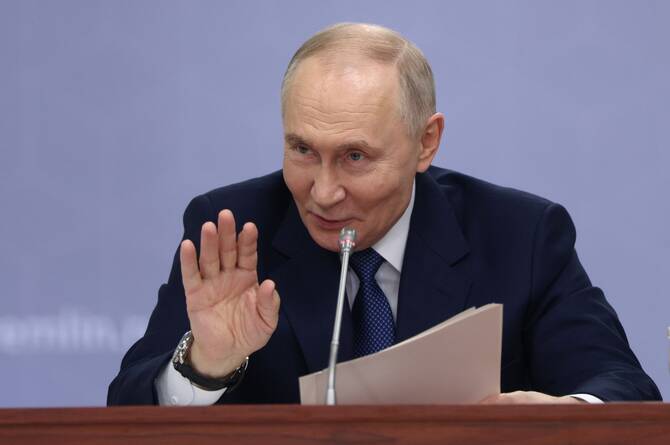
MOSCOW: Russian President Vladimir Putin has been invited to join US President Donald Trump’s “Board of Peace” aimed at resolving conflicts globally and oversee governance and reconstruction in Gaza, the Kremlin said Monday.
Moscow for years tried to balance relations with all major players in the Middle East — including Israel and the Palestinians.
But since the Israel-Hamas war and Russia’s assault on Ukraine, Putin has moved away from Israel, boosting ties with its foes like Iran.
Moscow has also sought closer relationships with the Gulf states amid growing Western isolation.
“President Putin also received an invitation to join this Board of Peace,” spokesman Dmitry Peskov told journalists, including AFP.
Russia was seeking to “clarify all the nuances” of the offer with Washington, he said, without adding if the Kremlin chief as inclined to join.
The White House has reached out to various figures around the world to sit on the so-called “Board of Peace,” chaired by the US president himself.
Putin has previously praised Trump’s efforts to resolve conflicts.
“He’s really doing a lot to resolve these complex crises, which have lasted for years, even decades,” Putin said last October.
Referring to the situation in the Middle East, Putin said: “If we succeed in achieving everything Donald has strived for... it will be a historic event.”
The assault on Ukraine and the war in Gaza have strained Moscow’s traditionally good relations with Israel, home to a large Russian-born community.
The Kremlin has repeatedly criticized Israel’s response to the October 7 attacks and called for restraint.
“The Gaza Strip is experiencing a humanitarian catastrophe in the full sense of the word,” Putin was quoted as saying by the news agency RIA Novosti, at a meeting with Palestinian leader Mahmud Abbas last May.
“Russia, as a friend of the Palestinian people, is trying to provide regular assistance,” the Russian president added.


![]()

Putin invited to Trump’s ‘Board of Peace’: Kremlin
Short Url
https://arab.news/97r6w
Putin invited to Trump’s ‘Board of Peace’: Kremlin
- The White House has reached out to various figures around the world to sit on the so-called “Board of Peace,” chaired by the US president himself


Latest updates


© 2026 SAUDI RESEARCH & PUBLISHING COMPANY, All Rights Reserved And subject to Terms of Use Agreement.