


LONDON: Escalating wars, rising disinformation, and intensifying climate challenges rank as the most pressing global threats for 2025, according to the World Economic Forum’s Global Risk Report, released Wednesday ahead of the Davos annual meeting.
Based on insights from 900 global leaders in business, politics and academia, the report highlights escalating geopolitical tensions, environmental crises and misinformation as critical issues shaping the year ahead.
“Rising geopolitical tensions and a fracturing of trust are driving the global risk landscape,” said Mirek Dusek, WEF managing director.
“In this complex and dynamic context, leaders have a choice: to find ways to foster collaboration and resilience, or face compounding vulnerabilities.”
State-based armed conflicts are flagged as the most immediate concern for 23 percent of respondents, with wars in the Middle East, Sudan and Ukraine driving global instability.
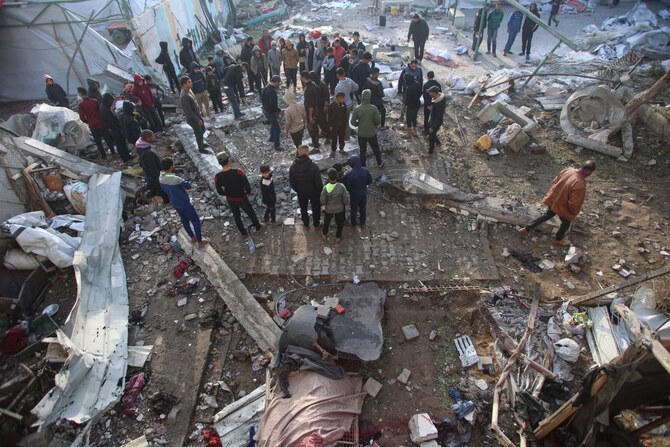
The forum will host a historic gathering of Middle Eastern leaders, including representatives from Iran, Syria, Yemen and Gulf countries, to discuss prospects for peace amid hopes of a ceasefire between Hamas and Israel after 15 months of devastating war that has killed tens of thousands of Palestinians.
Donald Trump, set to be sworn in as the 47th US president on Jan. 20, has vowed to end the war in Ukraine. He will deliver a virtual address to the forum on Jan. 23. Ukrainian President Volodymyr Zelensky will also attend and deliver a speech on Jan. 21.
“From conflicts to climate change, we are facing interconnected crises that demand coordinated, collective action,” said Mark Elsner, WEF’s head of the Global Risks Initiative, who urged world leaders to make “renewed efforts to rebuild trust and foster cooperation.”
While conflicts rank as the most immediate threat, the survey highlights the climate crisis as the dominant risk of the next decade. Environmental risks — including extreme weather, biodiversity loss and critical changes to Earth’s systems — account for three of the top four long-term global concerns.
In 2024, global warming hit a record 1.54 degrees Celsius above pre-industrial levels, triggering catastrophic weather events, such as the Los Angeles wildfires, devastating floods in Spain caused by the DANA weather phenomenon and unprecedented rainfall across the Middle East, which triggered floods in the Arabian Peninsula and Sahara Desert for the first time in half a century.
“The climate and nature crisis requires urgent attention and action,” said Gim Huay Neo, the WEF’s managing director for the Center for Nature and Climate.
Two technology-related concerns ranked next on the list of global threats: “Misinformation and disinformation” and the “adverse outcomes of AI technologies.”
The survey, conducted between September and October, noted rising anxieties about misinformation. These concerns have intensified following Donald Trump’s election victory and his alignment with tech leaders like Elon Musk and Mark Zuckerberg, who are reportedly advocating for deregulation policies expected to benefit the tech industry.
It coincides with Zuckerberg’s recent decision to scale back fact-checking and content moderation across Meta’s platforms, a move widely criticized by experts as an appeasement of Trump, whose return to the White House will overlap with the forum’s opening.
Organizers are expecting 60 heads of state and government to attend, alongside chief executives and campaigners. Several ministers and business leaders from Saudi Arabia are also expected to take part.
The WEF’s report found that 64 percent of experts foresee a fragmented global order dominated by competition among middle and great powers, with multilateralism under significant strain.
Against this backdrop, the forum’s theme, “A Call for Collaboration in the Intelligent Age,” highlights the need for renewed cooperation, even as Trump’s anticipated policy shifts could undermine collective efforts on critical global issues, including the climate crisis.


