Strong Middle East representation as World Economic Forum unveils annual meeting agenda

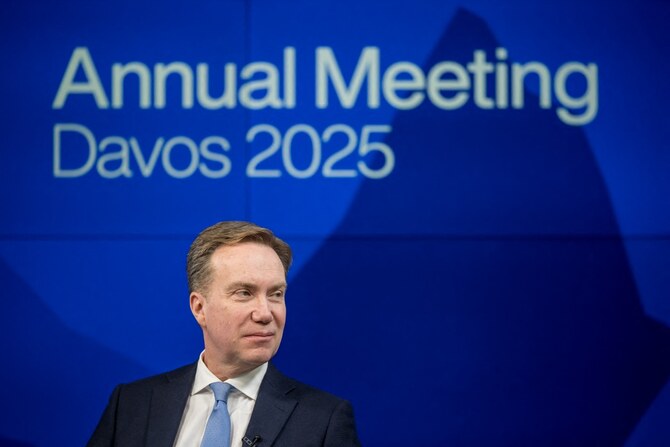
In a surprise announcement, Brende said US President-elect Trump, whose inauguration coincides with the opening day of the forum, would participate via a digital address. (AFP/File)
Short Url
Updated 15 January 2025
Follow

Strong Middle East representation as World Economic Forum unveils annual meeting agenda

  • Leaders from Israel, Iran, Syria and Palestine to be key speakers at event, which will address ongoing conflicts in the region and explore its future prospects
  • US President-elect Donald Trump set to appear; organizers highlight growing presence of Global South and tout ‘parity’ among developing and developed countries

LONDON: The Middle East will have a significant presence at the annual meeting of the World Economic Forum next week, reflecting the growing influence of emerging markets, the organization said on Tuesday.

Mirek Dusek, the forum’s managing director, said he was “pleased” with the increase in the number of representatives from emerging markets expected to attend the event. He added that the “proportion is growing this year. We’re seeing particularly strong numbers, for example, from the Middle East, also from South Asia.”

Nearly 3,000 people from more than 130 countries, including 900 business leaders, are expected to attend the annual meeting, which will take place in Davos, Switzerland, from Jan. 20 to 25.

The forum has faced repeated criticism from some for being an elite gathering focused on the traditional major powers and big business, but Dusek highlighted the growing presence of leaders from the Global South. He said participation among developing nations was now “on parity” with that of developed countries.

The theme of this year’s meeting is “Collaboration for the Intelligent Age” and it will address “five distinct but interconnected thematic priorities,” the forum said, reflecting its efforts to navigate a complex geopolitical and economic landscape.

“(The agenda) is linked, first and foremost, to this deep sense of being on the cusp of a new era for the world economy, or at least in transition to a new situation for the world economy,” Dusek said.

Key discussions will consider the transformative effects of rapid technological advances, including developments in artificial intelligence, as well as the challenges arising from geopolitical fragmentation and the need to foster global collaboration during what Dusek described as a “key time for the world economy.”

The forum will also address issues such as economic growth, trade and investment, exploring “new sources of growth in this global economy.” It will examine how the public and private sectors can invest in the development of human capital and create quality jobs to help build modern and resilient societies.

The forum’s president and CEO, Borge Brende, said: “It is our 55th annual meeting taking place in Davos, and it is happening against the most complicated geopolitical backdrop in generations. But still, in the fragmented and partly polarized world, there are still areas where we can collaborate.”

The Middle East is expected to play a pivotal role in the discussions, as the forum addresses ongoing conflicts in the region and its future prospects.

Syria’s foreign minister, Asaad Hassan Al-Shaibani, is scheduled to present his country’s plans for the future after the fall of the Assad regime in December after its 52-year rule.

The humanitarian crisis in Gaza will also feature prominently in discussions, alongside efforts to rebuild trust and promote reconciliation in the region. Israeli President Isaac Herzog, Palestinian Prime Minister Mohammed Mustafa, Iranian Vice President Mohammed Reza Aref, and the UN’s special envoy for Yemen, Hans Grundberg, are among the key speakers who will address the issues.

“We were very close (to a full-scale conflict) between Israel and Iran, and I don’t think we’re out of the woods yet,” said Brende, as he expressed hope that the forum will serve as a platform “for peace, reconciliation, and addressing humanitarian suffering.”

Rebuilding trust between institutions and efforts to address climate change are other longstanding priorities for forum, and organizers said these will remain central to the discussions.

Amid concerns that such topics have been “losing ground” amid other political and economic challenges, Gim Huay Neo, the forum’s managing director, reiterated its focus on finding and implementing tangible solutions.

“There will be multiple dialogs that will be really focused around tangible action that companies and governments can take to support the net-zero, nature-positive transition pathways and, more importantly, how they can work together to build partnerships that can enable and empower the action in a faster and much more skilled manner,” she said.

In a surprise announcement, Brende said US President-elect Trump, whose inauguration coincides with the opening day of the forum, would participate via a digital address. He is expected to outline his administration’s plans for implementing its policies, in particular his pledge to end the war in Ukraine.

Ukrainian President Volodymyr Zelensky will also deliver a special address and take part in a question-and-answer session.

In total, 60 heads of state and government will take part in the event, including European Commission President Ursula von der Leyen and Chinese Vice Premier Ding Xuexiang.


First EU–Saudi roundtable on critical raw materials reflects shared policy commitment

Updated 16 January 2026
Follow

First EU–Saudi roundtable on critical raw materials reflects shared policy commitment

RIYADH: The EU–Saudi Arabia Business and Investment Dialogue on Advancing Critical Raw Materials Value Chains, held in Riyadh as part of the Future Minerals Forum, brought together senior policymakers, industry leaders, and investors to advance strategic cooperation across critical raw materials value chains.

Organized under a Team Europe approach by the EU–GCC Cooperation on Green Transition Project, in coordination with the EU Delegation to Saudi Arabia, the European Chamber of Commerce in the Kingdom and in close cooperation with FMF, the dialogue provided a high-level platform to explore European actions under the EU Critical Raw Materials Act and ResourceEU alongside the Kingdom’s aspirations for minerals, industrial, and investment priorities.

This is in line with Saudi Vision 2030 and broader regional ambitions across the GCC, MENA, and Africa.

ResourceEU is the EU’s new strategic action plan, launched in late 2025, to secure a reliable supply of critical raw materials like lithium, rare earths, and cobalt, reducing dependency on single suppliers, such as China, by boosting domestic extraction, processing, recycling, stockpiling, and strategic partnerships with resource-rich nations.

The first ever EU–Saudi roundtable on critical raw materials was opened by the bloc’s Ambassador to the Kingdom, Christophe Farnaud, together with Saudi Deputy Minister for Mining Development Turki Al-Babtain, turning policy alignment into concrete cooperation.

Farnaud underlined the central role of international cooperation in the implementation of the EU’s critical raw materials policy framework.

“As the European Union advances the implementation of its Critical Raw Materials policy, international cooperation is indispensable to building secure, diversified, and sustainable value chains. Saudi Arabia is a key partner in this effort. This dialogue reflects our shared commitment to translate policy alignment into concrete business and investment cooperation that supports the green and digital transitions,” said the ambassador.

Discussions focused on strengthening resilient, diversified, and responsible CRM supply chains that are essential to the green and digital transitions.

Participants explored concrete opportunities for EU–Saudi cooperation across the full value chain, including exploration, mining, and processing and refining, as well as recycling, downstream manufacturing, and the mobilization of private investment and sustainable finance, underpinned by high environmental, social, and governance standards.

From the Saudi side, the dialogue was framed as a key contribution to the Kingdom’s industrial transformation and long-term economic diversification agenda under Vision 2030, with a strong focus on responsible resource development and global market integration.

“Developing globally competitive mineral hubs and sustainable value chains is a central pillar of Saudi Vision 2030 and the Kingdom’s industrial transformation. Our engagement with the European Union through this dialogue to strengthen upstream and downstream integration, attract high-quality investment, and advance responsible mining and processing. Enhanced cooperation with the EU, capitalizing on the demand dynamics of the EU Critical Raw Materials Act, will be key to delivering long-term value for both sides,” said Al-Babtain.

Valere Moutarlier, deputy director-general for European industry decarbonization, and directorate-general for the internal market, industry, entrepreneurship and SMEs at European Commission, said the EU Critical Raw Materials Act and ResourceEU provided a clear framework to strengthen Europe’s resilience while deepening its cooperation with international partners.

“Cooperation with Saudi Arabia is essential to advancing secure, sustainable, and diversified critical raw materials value chains. Dialogues such as this play a key role in translating policy ambitions into concrete industrial and investment cooperation,” she added.