Iran warns US troops and Israel will be targets if America strikes over protests as death toll rises

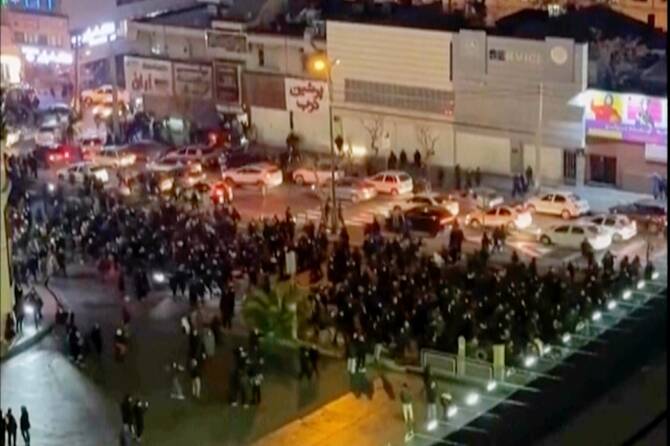
In this frame grab from video taken by an individual not employed by The Associated Press and obtained by the AP outside Iran shows people blocking an intersection during a protest in Tehran, Iran.
Short Url
Updated 11 January 2026
Follow

Iran warns US troops and Israel will be targets if America strikes over protests as death toll rises

  • Iran’s parliament speaker warned the US military and Israel would be “legitimate targets” if America strikes the Islamic Republic, as threatened by President Donald Trump

DUBAI: Nationwide protests challenging Iran’s theocracy saw protesters flood the streets in the country’s capital and its second-largest city into Sunday, crossing the two-week mark as violence surrounding the demonstrations has killed at least 116 people, activists said.
With the Internet down in Iran and phone lines cut off, gauging the demonstrations from abroad has grown more difficult. But the death toll in the protests has grown, while 2,600 others have been detained, according to the US-based Human Rights Activists News Agency.
Meanwhile, Iran’s parliament speaker warned the US military and Israel would be “legitimate targets” if America strikes the Islamic Republic, as threatened by President Donald Trump. Qalibaf made the threat as lawmakers rushed the dais in the Iranian parliament, shouting: “Death to America!”
Those abroad fear the information blackout will embolden hard-liners within Iran’s security services to launch a bloody crackdown, despite warnings from Trump he’s willing to strike the Islamic Republic to protect peaceful demonstrators.
Trump offered support for the protesters, saying on social media that “Iran is looking at FREEDOM, perhaps like never before. The USA stands ready to help!!!” The New York Times and Wall Street Journal, citing anonymous US officials, said on Saturday night that Trump had been given military options for a strike on Iran, but hadn’t made a final decision.
The State Department separately warned: “Do not play games with President Trump. When he says he’ll do something, he means it.”
Parliament rallies
Iranian state television broadcast the parliament session live. Qalibaf, a hard-liner who has run for the presidency in the past, gave a speech applauding police and Iran’s paramilitary Revolutionary Guard, particularly its all-volunteer Basij, for having “stood firm” during the protests.
“The people of Iran should know that we will deal with them in the most severe way and punish those who are arrested,” Qalibaf said.
He went on to directly threaten Israel, “the occupied territory” as he referred to it, and the US military, possibly with a preemptive strike.
“In the event of an attack on Iran, both the occupied territory and all American military centers, bases and ships in the region will be our legitimate targets,” Qalibaf said. “We do not consider ourselves limited to reacting after the action and will act based on any objective signs of a threat.”
It remains unclear just how serious Iran is about launching a strike, particularly after seeing its air defenses destroyed during the 12-day war in June with Israel. Any decision to go to war would rest with Iran’s 86-year-old Supreme Leader Ayatollah Ali Khamenei.
The US military has said in the Mideast it is “postured with forces that span the full range of combat capability to defend our forces, our partners and allies and US interests.”
Protests in Tehran and Mashhad
Online videos sent out of Iran, likely using Starlink satellite transmitters, purportedly showed demonstrators gathering in northern Tehran’s Punak neighborhood. There, it appeared authorities shut off streets, with protesters waving their lit mobile phones. Others banged metal while fireworks went off.
Other footage purportedly showed demonstrators peacefully marching down a street and others honking their car horns on the street.
In Mashhad, Iran’s second-largest city, some 725 kilometers (450 miles) northeast of Tehran, footage purported to show protesters confronting security forces. Flaming debris and dumpsters could be seen in the street, blocking the road. Mashhad is home to the Imam Reza shrine, the holiest in Shiite Islam, making the protests there carry heavy significance for the country’s theocracy.
Protests also appeared to happen in Kerman, 800 kilometers (500 miles) southeast of Tehran.
Iranian state television on Sunday morning took a page from demonstrators, having their correspondents appear on streets in several cities to show calm areas with a date stamp shown on screen. Tehran and Mashhad were not included. They also showed pro-government demonstrations in Qom and Qazvin.
Khamenei has signaled a coming clampdown, despite US warnings. Tehran escalated its threats Saturday, with Iran’s attorney general, Mohammad Movahedi Azad, warning that anyone taking part in protests will be considered an “enemy of God,” a death-penalty charge. The statement carried by Iranian state television said even those who “helped rioters” would face the charge.
More demonstrations planned Sunday
Iran’s theocracy cut off the nation from the Internet and international telephone calls on Thursday, though it allowed some state-owned and semiofficial media to publish. Qatar’s state-funded Al Jazeera news network reported live from Iran, but they appeared to be the only major foreign outlet able to work.
Iran’s exiled Crown Prince Reza Pahlavi, who called for protests Thursday and Friday, asked in his latest message for demonstrators to take to the streets Saturday and Sunday. He urged protesters to carry Iran’s old lion-and-sun flag and other national symbols used during the time of the shah to “claim public spaces as your own.”
Pahlavi’s support of and from Israel has drawn criticism in the past — particularly after the 12-day war. Demonstrators have shouted in support of the shah in some protests, but it isn’t clear whether that’s support for Pahlavi himself or a desire to return to a time before the 1979 Islamic Revolution.
The demonstrations began Dec. 28 over the collapse of the Iranian rial currency, which trades at over 1.4 million to $1, as the country’s economy is squeezed by international sanctions in part levied over its nuclear program. The protests intensified and grew into calls directly challenging Iran’s theocracy.


Italian fashion designer Valentino dead at 93

Updated 10 min 30 sec ago
Follow

Italian fashion designer Valentino dead at 93

ROME: Valentino Garavani, the jet-set Italian designer whose high-glamor gowns — often in his trademark shade of “Valentino red” — were fashion show staples for nearly half a century, has died at home in Rome, his foundation announced Monday. He was 93.
“Valentino Garavani was not only a constant guide and inspiration for all of us, but a true source of light, creativity and vision,″ the foundation said in a statement posted on social media.
His body will repose at the foundation’s headquarters in Rome on Wednesday and Thursday. The funeral will be held Friday at the Basilica Santa Maria degli Angeli e dei Martiri in Rome’s Piazza della Repubblica.
Universally known by his first name, Valentino was adored by generations of royals, first ladies and movie stars, from Jackie Kennedy Onassis to Julia Roberts and Queen Rania of Jordan, who swore the designer always made them look and feel their best.
“I know what women want,” he once remarked. “They want to be beautiful.”
Never one for edginess or statement dressing, Valentino made precious few fashion faux-pas throughout his nearly half-century-long career, which stretched from his early days in Rome in the 1960s through to his retirement in 2008.
His fail-safe designs made Valentino the king of the red carpet, the go-to man for A-listers’ awards ceremony needs. His sumptuous gowns have graced countless Academy Awards, notably in 2001, when Roberts wore a vintage black and white column to accept her best actress statue. Cate Blanchett also wore Valentino — a one-shouldered number in butter-yellow silk — when she won the Oscar for best supporting actress in 2004.
Valentino was also behind the long-sleeved lace dress Jacqueline Kennedy wore for her wedding to Greek shipping magnate Aristotle Onassis in 1968. Kennedy and Valentino were close friends for decades, and for a spell the one-time US first lady wore almost exclusively Valentino.
He was also close to Diana, Princess of Wales, who often donned his sumptuous gowns.
Beyond his signature orange-tinged shade of red, other Valentino trademarks included bows, ruffles, lace and embroidery; in short, feminine, flirty embellishments that added to the dresses’ beauty and hence to that of the wearers.
Perpetually tanned and always impeccably dressed, Valentino shared the lifestyle of his jet-set patrons. In addition to his 152-foot (46-meter) yacht and an art collection including works by Picasso and Miro, the couturier owned a 17th-century chateau near Paris with a garden said to boast more than a million roses.
Valentino and his longtime partner Giancarlo Giammetti flitted among their homes — which also included places in New York, London, Rome, Capri and Gstaad, Switzerland — traveling with their pack of pugs. The pair regularly received A-list friends and patrons, including Madonna and Gwyneth Paltrow.
“When I see somebody and unfortunately she’s relaxed and running around in jogging trousers and without any makeup ... I feel very sorry,” the designer told RTL television in a 2007 interview. “For me, woman is like a beautiful, beautiful flower bouquet. She has always to be sensational, always to please, always to be perfect, always to please the husband, the lover, everybody. Because we are born to show ourselves always at our best.”
Valentino was born into a well-off family in the northern Italian town of Voghera on May 11, 1932. He said it was his childhood love of cinema that set him down the fashion path.
“I was crazy for silver screen, I was crazy for beauty, to see all those movie stars being sensation, well dressed, being always perfect,” he explained in the 2007 television interview.
After studying fashion in Milan and Paris, he spent much of the 1950s working for established Paris-based designer Jean Desses and later Guy Laroche before striking out on his own. He founded the house of Valentino on Rome’s Via Condotti in 1959.
From the beginning, Giammetti was by his side, handling the business aspect while Valentino used his natural charm to build a client base among the world’s rich and fabulous.
After some early financial setbacks — Valentino’s tastes were always lavish, and the company spent with abandon — the brand took off.
Early fans included Italian screen sirens Gina Lollobrigida and Sophia Loren, as well as Hollywood stars Elizabeth Taylor and Audrey Hepburn. Legendary American Vogue editor-in-chief Diana Vreeland also took the young designer under her wing.
Over the years, Valentino’s empire expanded as the designer added ready-to-wear, menswear and accessories lines to his stable. Valentino and Giammetti sold the label to an Italian holding company for an estimated $300 million in 1998. Valentino would remain in a design role for another decade.
In 2007, the couturier feted his 45th anniversary in fashion with a 3-day-long blowout in Rome, capped with a grand ball in the Villa Borghese gallery.
Valentino retired in 2008 and was briefly replaced by fellow Italian Alessandra Facchinetti, who had stepped into Tom Ford’s shoes at Gucci before being sacked after two seasons.
Facchinetti’s tenure at Valentino proved equally short. As early as her first show for the label, rumors swirled that she was already on her way out, and just about one year after she was hired, Facchinetti was indeed replaced by two longtime accessories designers at the brand, Maria Grazia Chiuri and Pier Paolo Piccioli.
Chiuri left to helm Dior in 2016, and Piccioli continued to lead the house through a golden period that drew on the launch of the Rockstud pump with Chiuri and his own signature color, a shade of fuchsia called Pink PP. He left the house in 2024, later joining Balenciaga, and has been replaced by Alessandro Michele, who revived Gucci’s stars with romantic, genderless styles.
Valentino is owned by Qatar’s Mayhoola, which controls a 70 percent stake, and the French luxury conglomerate Kering, which owns 30 percent with an option to take full control in 2028 or 2029. Richard Bellini was named CEO last September.
Valentino has been the subject of several retrospectives, including one at the Musee des Arts Decoratifs, which is housed in a wing of Paris’ Louvre Museum. He was also the subject of a hit 2008 documentary, “Valentino: The Last Emperor,” that chronicled the end of his career in fashion.
In 2011, Valentino and Giammetti launched what they called a “virtual museum,” a free desktop application that allows viewers to feast their eyes on about 300 of the designer’s iconic pieces.