



BEIRUT: The Lebanese army declared on Thursday that progress on the second phase of a plan to place all weapons under state authority depends on external factors, highlighting constraints facing the state.
These include continued Israeli attacks on Lebanese territory, the occupation of several Lebanese sites, the establishment of buffer zones, repeated violations of the ceasefire agreement, and delays in the delivery of promised military capabilities to the army.
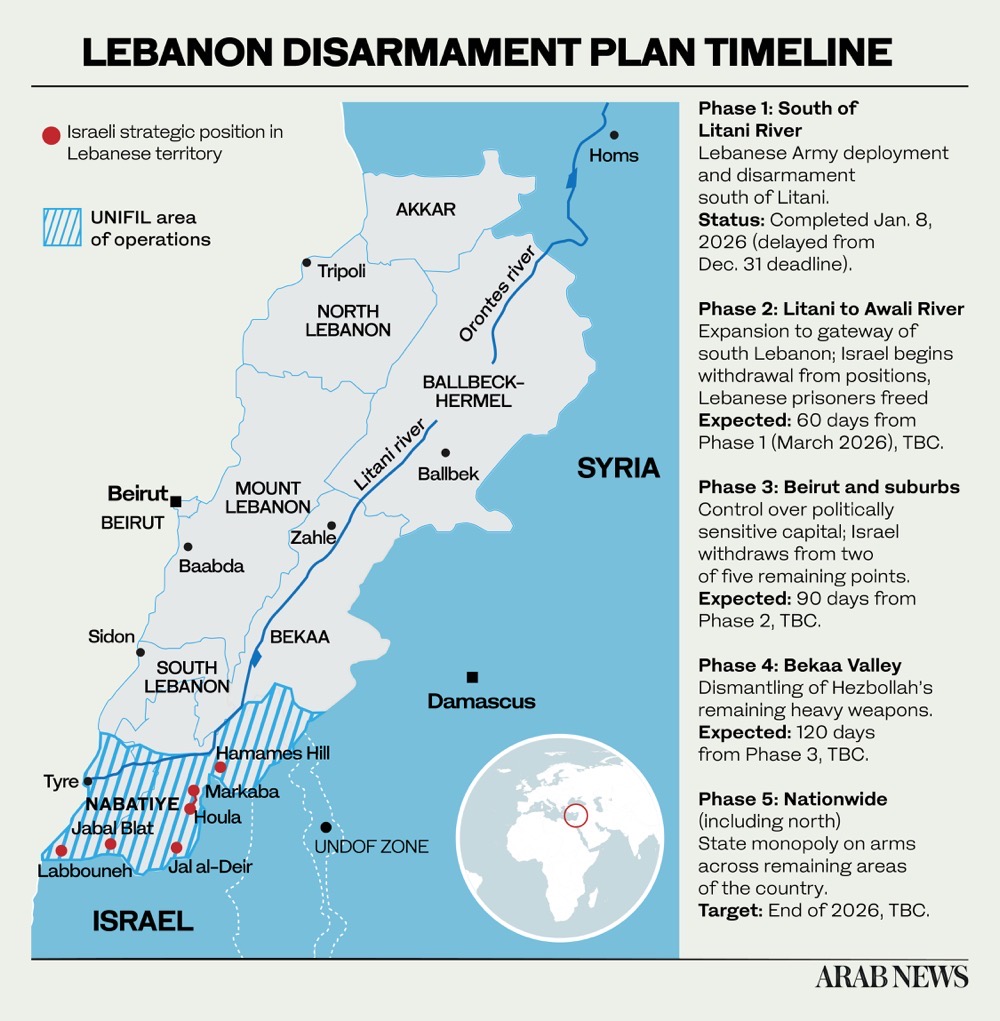
The statements were made during a cabinet session on Thursday, where the army announced the successful completion of the first phase of Hezbollah disarmament south of the Litani River.
Army Commander Gen. Rodolphe Haykal briefed ministers on the progress and confirmed that preparations are underway to assess conditions for launching the second phase, which will extend northward to the area between the Litani and Awali rivers.

The Lebanese army’s stance comes at a time of mounting Israeli and US pressure on Lebanon to disarm Hezbollah across all Lebanese territory, alongside Israeli skepticism about the army’s ability to carry out such a task.
Meanwhile, Hezbollah has refused to surrender its weapons north of the Litani River, despite the Lebanese state’s commitment to restoring “security and stability to the southern border and preventing its use as a launch pad for any military operations, in accordance with its decision to extend its authority exclusively through its own forces over all Lebanese territory.”
A Lebanese official told Arab News that the army’s position is based on the fact that Lebanon has fulfilled all its obligations within the limits of the army’s available resources in implementing what is required under the ceasefire agreement south of the Litani River.
The Lebanese Army, the source said, is leaning toward adopting a “weapons containment” strategy north of the Litani River.
“Talking about north of the Litani River means all of Lebanon, and therefore it is impossible to set a timeframe for implementation, given the army’s limited logistical capabilities,” the source said.
The weapons containment option ensures that no weapons are moved, imported, smuggled, or used within Lebanon. “This should concern no one,” the source added.
The mechanism committee, tasked with monitoring the implementation of the Israel-Hezbollah 2024 ceasefire agreement, receives regular updates on the disarmament.
Regarding whether Lebanon fears an Israeli military escalation in light of the army leadership’s stance, the source said that Lebanon is subjected to daily Israeli attacks despite fulfilling all its obligations.

“South of the Litani River, the only positions that could be confiscated are those held by the Israeli army,” the source added.
Michael Young, senior editor at the Malcolm H. Kerr Carnegie Middle East Center in Beirut, said the likelihood of Lebanon entering a full-blown war with Israel may not be imminent.
“If the Israelis and the Americans are pushing and the Lebanese are conceding, then the imperative to immediately escalate to a much larger conflict, which may not actually lead to any kind of decisive results, is going to be lessened,” he told Arab News.
However, Young warned that if the implementation of disarmament is delayed or obstructed for too long, Israel may eventually decide to escalate militarily.
Cabinet spokesman and Minister of Information Paul Morcos announced that the army will present a plan in February to begin the second phase of its deployment, aimed at withdrawing weapons from areas north of the Litani River.
Meanwhile, the cabinet commended the army’s achievements and called for the swift implementation of all phases of the disarmament plan.
The army command reiterated its ongoing coordination with UNIFIL and the ceasefire monitoring mechanism, which it said would contribute to greater stability south of the Litani River.
In a statement, the army thanked the countries participating in UNIFIL, highlighting the work of the US and French teams supporting the mechanism’s work.

It also commended “the awareness and constructive cooperation of southern citizens, whose commitment to security and stability was crucial to the successful implementation of the first phase.”
The army added that the achievement reflects “deep mutual trust between the people and the military institution.”
The command further commended the dedication and sacrifices of its soldiers, noting they carried out their duties under harsh conditions and constant danger, from landmines and unexploded ordnance to direct Israeli strikes targeting their deployment zones.
Following the army’s announcement on completing the first phase of its disarmament plan, President Joseph Aoun said the state “stands firmly behind the Lebanese Armed Forces in their mission to extend authority and restore sovereignty, particularly in the south.”
Aoun emphasized that the army’s deployment south of the Litani River stems from a unified national decision rooted in the constitution and international commitments.

He reiterated his call for a full Israeli withdrawal, release of prisoners, and respect for the cessation of hostilities as key to restoring state control, ensuring the safe return of displaced civilians to the southern regions, and enabling reconstruction.
Aoun also urged international backing to strengthen the army’s capabilities and prevent the transfer of arms to non-state actors. Praising the resilience of southern communities, he reaffirmed their trust in the army as Lebanon’s sole legitimate protector.
Parliament Speaker Nabih Berri voiced support for the army’s statement but stressed that “the mission remains incomplete due to Israel’s ongoing occupation of Lebanese territory, daily violations, and obstruction of the army’s work despite unfulfilled promises of military support.”
Berri warned that Israel’s actions, including the targeting of UNIFIL and calls to end their mandate, threaten the implementation of UN Resolution 1701.
He added that “the south longs for the presence and protection of its army,” and demanded Israel’s full withdrawal from Lebanese land and airspace.
Prime Minister Nawaf Salam also praised “the Lebanese command, officers and soldiers” for completing the first phase of disarmament, and paid tribute to the soldiers killed on that mission.
He stressed the urgent need for logistical and financial support to advance to the next phase and said securing the return of displaced residents and launching reconstruction in the south are top priorities over the coming weeks, pending parliament’s approval of a World Bank loan.
Salam also reaffirmed the state’s push for Arab and international support to pressure Israel to withdraw from occupied areas, end its attacks, and release Lebanese detainees — key steps to restoring full sovereignty.
UN Special Coordinator Jeanine Hennis-Plasschaert praised the progress of the Lebanese army in a post on X, saying: “Great to see the Lebanese army confirm it has assumed operational control south of the Litani.
“This is undeniable progress. Hard work lies ahead. But today’s milestone shows commitment and reinforces the role of the mechanism established by the November 2024 arrangement.”
For his part, UN Under-Secretary-General for Peace Operations Jean-Pierre Lacroix, concluding his visit to Lebanon before heading to Syria, emphasized the role of UNIFIL in maintaining stability and advancing the implementation of Resolution 1701 until the end of the mission’s mandate in December 2026, despite recent budget cuts.
In recent months, UNIFIL troops have come under Israeli fire amid tensions over their reports documenting Israeli violations south of the Litani River, particularly breaches of the Blue Line, including the construction of installations on Lebanese territory.
Israeli Prime Minister Benjamin Netanyahu’s office described Lebanon’s disarmament efforts as “encouraging but insufficient,” stressing that the ceasefire agreement requires Hezbollah’s full disarmament, which it called vital for both Israeli security and Lebanon’s future.
The statement also accused Iran of aiding Hezbollah’s rearmament. Meanwhile, the Israeli army claimed Hezbollah remains active south of the Litani River and said the Lebanese army’s declaration does not reflect “the reality on the ground.”

Young said Israel overstates the threat posed by Hezbollah to gain leverage in Washington, adding that Hezbollah has been significantly weakened despite its presence in the country.
He noted the party’s political isolation, lack of broader support, and growing internal pressure, particularly due to the displacement of “hundreds of thousands of Shiites whose villages are destroyed.”
“There is a terrible burden on the party,” he said. “It cannot indefinitely ignore the fate of these people.”
Young argued that Hezbollah is “not in a position to mount any kind of military operation across the border,” pointing to the fact that “both the Lebanese army, the Lebanese society and the Lebanese state — all of them oppose this.”
Israeli newspapers hinted that Israel is preparing for a large-scale operation in Lebanon. One paper, Maariv, accused Lebanese army commanders of presenting an “inaccurate narrative.”
It said the Israeli military plans to present photos and videos gathered by military intelligence and the Northern Command, allegedly showing Hezbollah weapons and missile storage sites, including buildings north of the Litani River.
It added that offensive plans are finalized and awaiting political approval.
Amid these developments, Iranian Foreign Minister Abbas Araghchi arrived in Beirut for meetings with Lebanon’s president, parliament speaker, prime minister, and foreign minister to discuss regional developments and bilateral relations.

His visit comes after a year of strained Lebanese-Iranian ties, marked by Iran’s pro-Hezbollah stance in its conflict with Israel — positions viewed by Beirut as interference in Lebanon’s sovereignty.
Facing pressure from both Israel and the US, Araghchi said: “Iran does not seek war, but it is ready for it.” He added that Tehran remains open to negotiations “based on mutual respect and shared interests,” asserting that US-Israeli strategies against Iran have “failed miserably.”
While Hezbollah did not issue an immediate response to the positions taken by the army and state officials, MP Kassem Hachem described the army’s statement as “expressing the will of the Lebanese people and the army’s commitment to Lebanon’s interests, free from any dictates or pressure.”
He told Arab News that Israel’s reaction to the army’s statement “only confirms the hostile intentions it has long harbored toward Lebanon,” stressing that the international community, particularly ceasefire sponsors, must recognize the risks of allowing Israel to evade accountability.
Hachem added that such impunity would undermine international norms and resolutions, especially as the Mechanism Committee continues to observe the “positive role” played by the Lebanese army and its actions on the ground.


