

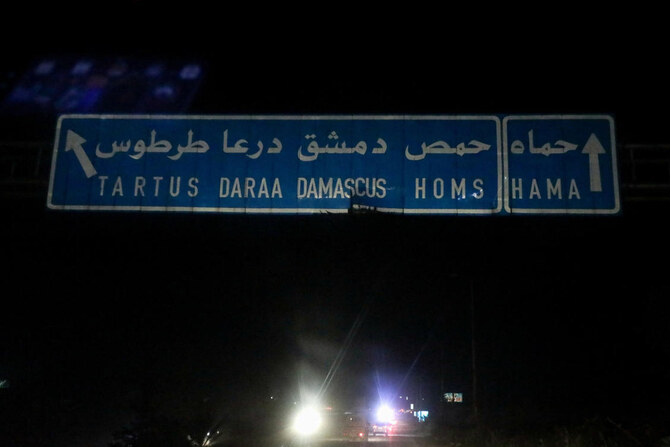
Strikes on key bridge linking Syria’s Homs, Hama: war monitor

Air strikes targeted a bridge on the highway linking the Syrian cities of Homs and Hama, a war monitor said Friday. (REUTERS)
Short Url
Updated 06 December 2024
Follow

Strikes on key bridge linking Syria’s Homs, Hama: war monitor

  • Air strikes targeted a bridge on the highway linking the Syrian cities of Homs and Hama, a war monitor said Friday

BEIRUT: Air strikes targeted a bridge on the highway linking the Syrian cities of Homs and Hama, a war monitor said Friday, as government forces scramble to secure Homs after Islamist-led militants captured Hama and commercial hub Aleppo.
“Fighter jets executed several airstrikes, targeting Al-Rastan bridge on (the) Homs-Hama highway... as well as attacking positions around the bridge, attempting to cut off the road between Hama and Homs and secure Homs,” the Britain-based Syrian Observatory for Human Rights said.
The militants led by Islamist group Hayat Tahrir Al-Sham (HTS) launched their offensive a little more than a week ago, just as a ceasefire in neighboring Lebanon took hold between Israel and Syrian President Bashar Assad’s ally Hezbollah.
To slow the militants advance, the Observatory said Assad’s forces erected soil barriers on the highway north of Homs, Syria’s third-largest city which lies just 40 kilometers (25 miles) south of Hama.
Tens of thousands of members of Assad’s Alawite minority community were fleeing Homs on Thursday, for fear that the militants would keep up their advance, the Observatory said earlier.
The militants captured Hama on Thursday following street battles with government forces, announcing “the complete liberation of the city” in a message on their Telegram channel.
Militant fighters kissed the ground and let off volleys of celebratory gunfire as they entered Syria’s fourth-largest city.
Many residents turned out to welcome the militants. An AFP photographer saw some residents set fire to a giant poster of Assad on the facade of city hall.
The army admitted losing control of the city, strategically located between Aleppo and Assad’s seat of power in Damascus.
Defense Minister Ali Abbas insisted that the army’s withdrawal was a “temporary tactical measure.”
“Our forces are still in the vicinity,” he said in a statement carried by the official SANA news agency.

Aron Lund, a fellow of the Century International think tank, called the loss of Hama “a massive, massive blow to the Syrian government” because the army should have had an advantage there to reverse militants gains “and they couldn’t do it.”
He said HTS would now try to push on toward Homs, where many residents were already leaving on Thursday.
Observatory director Rami Abdel Rahman reported a mass exodus from the city of members of Assad’s Alawite minority community.
He said tens of thousands were heading toward areas along Syria’s Mediterranean coast, where the Alawites, followers of an offshoot of Shiite Islam, form the majority.
“We are afraid and worried that what happened in Hama will be repeated in Homs,” said a civil servant, who gave his name only as Abbas.
“We fear they (the militants) will take revenge on us,” the 33-year-old said.
Until last week, the war in Syria had been mostly dormant for years, but analysts have said it was bound to resume as it was never truly resolved.
In a video posted online, HTS leader Abu Mohammed Al-Jolani said his fighters had entered Hama to “cleanse the wound that has endured in Syria for 40 years,” referring to a crackdown on the Muslim Brotherhood in 1982, which led to thousands of deaths.
In a later message on Telegram congratulating “the people of Hama on their victory,” he used his real name, Ahmed Al-Sharaa, instead of his nom de guerre for the first time.

The Observatory, which relies on a network of sources in Syria, said 826 people, mostly combatants but also including 111 civilians, have been killed in the country since the violence erupted last week.
It marks the most intense fighting since 2020 in the civil war sparked by the repression of pro-democracy protests in 2011.
Key to the militants’ successes since the start of the offensive last week was the takeover of Aleppo, which in more than a decade of war had never entirely fallen out of government hands.
While the advancing militants met little resistance earlier in their offensive, the fighting around Hama has been especially fierce.
Assad ordered a 50-percent raise in career soldiers’ pay, state news agency SANA reported Wednesday, as he seeks to bolster his forces for a counteroffensive.
Militants drove back the Syrian armed forces despite the fact that the government sent in “large military convoys,” the Observatory said.
The militants launched their offensive in northern Syria on November 27, the same day a ceasefire took effect in the war between Israel and Hezbollah in neighboring Lebanon.
Both Hezbollah and Russia have been crucial backers of Assad’s government, but have been mired in their own conflicts in recent years.
HTS is rooted in Syria’s Al-Qaeda branch.
The group has sought to moderate its image in recent years, but experts say it faces a challenge convincing Western governments it has fully renounced hard-line jihadism.
The United States maintains hundreds of troops in eastern Syria as part of a coalition formed against Daesh group jihadists.


Syria moves military reinforcements east of Aleppo after telling Kurds to withdraw

Updated 3 sec ago
Follow

Syria moves military reinforcements east of Aleppo after telling Kurds to withdraw

ALEPPO: Syria’s army was moving reinforcements east of Aleppo city on Wednesday, a day after it told Kurdish forces to withdraw from the area following deadly clashes last week.
The deployment comes as Syria’s Islamist-led government seeks to extend its authority across the country, but progress has stalled on integrating the Kurds’ de facto autonomous administration and forces into the central government under a deal reached in March.
The United States, which for years has supported Kurdish fighters but also backs Syria’s new authorities, urged all parties to “avoid actions that could further escalate tensions” in a statement by the US military’s Central Command chief Admiral Brad Cooper.
On Tuesday, Syrian state television published an army statement with a map declaring a large area east of Aleppo city a “closed military zone” and said “all armed groups in this area must withdraw to east of the Euphrates” River.
The area, controlled by Kurdish forces, extends from near Deir Hafer, around 50 kilometers (30 miles) from Aleppo, to the Euphrates about 30 kilometers further east, as well as toward the south.
State news agency SANA published images on Wednesday showing military reinforcements en route from the coastal province of Latakia, while a military source on the ground, requesting anonymity, said reinforcements were arriving from both Latakia and the Damascus region.
Both sides reported limited skirmishes overnight.
An AFP correspondent on the outskirts of Deir Hafer reported hearing intermittent artillery shelling on Wednesday, which the military source said was due to government targeting of positions belonging to the US-backed, Kurdish-led Syrian Democratic Forces.

’Declaration of war’

The SDF controls swathes of the country’s oil-rich north and northeast, much of which it captured during Syria’s civil war and the fight against the Daesh group.
On Monday, Syria accused the SDF of sending reinforcements to Deir Hafer and said it would send its own personnel there in response.
Kurdish forces on Tuesday denied any build-up of their personnel and accused the government of attacking the town, while state television said SDF sniper fire there killed one person.
Cooper urged “a durable diplomatic resolution through dialogue.”
Elham Ahmad, a senior official in the Kurdish administration, said that government forces were “preparing themselves for another attack.”
“The real intention is a full-scale attack” against Kurdish-held areas, she told an online press conference, accusing the government of having made a “declaration of war” and breaking the March agreement on integrating Kurdish forces.
Syria’s government took full control of Aleppo city over the weekend after capturing its Kurdish-majority Sheikh Maqsud and Ashrafiyeh neighborhoods and evacuating fighters there to Kurdish-controlled areas in the northeast.
Both sides traded blame over who started the violence last week that killed dozens of people and displaced tens of thousands.

PKK, Turkiye

On Tuesday in Qamishli, the main Kurdish city in the country’s northeast, thousands of people demonstrated against the Aleppo violence, with some burning pictures of Syrian President Ahmed Al-Sharaa, an AFP correspondent said, while shops were shut in a general strike.
Some protesters carried Kurdish flags and banners in support of the SDF.
“Leave, Jolani!” they shouted, referring to President Sharaa by his former nom de guerre, Abu Mohammed Al-Jolani.
“This government has not honored its commitments toward any Syrians,” said cafe owner Joudi Ali.
Other protesters burned portraits of Turkish Foreign Minister Hakan Fidan, whose country has lauded the Syrian government’s Aleppo operation “against terrorist organizations.”
Turkiye has long been hostile to the SDF, seeing it as an extension of the Kurdistan Workers’ Party (PKK) and a major threat along its southern border.
Last year, the PKK announced an end to its long-running armed struggle against the Turkish state and began destroying its weapons, but Ankara has insisted that the move include armed Kurdish groups in Syria.
On Tuesday, the PKK called the “attack on the Kurdish neighborhoods in Aleppo” an attempt to sabotage peace efforts between it and Ankara.
A day earlier, Ankara’s ruling party levelled the same accusation against Kurdish fighters.
The Britain-based Syrian Observatory for Human Rights reported 45 civilians and 60 soldiers and fighters from both sides killed in the Aleppo violence.
Aleppo civil defense official Faysal Mohammad said Tuesday that 50 bodies had been recovered from the Kurdish-majority neighborhoods after the fighting.