

Saudi Arabia, France civil aviation authorities discuss boosting air connectivity

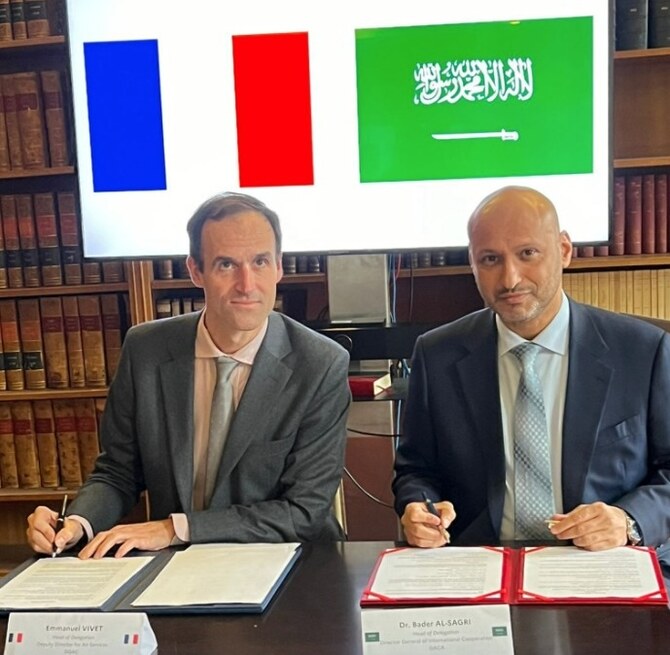
Bader Al-Sagri, representative of the Saudi General Authority of Civil Aviation, and Emmanuel Vivet, representative of the French Civil Aviation Authority, signed the document in Paris, Dec. 5 (SPA)
Short Url
Updated 06 December 2024
Follow

Saudi Arabia, France civil aviation authorities discuss boosting air connectivity

  • Riyadh and Paris aim to increase the number of flights connecting them

RIYADH: Saudi Arabian and French civil aviation authorities signed a record of discussions to boost air transport connectivity between the two countries on Thursday. 

Bader Al-Sagri, the director of the international cooperation department at the Saudi General Authority of Civil Aviation, and Emmanuel Vivet, the deputy director of air services at the French Civil Aviation Authority, signed the document in Paris. 

The document aims to strengthen the partnership between Riyadh and Paris in civil aviation, increase the number of flights, and grow air transport between the two countries. 

The cooperation will further enhance Saudi Arabia’s position as a global logistics center for civil aviation and air transport services, the Saudi Press Agency reported.  

The Kingdom’s Vision 2030 aims to position the country as a hub for aviation connectivity to 250 international destinations, serving an expected 330 million passengers annually by 2030. 

This week, during French President Emmanuel Macron’s state visit to Saudi Arabia, Riyadh and Paris have inked numerous pacts across diverse sectors. 

On Wednesday, the Kingdom’s national carrier, Saudia signed a strategic partnership with Air France-KLM to collaborate in aircraft maintenance, repair, and overhaul services.


Najran’s camels are embedded in local culture and traditions

Camels are not only a vital livestock resource in Najran, but also a cornerstone of local identity and tradition. (SPA)
Updated 25 December 2025
Follow

Najran’s camels are embedded in local culture and traditions

  • Several distinct camel breeds are found in the region
  • Animals permeate Arab consciousness, says expert

RIYADH: In Najran, camels are not only a vital livestock resource but also a cornerstone of local identity and tradition.

According to Hadi Benyan Al-Amer, head of Najran’s Camel Association, the region has several distinct camel breeds.

Principal among them is the Awarik, an ancient Arabian lineage linked to territories where arak trees flourish, the Saudi Press Agency reported on Thursday.

These light-colored, sparsely-haired camels possess remarkable resilience, and are prevalent across southern Arabia.

The Majahim are characterized by dark hues spanning black to brown, and excel in both milk yield and endurance.

The Asayil are prized for their sleek, lean physiques, and dominate in speed-based competitions.

Al-Amer said traditional water sources known as Odood, or traditional water wells and artesian wells, have sustained herders navigating the Empty Quarter’s grazing lands for generations.

These permanent water points, equipped with dedicated drinking basins for camels, showcase the animals’ extraordinary environmental resilience.

Among the principal wells accessible from Najran are Al-Minkhali, Abu Shadid, Hamra Nathil, Tamani, Umm Al-Wahat, and Khujaima.

Countless additional wells dot the Empty Quarter and adjacent territories, forming the backbone of camel owners’ far-reaching pastoral networks.

Dr. Hind bint Dawood Al-Shuqair of Najran University’s Arabic Language Department explained how camels have permeated Arab consciousness through legends and stories spanning thousands of years.

Representing endurance, power, and grace, they have become inseparable from Arab cultural identity.

Archaeological evidence at Al-Ukhdood, Mount Al-Tharwa and Hima, preserves through carvings and ancient artwork the deep bond between people and camels, Al-Shuqair said.

She drew attention to Saudi Arabia’s substantial investment in camel heritage, exemplified by proclaiming 2024 as the Year of the Camel.

This designation emphasizes their importance to national prosperity and cultural heritage while backing global initiatives to promote awareness of camels as valuable economic and cultural assets.

The Kingdom further demonstrates its commitment to protecting the animals through the annual King Abdulaziz Festival, the SPA reported.