Pakistan says 67 militants, 10 troops killed as security forces repel attacks in Balochistan

1 / 3
Pakistani army soldiers and other security officials examine a site following militants attack with guns and grenades, in Quetta, Pakistan, on Jan. 31, 2026. (AP)
2 / 3
A journalist takes photo with his mobile phone to ambulances carrying the bodies of police officers who were killed in a militants attack, outside a hospital in Quetta, Pakistan, on Jan. 31, 2026. (AP)
3 / 3
Security personnel inspect the blast site after an attack by Baloch separatists in Quetta on January 31, 2026. Ethnic Baloch separatists launched "coordinated" attacks across Pakistan's Balochistan province on January 31, killing at least four policemen, officials said, the latest violence in insurgency-hit southwest region. (AFP)
Short Url
Updated 31 January 2026
Follow

Pakistan says 67 militants, 10 troops killed as security forces repel attacks in Balochistan

  • Attacks hit Quetta, Gwadar, Kharan and Kalat, killing security personnel and civilians as clearance operations continue
  • Prime Minister Sharif praises security forces for foiling organized attempts to destabilize the southwestern province

QUETTA/ISLAMABAD: Pakistani forces killed 67 militants while repelling coordinated separatist attacks across the southwestern province of Balochistan on Saturday, according to security officials, as clearance operations continued across multiple districts.

The attacks, involving gunfire and explosions, targeted several locations including the provincial capital Quetta and the coastal city of Gwadar, as well as towns in Kharan and Kalat, according to security and police officials who spoke on condition of anonymity.

“In the ongoing operation since this morning, the confirmed number of neutralized militants has risen to 67,” one of the security officials said, adding that follow-up operations were underway with reports of further damage to militant networks.
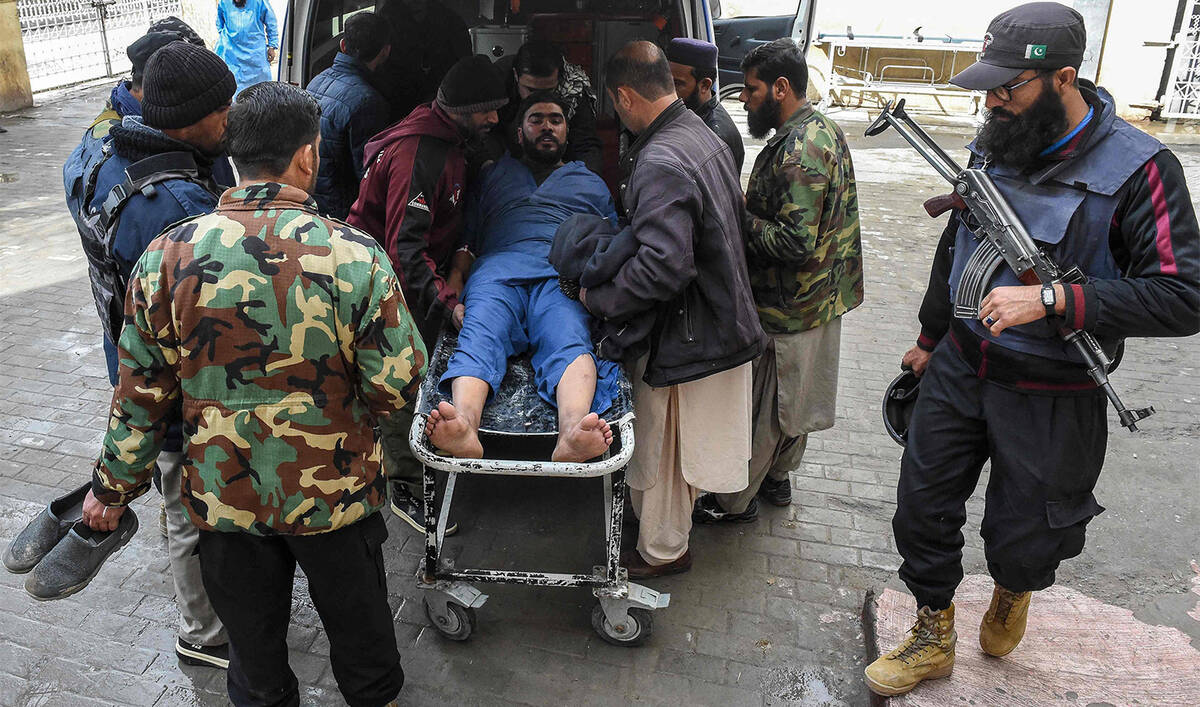


Security personnel shift an injured man at a hospital in Quetta on January 31, 2026, following an attack by Baloch separatists. Ethnic Baloch separatists launched "coordinated" attacks across Pakistan's Balochistan province on January 31, killing at least four policemen, officials said, the latest violence in insurgency-hit southwest region. (AFP)

At least 10 members of the security forces were also killed in the violence, the officials said.

In Gwadar, militants attacked laborer families, killing 11 civilians, including women and children, the officials said, adding that all assailants involved in that incident were later killed during follow-up operations.

According to Abdul Baqi Baloch, the station house officer in Kharan, armed militants stormed a residence in the town early Saturday, killing seven people, including a tribal elder, before fleeing the area.

“The clearance operation is ongoing in the city and its outskirts,” he said.

In Kalat, attackers set a city police station on fire, injuring three policemen, police official Majeed Raisani said, adding that the situation was under control but security operations were continuing.

A hospital official in Quetta said 15 bodies, including nine policemen, had been received, while several injured people were treated for gunshot wounds.

Prime Minister Shehbaz Sharif praised security forces for foiling what he described as organized attempts to destabilize Balochistan, and paid tribute to personnel killed during the operations.

The separatist group the Baloch Liberation Army (BLA) said it had launched what it called “Operation Herof 2.0,” claiming responsibility for attacks in multiple locations.
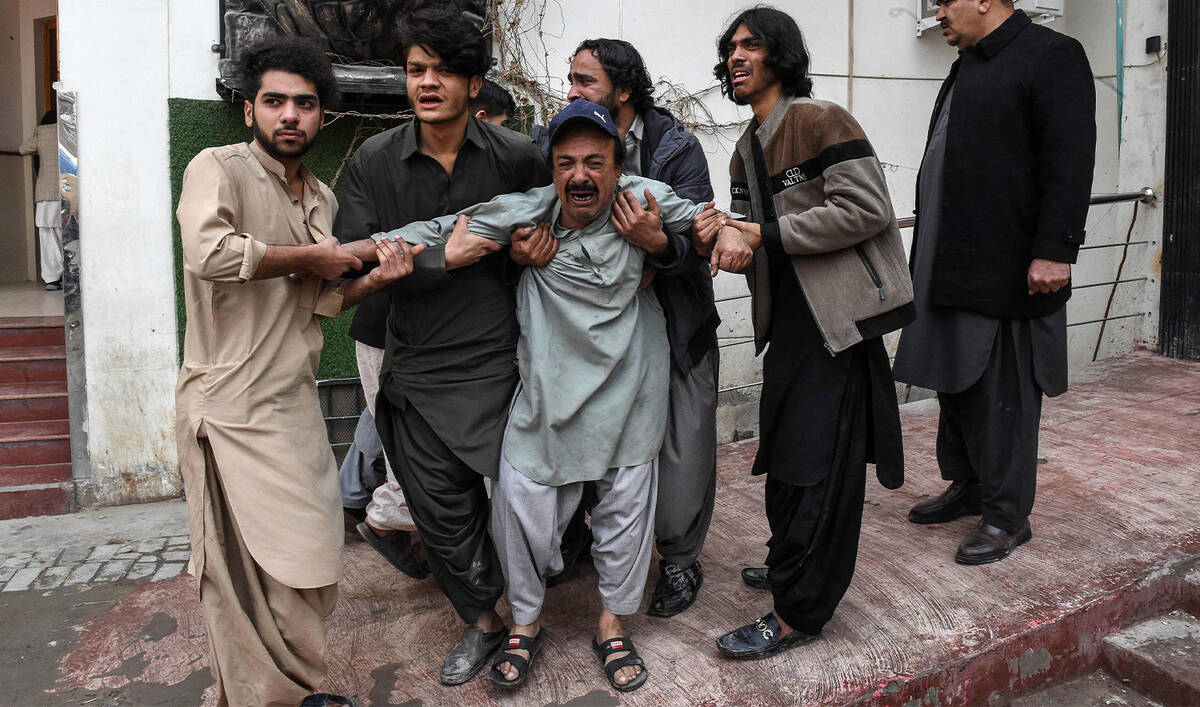


Family members mourn the death of a relative killed in an attack by Baloch separatists, at a hospital in Quetta on January 31, 2026. Ethnic Baloch separatists launched "coordinated" attacks across Pakistan's Balochistan province on January 31, killing at least four policemen, officials said, the latest violence in insurgency-hit southwest region. (AFP)

Pakistani officials describe BLA militants as Indian proxies, a charge New Delhi denies.

Balochistan, which borders Iran and Afghanistan, has faced a decades-long insurgency by separatist groups who accuse the central government of exploiting the region’s resources without benefiting local communities. The government denies the allegations.
Pakistani, Libyan commanders discuss regional security, military cooperation

Updated 6 sec ago
Follow

Pakistani, Libyan commanders discuss regional security, military cooperation

  • The meeting follows reports that Pakistan struck a $4 billion defense deal to sell military equipment to Libyan National Army
  • Both sides exchanged views on matters of mutual interest, with particular focus on security dynamics in respective regions

ISLAMABAD: Libyan National Army Commander Field Marshal Khalifa Haftar met with Pakistan’s Chief of Defense Forces Field Marshal Asim Munir in Rawalpindi and discussed with him military cooperation and regional security, the Pakistani military said on Monday.

The meeting takes place after Munir’s visit to Libya in December that was followed by reports suggesting Pakistan had struck a $4 billion defense deal to sell military equipment, including JF-17 fighter jets and Super Mushak trainer aircraft, to the Libyan National Army that controls eastern Libya. There has been no official confirmation of the deal so far.

Haftar and Prime Minister Dr. Osama Saad Hammad, who governs eastern Libya, called on Field Marshal Munir at Pakistan Army’s General Headquarters in Rawalpindi, according to the Inter-Services Public Relations (ISPR), the Pakistani military’s media wing.

“During the meeting, both sides exchanged views on matters of mutual interest, with particular focus on security dynamics in respective regions and professional cooperation,” the ISPR said in a statement.

“The discussion underscored the importance of continued engagement and collaboration between the Armed Forces of Pakistan and Libya.”

Libya has been subject to a UN arms embargo since 2011, requiring approval from the UN for transfers of weapons and related material. It was not clear whether Pakistan or Libya had applied for ⁠any exemptions to the UN embargo.

During Monday’s meeting, Munir reaffirmed Pakistan’s commitment to strengthening bilateral relations with Libya, reiterating his country’s support for peace, stability and institutional development in Libya, according to the ISPR.

“The meeting was held in a cordial and constructive atmosphere, reflecting the longstanding friendly relations between Pakistan and Libya,” the Pakistani military said.