

Filipinos worry about future as Manila posts worst economic growth in 15 years

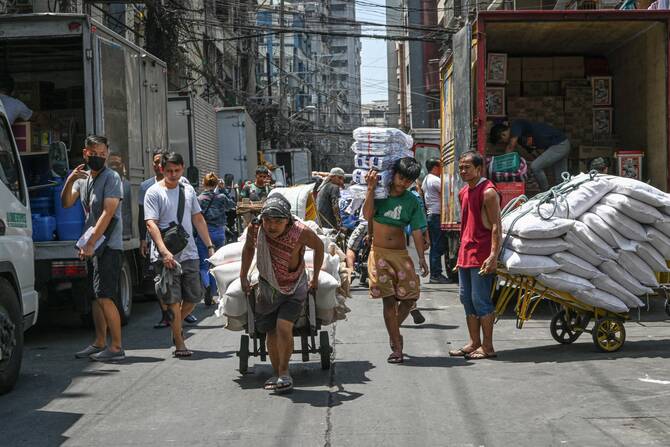
Men pull a trolley of agricultural products along a street in Manila on May 9, 2024. (AFP)
Short Url
Updated 31 January 2026
Follow

Filipinos worry about future as Manila posts worst economic growth in 15 years

  • Philippine economy slowed to weakest pace last quarter, with only 3.0 percent growth
  • Filipinos struggle with high prices, increased business cost, reduced savings 

MANILA: Over ten years ago, when Fatima Macud brought home roughly 30,000 pesos ($509) a month, the money was enough to cover her expenses and still leave room for savings.

Though she now earns 45,000 pesos, Macud finds herself unable to save any money as she struggles with rising prices to cover daily spending. 

“Yes, I got a salary increase, but the thing is, the cost of living here in the city also increased,” the 52-year-old resident of Metro Manila told Arab News on Saturday.

“Now for me, it barely covers my basic needs because the price of commodities just keeps rising — goods, services, everything … Everything feels way too expensive … Now, I can’t save money at all. It’s not enough.” 

The Philippine economy has slowed to the weakest pace in nearly 15 years outside of the pandemic, with data from the Philippines Statistics Authority showing just 3.0 percent growth in October to December, compared with 5.3 percent from the same period a year earlier. 

The full-year growth in 2025 settled at 4.4 percent, below the 5.7 percent posted in 2024 and lower than the government’s revised target of at least 4.8 percent. 

It was the result of “several converging factors,” Economic Planning Secretary Arsenio Balisacan told reporters earlier this week. 

“These include the adverse economic effects of weather and climate-related disruptions. Admittedly, the flood control corruption scandal also weighed on business and consumer confidence,” he said. 

But on the ground, Filipinos were more concerned about their day-to-day lives, and the state of the economy has begun to spark new worries about the future. 

“I am worried about my future,  especially my retirement. If the government is in a bankruptcy state or ends up in financial trouble, will they be able to pay my pension? Can I still avail the free health services with full benefits?” Macud said. 

“I’m also worried about my family’s future; the rising cost of living and the lack of employment opportunities.”

Olga Resureccion, a 52-year-old worker in Manila, is among those who believes the government has been “trying its best,” and is keeping her hopes alive. 

“You can’t lose hope,” she said. “Most people are still able to provide for themselves and their family. Like (me), I’m able to provide. You just really need to work hard.” 

Yet for entrepreneurs such as John Paul Maunes, the economic slowdown was taking a toll on his small restaurant in Cebu City, as he struggled with increasing prices of supplies, taxes and cost of government permits. 

“I think people from the ground, especially business owners, are really struggling right now. Particularly those who are SMEs (small and medium enterprises),” Maunes said. 

“We cannot increase our prices the way we want it because we’ll lose our customers. And at the same time, we are also struggling on how we can cope with the rising prices of commodities. Plus, the government permits and taxes are increasing every year.” 

Over the years, the 41-year-old has had to lay off employees to survive, while hoping for more government support and opportunities through economic growth. 

“We have this fear of impending doom as small business owners … With the increasing prices and economic impact on us on the ground, it’s a huge challenge,” he said.

 “We’re just hoping that better things will come for our government, for our economy.”


In Ethiopia, Tigrayans fear return to ‘full-scale war’

Updated 2 min 23 sec ago
Follow

In Ethiopia, Tigrayans fear return to ‘full-scale war’

  • Flights have been suspended into Tigray since Thursday and local authorities reported drone strikes on goods lorries
  • The international community fears the fighting could turn into an international conflict between Ethiopia and Eritrea
ADDIS ABABA: Tigrayans in northern Ethiopia fear a return to all-out war amid reports that clashes were continuing between local and federal forces on Monday, barely three years after the last devastating conflict in the region.
The civil war of 2020-2022 between the Ethiopian government and Tigray forces killed more than 600,000 people and a peace deal known as the Pretoria Agreement has never fully resolved the tensions.
Fighting broke out again last week in a disputed area of western Tigray called Tselemt and the Afar region to the east of Tigray.
Abel, 38, a teacher in Tigray’s second city Adigrat, said he still hadn’t recovered from the trauma of the last war and had now “entered into another round of high anxiety.”
“If war breaks out now... it could lead to an endless conflict that can even be dangerous to the larger east African region,” added Abel, whose name has been changed along with other interviewees to protect their identity.
Flights have been suspended into Tigray since Thursday and local authorities reported drone strikes on goods lorries on Saturday that killed at least one driver.
In Afar, a humanitarian worker, speaking to AFP on condition of anonymity, said there had been air strikes on Tigrayan forces and that clashes were ongoing on Monday, with tens of thousands of people displaced.
AFP could not independently verify the claims and the government has yet to give any comment on the clashes.
In the regional capital Mekele, Nahom, 35, said many people were booking bus tickets this weekend to leave, fearing that land transport would also be restricted soon.
“My greatest fear is the latest clashes turning into full-scale war and complete siege like what happened before,” he told AFP by phone, adding that he, too, would leave if he could afford it.
Gebremedhin, a 40-year-old civil servant in the city of Axum, said banks had stopped distributing cash and there were shortages in grocery stores.
“This isn’t only a problem of lack of supplies but also hoarding by traders who fear return of conflict and siege,” he said.
The region was placed under a strict lockdown during the last war, with flights suspended, and banking and communications cut off.
The international community fears the fighting could turn into an international conflict between Ethiopia and Eritrea, whose relations have been increasingly tense in recent months.
The Ethiopian government accuses the Tigrayan authorities and Eritrea of forging closer ties.
United Nations Secretary-General Antonio Guterres is “deeply concerned about... the risk of a return to a wider conflict in a region still working to rebuild and recover,” his spokesman said.
The EU said that an “immediate de-escalation is imperative to prevent a renewed conflict.”