Ice-cool Rybakina beats Sabalenka in tense Australian Open final

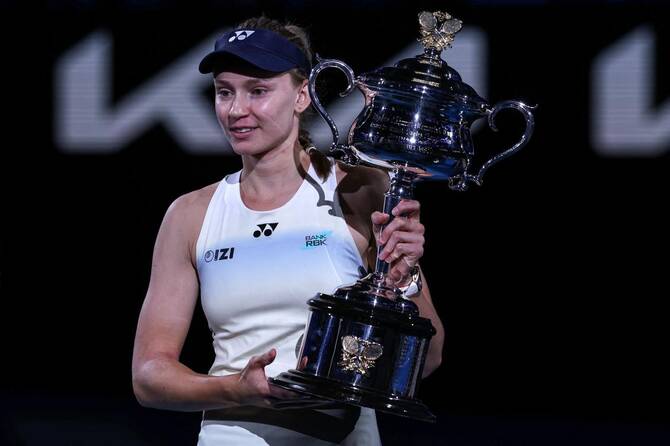
Kazakhstan’s Elena Rybakina celebrates with the Daphne Akhurst Memorial Cup after her victory against Belarus’ Aryna Sabalenka during the women’s singles final of the Australian Open on Jan. 31, 2026. (AFP)
Short Url
Updated 31 January 2026
Follow

Ice-cool Rybakina beats Sabalenka in tense Australian Open final

  • The big-serving Kazakh fifth seed held her nerve to pull through 6-4, 4-6, 6-4
  • Rybakina who was born in Moscow, adds her Melbourne triumph to her Wimbledon win in 2022

MELBOURNE: Elena Rybakina took revenge over world number one Aryna Sabalenka to win a nail-biting Australian Open final on Saturday and clinch her second Grand Slam title.
The big-serving Kazakh fifth seed held her nerve to pull through 6-4, 4-6, 6-4 at Rod Laver Arena in Melbourne in 2hrs 18mins.
It was payback after the Belarusian Sabalenka won the 2023 final between two of the hardest hitters in women’s tennis.
The ice-cool Rybakina, 26, who was born in Moscow, adds her Melbourne triumph to her Wimbledon win in 2022.
“Hard to find the words now,” said Rybakina, and then addressed her beaten opponent to add: “I know it is tough, but I hope we play many more finals together.”
Turning to some Kazakh fans in the crowd, she said: “Thank you so much to Kazakhstan. I felt the support from that corner a lot.”
It was more disappointment in a major final for Sabalenka, who won the US Open last year for the second time but lost the French Open and Melbourne title deciders.
She was into her fourth Australian Open final in a row and had been imperious until now, with tears in her eyes at the end.
“Let’s hope maybe next year will be a better year for me,” Sabalenka said ruefully.
Rybakina fights back
With the roof on because of drizzle in Melbourne, Rybakina immediately broke serve and then comfortably held for 2-0.
Rybakina faced two break points at 4-3, but found her range with her serve to send down an ace and dig herself out of trouble, leaving Sabalenka visibly frustrated.
Rybakina looked in the zone and wrapped up the set in 37 minutes on her first set point when Sabalenka fired long.
Incredibly, it was the first set Sabalenka had dropped in 2026.
The second game of the second set was tense, Rybakina saving three break points in a 10-minute arm-wrestle.
They went with serve and the seventh game was another tussle, Sabalenka holding for 4-3 after the best rally of a cagey affair.
The tension ratcheted up and the top seed quickly forged three set points at 5-4 on the Kazakh’s serve, ruthlessly levelling the match at the first chance to force a deciding set.
Sabalenka was now in the ascendancy and smacked a scorching backhand to break for a 2-0 lead, then holding for 3-0.
Rybakina, who also had not dropped a set in reaching the final, looked unusually rattled.
She reset to hold, then wrestled back the break, allowing herself the merest of smiles.
At 3-3 the title threatened to swing either way.
But a surging Rybakina won a fourth game in a row to break for 4-3, then held to put a thrilling victory within sight.
Rybakina sealed the championship with her sixth ace of the match.
The finalists were familiar foes having met 14 times previously, with Sabalenka winning eight of them.
Sabalenka came into the final as favorite but Rybakina has been one of the form players on the women’s tour in recent months.
She also defeated Sabalenka in the decider at the season-ending WTA Finals.
Rybakina beat second seed Iga Swiatek in the quarter-finals and sixth seed Jessica Pegula in the last four in Melbourne.
Rybakina switched to play under the Kazakh flag in 2018 when she was a little-known 19-year-old, citing financial reasons.


Like Leicester and Bodø/Glimt, Swiss soccer club Thun set to be historic league champion

Updated 6 sec ago
Follow

Like Leicester and Bodø/Glimt, Swiss soccer club Thun set to be historic league champion

  • Thun have never won the top-tier league in the club’s 128-year history yet this season has turned the standings into a procession
  • Thun are the latest unheralded European club taking inspiration from Leicester

GENEVA: Like Leicester’s Premier League title in 2016 and Bodø/Glimt’s stunning rise in Norway since 2020, Swiss soccer looks set to get its own surprise champion.
Thun have never won the top-tier league in the club’s 128-year history yet this season has turned the standings into a procession — even as a newly promoted club.
A 2-2 draw with second-place St. Gallen late Thursday stopped Thun’s run of 10 straight wins yet coach Mauro Lustrinelli’s team are 14 points clear with 10 rounds left.
“We are also a young team in the sense that the team are experiencing their first Super League,” Lustrinelli told Swiss public broadcaster SRF after his players conceded a stoppage-time goal to drop points for the first time since December.
Thun head Sunday to local rival Young Boys, a 17-time title winner and Champions League regular in recent years, as the current best team in Switzerland.
Following Leicester’s lead
Thun are the latest unheralded European club taking inspiration from Leicester.
Last year, Union Saint-Gilloise won their first Belgian title for 90 years and tiny Mjällby were champion of Sweden for the first time in their 86-year history.
Title races across Europe see Hearts on course for a first Scottish title in 66 years and Paris Saint-Germain being chased by Lens which won their only French title 28 years ago.
The most common link is clubs in provincial towns and cities run on low budgets with a collective team-first ethic.
“You really feel that it’s like a family,” Lustrinelli said last year when extending his contract at the club where he was once a star striker and has coached for four seasons.
Thun’s key players
It took Thun five years to get out of the second division after being relegated in 2020. That period included severe financial issues and being part of a multi-club ownership group backed by American and Chinese investors.
Thun are independent and locally owned again, and built a plan with Lustrinelli for a team playing the direct, pressing style he wants with two central strikers.
Top scorer this season is 12-goal Elmin Rastoder, a Swiss-born North Macedonia international who could feature in the World Cup playoffs against Denmark later this month.
Rastoder’s strike partner Thursday was Brighton Labeau, once a teammate of Kylian Mbappé, who is three years younger, when they were both in the Monaco academy.
Thun’s star prospect is Ethan Meichtry, a Switzerland under-21 midfielder who could yet make the World Cup squad.
Champions League debut
Thun were one of the smallest clubs to play in the Champions League after Lustrinelli’s 20-goal season lifted the team to Swiss league runner-up in 2005.
Thun advanced through two qualifying rounds to reach the elite stage, finishing third in a group behind Arsenal and Ajax.
Back then, Thun played European games at Young Boys’ stadium in Bern because their old home was below UEFA standard.
If Thun enter the Champions League in the second qualifying round in July, home games should be at their 10,000-seat Stockhorn Arena — with artificial turf, just like at Bodø/Glimt inside the Arctic Circle in Norway.
The Swiss champion must win through three qualifying rounds to reach the 36-team league phase.
Home of Swiss soccer
Thun will soon be the home of Switzerland’s soccer federation.
The Swiss Football Home project was approved last August and will include a new headquarters for the federation plus training fields for national teams. Next door will likely be the next Swiss champion.
“The road is still long,” Lustrinelli said of the 10-game run-in, “and we want everyone who will help us get those 30 points.”