

India’s Naga separatists threaten to resume violence after decades-long truce

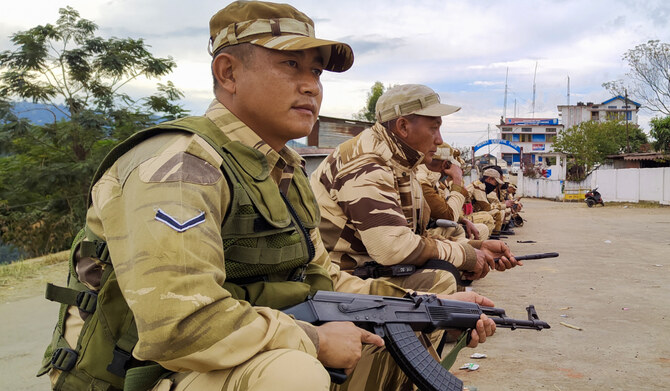
Police guard an area after 14 civilians were killed by Indian security forces over the weekend in Mon district, Nagaland, on December 6, 2021. (AFP)
Short Url
Updated 08 November 2024
Follow

India’s Naga separatists threaten to resume violence after decades-long truce

  • “The violent confrontation between India and Nagalim shall be purely on account of the deliberate betrayal and breach of commitment by India and its leadership to honor the letter and spirit of Framework Agreement of 2015,” he said

GUWAHATI, India: An armed separatist group in a remote northeast Indian state on Friday threatened to “resume violent armed resistance” after nearly three decades of ceasefire, accusing New Delhi of failing to honor promises in earlier agreements.
The Naga insurgency, India’s oldest, is aimed at creating a separate homeland of Nagalim that unites parts of India’s mountainous northeast with areas of neighboring Myanmar for ethnic Naga people. About 20,000 people have died in the conflict since it began in 1947.
A ceasefire between the National Socialist Council of Nagaland (Isak-Muivah), a leading separatist group, and Indian security forces has held since it was enforced in 1997 and the group signed an agreement with New Delhi in 2015 toward striking a resolution on their demands.

BACKGROUND

A ceasefire between the National Socialist Council of Nagaland (Isak-Muivah), a leading separatist group, and Indian security forces has held since it was enforced in 1997.

But talks have stagnated since and in a statement Friday, the group’s chief, Thuingaleng Muivah, accused India of “betrayal of the letter and spirit” of the 2015 agreement.
India’s Interior Ministry did not immediately respond to a request for comment on Muivah’s remarks.
In a statement, Muivah urged Prime Minister Narendra Modi’s federal government to “respect and honor” the 2015 agreement, which he said “officially recognized and acknowledged” the right to a sovereign flag and constitution for the separatists.
Muivah proposed a “third party intervention” to resolve the impasse, threatening that it would resume violence if “such a political initiative was rejected.”
“The violent confrontation between India and Nagalim shall be purely on account of the deliberate betrayal and breach of commitment by India and its leadership to honor the letter and spirit of Framework Agreement of 2015,” he said.
“India and its leadership shall be held responsible for the catastrophic and adverse situation that will arise out of the violent armed conflict between India and Nagalim,” he said.


Energy independence, transition take center stage at India’s flagship industry forum

Updated 4 sec ago
Follow

Energy independence, transition take center stage at India’s flagship industry forum

  • Modi announces investment opportunities of $500 billion in India’s energy ecosystem
  • India, Canada launch ministerial energy dialogue during India Energy Week 2026

NEW DELHI: Thousands of top industry executives, innovators and policymakers are gathered in Goa for India Energy Week 2026, where they are discussing global energy transition technologies, including hydrogen and future fuels.

Organized under the patronage of India’s Ministry of Petroleum and Natural Gas, the event opened on Tuesday and will run through Jan. 30, featuring 10 country pavilions and exhibitions by more than 700 local and international industry players.

The organizers expect 75,000 people to visit the venue at the ONGC Advanced Training Institute in Goa — a petroleum industry training campus operated by Oil and Natural Gas Corporation, India’s largest state‑owned oil and gas company.

In his opening remarks, Prime Minister Narendra Modi announced investment opportunities of up to $500 billion in oil and gas exploration, refining, and energy infrastructure.

“We are doing reforms to empower domestic hydrocarbons and are creating a transparent and investor-friendly environment for global collaboration. India is now working on the mission of energy independence, moving beyond energy security,” he said.

“We are striving to take investment in our oil and gas sector to $100 billion by the end of this decade.”

The minister of petroleum and natural gas, Hardeep Singh Puri, told participants that India’s share of global energy demand is estimated to be 10 percent by 2050 — about 30 percent more than at present — and it will be backed by conventional and renewable energy sources.

“While renewable and alternative energy sources are expanding at pace, conventional energy will remain essential to meet growing demand. Energy transition, energy security, and system resilience must advance together, and energy addition has emerged as a practical pathway to balance these priorities,” he said.

“India is diversifying its energy journey on a sustainable path. With strong progress across green hydrogen, compressed biogas, CNG (compressed natural gas), and LNG (liquefied natural gas), India continues to address the energy trilemma of availability, affordability and sustainability.”

India depends mainly on Russia, Iraq and Saudi Arabia for crude, and Qatar for LNG.

A new source for both may become Canada, whose Energy Minister Timothy Hodgson launched with Puri the India-Canada Ministerial Energy Dialogue on the sidelines of the Goa event on Tuesday.

Hodgson told India Energy Week participants that Canada could supply crude oil and LNG to India, as well as uranium — which India needs to achieve its target of 100 GW nuclear capacity by 2047.

“Canada used to provide 98 percent of its energy to one customer,” Hodgson said, referring to the US. “We are committed to diversifying our supply. We see the opportunity to work with India.”