

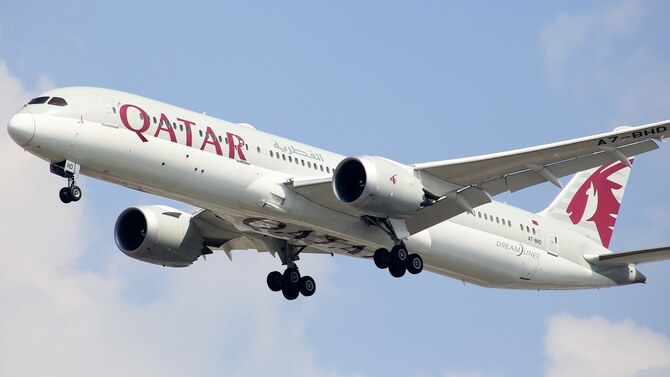

SYDNEY: Qatar Airways will buy a 25 percent stake in Virgin Australia from US private equity firm Bain Capital, posing a tougher contest for Qantas Airways that has dominated Australian routes and pushed back against giving access to the Middle Eastern carrier.
The purchase of the minority stake for an undisclosed amount will need to be signed off by Australia’s government, which denied Qatar Airways’ requests last year to fly additional services into Sydney, Melbourne, Brisbane and Perth.
“This partnership brings the missing piece to Virgin Australia’s longer-term strategy,” Virgin Australia CEO Jayne Hrdlicka said in a statement.
“It means that we’ve got an important shareholder who has a scale that we don’t have, who has the expertise that we don’t have, that can help us compete better domestically by giving us access to that scale,” Hrdlicka said later in an interview with ABC television on Tuesday.
Shares in Qantas fell as much as 4.3 percent by 5:39 a.m. Saudi time and were among the worst performers on the benchmark S&P/ASX 200 index.
The stake sale also serves as a cornerstone investment ahead of an anticipated return of Virgin Australia into public ownership, the companies said.
Bain said last year it would explore an IPO of Virgin Australia, which it bought for A$3.5 billion ($2.42 billion) including liabilities after it was placed in voluntary administration in 2020.
Bain was targeting an A$1 billion listing, but the plans were delayed, Reuters reported last year.
Bain declined to comment further on the IPO plans.
Government approval
As part of the deal with Qatar Airways, Virgin Australia plans to launch flights from Brisbane, Melbourne, Perth and Sydney to Doha with leased aircraft by mid-2025, subject to approval from Australia’s competition regulator.
That would allow Qatar to gain more traffic to its Doha hub, regardless of whether the Australian government approves Qatar Airways’ push for more flying rights.
The denial last year raised questions about the Australian government’s relationship with Qantas, which lobbied against more access for the Qatari carrier. Qantas has a partnership with Dubai-based Emirates, a rival of Qatar Airways.
Qantas did not respond immediately to a request for comment.
Qatar Airways CEO Badr Mohammed Al Meer in Tuesday’s joint statement said his airline believed competition in aviation was “a good thing and it helps raise the bar, ultimately benefiting customers.”
Australia’s Foreign Investment Review Board must approve the sale of the Virgin Australia stake to Qatar Airways, but the treasurer has the power after that to accept or reject the recommendation and impose conditions on the deal.
“It wouldn’t be appropriate for me to pre-empt that process or comment further,” Australian Treasurer Jim Chalmers told reporters after the deal was announced. “More broadly, we do want to see a strong, secure airline industry that delivers for consumers.”
Qatar Airways also owns minority stakes in British Airways owner IAG, Hong Kong’s Cathay Pacific Airways and China Southern Airlines.


