

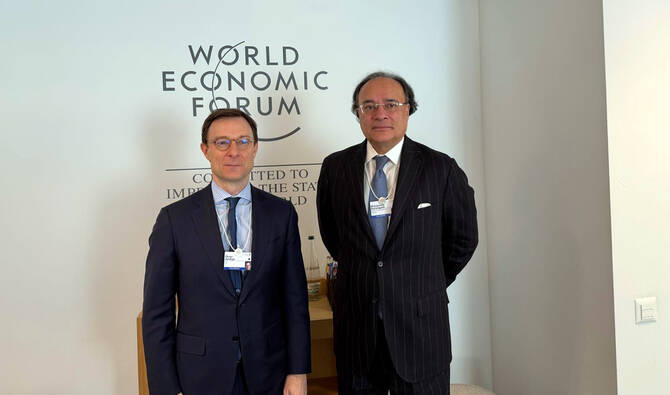

ISLAMABAD: Pakistan is utilizing the World Economic Forum in Davos this week to project itself as a stabilizing, reform-oriented economy, with Finance Minister Muhammad Aurangzeb holding separate meetings with global payments giant Visa, the ADB and Kuwait’s finance minister to attract digital investment and long-term Gulf capital.
The meetings on Wednesday in Davos come as Pakistan seeks to convert recent macroeconomic stabilization into sustained growth, using the World Economic Forum as a platform to re-engage global investors, multilateral lenders and strategic partners. After securing an International Monetary Fund stabilization program last year, Islamabad is now pitching reforms in taxation, privatization, digital payments and energy to attract long-term capital, strengthen financial inclusion and avoid past boom-and-bust cycles that have repeatedly undermined economic confidence
On Wednesday, Aurangzeb met Visa Group President Oliver Jenkyn on the sidelines of the annual forum to discuss cooperation in digital payments, financial innovation and Pakistan’s transition toward a modern, digitally enabled economy, according to a statement from the finance ministry.
During the meeting, Jenkyn reaffirmed Visa’s long-term interest in Pakistan, highlighting the global shift toward digital payments and the importance of enabling policy frameworks, the finance minister said.
“Expanding trade reflects a strong foundation that highlights the positive impact of US economic engagement in Pakistan and globally. The United States and Pakistan are pursuing a fair and balanced trade relationship that creates prosperity for both our nations,” the ministry statement quoted Jenkyn as saying, adding that Visa remained keen to support Pakistan’s next phase of growth through innovation, secure payment solutions and knowledge transfer.
Aurangzeb told the Visa delegation policy consistency and a clear reform roadmap were central to Pakistan’s economic strategy, noting that the government was strengthening digital infrastructure, connectivity and regulatory frameworks to support innovation and private sector participation.
The finance minister also emphasized Pakistan’s efforts to promote transparency, documentation of the economy and digitization across sectors, which he said were creating opportunities for trusted global partners to scale market-ready solutions.
Separately, Aurangzeb held talks with Kuwait’s Finance Minister Subaih Abdul Aziz Al-Mukhaizeem, as Pakistan sought to deepen economic and investment cooperation with Gulf partners increasingly looking beyond traditional markets.
According to the finance ministry, the Kuwaiti minister shared a positive assessment of Pakistan’s economic potential and described Kuwait’s investment approach as long-term and partnership-oriented.
Aurangzeb briefed his counterpart on Pakistan’s improving macroeconomic indicators, saying the country had moved toward stability and was now focused on achieving sustainable and inclusive growth while avoiding past boom-and-bust cycles.
He highlighted strengthening external accounts, rising remittances, growing information technology exports and renewed momentum in structural reforms, including privatization initiatives that had attracted strong interest from domestic investors.
The finance minister said new opportunities were emerging across priority sectors such as agriculture, minerals and mining, pharmaceuticals and technology, offering scope for long-term investment partnerships.
Aurangzeb also met Asian Development Bank President Masato Kanda in Davos, where both sides reviewed Pakistan’s reform agenda, macroeconomic stabilization and their long-standing development partnership. The finance minister cited improving indicators including easing inflation, lower policy rates, stronger foreign exchange reserves and rising investor confidence, while briefing Kanda on progress in structural reforms, privatization and private sector participation.
Kanda welcomed Pakistan’s progress and reaffirmed the ADB’s commitment to continued support, including cooperation on energy reforms, sustainable development and access to international capital markets, the finance ministry said.
The meetings come as Pakistan seeks to rebuild investor confidence after years of economic volatility, high inflation and external financing pressures.
Officials say outreach to global financial platforms such as Visa and sovereign-linked Gulf investors reflects a broader strategy to align digital reform, private sector participation and long-term capital inflows as Pakistan seeks a transition from stabilization toward growth.


