

Qatar Airways says it will take 25% stake in South Africa's Airlink 

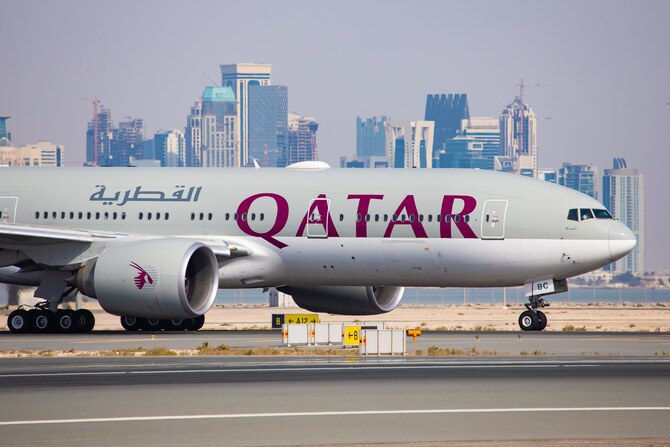
Qatar Airways announced on Tuesday that it would acquire a 25 percent stake in South African carrier Airlink.  Supplied
Short Url
Updated 20 August 2024
Follow

Qatar Airways says it will take 25% stake in South Africa's Airlink 

  • Investment would boost Qatar Airways’ access to passengers in regional cities in Africa
  • Qatar Airways will take the maximum foreign ownership share that South African regulators allow for airlines

DOHA: Qatar Airways will take a 25 percent stake in South Africa-based regional carrier Airlink as both airlines seek to boost services and passenger numbers across Africa, they said on Tuesday.
Qatar Airways CEO Badr Mohammed Al-Meer, speaking alongside Airlink’s CEO Rodger Foster in Doha, told reporters the investment would boost Qatar Airways’ access to passengers in regional cities in Africa.
Foster said it would allow privately owned Airlink to expand in Africa and eventually to operate larger aircraft on one or two routes. It would not expand beyond Africa, he said.
The executives did not disclose the value of the investment that was officially agreed on Tuesday, and Qatar Airways’ Al Meer said it would require regulatory approval.

With a 25 percent equity stake in Airlink, Qatar Airways will take the maximum foreign ownership share that South African regulators allow for airlines, Foster said.
Airlink is currently owned by Foster’s family, South Africa’s Webb family and institutional investors Coronation Global and Sishen Iron Ore Company Community Development Trust, according to Foster.
Qatar Airways will gain two seats on Airlink’s 14 member board and will have 25 percent shareholder voting rights, Foster told Reuters.
State-owned Qatar Airways holds stakes in British Airways-owner International Airlines Group, Latam Airlines, Cathay Pacific Airways, and China Southern Airlines.

It has also been in talks to acquire a minority stake in Rwanda’s RwandAir and in 2019 agreed with the country’s government to take a majority stake in a new international airport in Rwanda.
Airlink, which flies to more than 45 destinations in 15 African countries, and RwandAir both operate on several of the same routes.
“It makes sense that as Qatar Airways gets more involved in RwandAir, we start rationalizing the duplicated activity,” Foster said, adding that though discussions have not started yet, it could mean an interline or code share agreement with the airline.
Airlink already has a code share agreement with Qatar Airways, which allows the airlines to sell tickets on flights operated by each other.
The African carrier has a similar agreement with Dubai’s state-owned Emirates, a competitor of Qatar Airways, which Foster said would continue.


First EU–Saudi roundtable on critical raw materials reflects shared policy commitment

Updated 16 January 2026
Follow

First EU–Saudi roundtable on critical raw materials reflects shared policy commitment

RIYADH: The EU–Saudi Arabia Business and Investment Dialogue on Advancing Critical Raw Materials Value Chains, held in Riyadh as part of the Future Minerals Forum, brought together senior policymakers, industry leaders, and investors to advance strategic cooperation across critical raw materials value chains.

Organized under a Team Europe approach by the EU–GCC Cooperation on Green Transition Project, in coordination with the EU Delegation to Saudi Arabia, the European Chamber of Commerce in the Kingdom and in close cooperation with FMF, the dialogue provided a high-level platform to explore European actions under the EU Critical Raw Materials Act and ResourceEU alongside the Kingdom’s aspirations for minerals, industrial, and investment priorities.

This is in line with Saudi Vision 2030 and broader regional ambitions across the GCC, MENA, and Africa.

ResourceEU is the EU’s new strategic action plan, launched in late 2025, to secure a reliable supply of critical raw materials like lithium, rare earths, and cobalt, reducing dependency on single suppliers, such as China, by boosting domestic extraction, processing, recycling, stockpiling, and strategic partnerships with resource-rich nations.

The first ever EU–Saudi roundtable on critical raw materials was opened by the bloc’s Ambassador to the Kingdom, Christophe Farnaud, together with Saudi Deputy Minister for Mining Development Turki Al-Babtain, turning policy alignment into concrete cooperation.

Farnaud underlined the central role of international cooperation in the implementation of the EU’s critical raw materials policy framework.

“As the European Union advances the implementation of its Critical Raw Materials policy, international cooperation is indispensable to building secure, diversified, and sustainable value chains. Saudi Arabia is a key partner in this effort. This dialogue reflects our shared commitment to translate policy alignment into concrete business and investment cooperation that supports the green and digital transitions,” said the ambassador.

Discussions focused on strengthening resilient, diversified, and responsible CRM supply chains that are essential to the green and digital transitions.

Participants explored concrete opportunities for EU–Saudi cooperation across the full value chain, including exploration, mining, and processing and refining, as well as recycling, downstream manufacturing, and the mobilization of private investment and sustainable finance, underpinned by high environmental, social, and governance standards.

From the Saudi side, the dialogue was framed as a key contribution to the Kingdom’s industrial transformation and long-term economic diversification agenda under Vision 2030, with a strong focus on responsible resource development and global market integration.

“Developing globally competitive mineral hubs and sustainable value chains is a central pillar of Saudi Vision 2030 and the Kingdom’s industrial transformation. Our engagement with the European Union through this dialogue to strengthen upstream and downstream integration, attract high-quality investment, and advance responsible mining and processing. Enhanced cooperation with the EU, capitalizing on the demand dynamics of the EU Critical Raw Materials Act, will be key to delivering long-term value for both sides,” said Al-Babtain.

Valere Moutarlier, deputy director-general for European industry decarbonization, and directorate-general for the internal market, industry, entrepreneurship and SMEs at European Commission, said the EU Critical Raw Materials Act and ResourceEU provided a clear framework to strengthen Europe’s resilience while deepening its cooperation with international partners.

“Cooperation with Saudi Arabia is essential to advancing secure, sustainable, and diversified critical raw materials value chains. Dialogues such as this play a key role in translating policy ambitions into concrete industrial and investment cooperation,” she added.