

Creditor meeting approves sale of Virgin Australia to Bain Capital

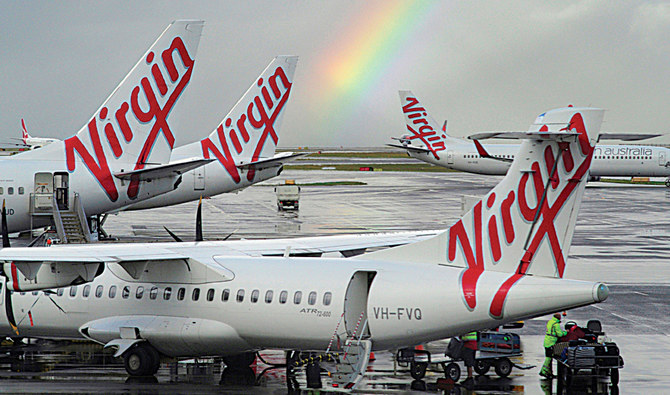
Virgin Australia is looking to switch to smaller aircraft. (Reuters)
Short Url
Updated 05 September 2020
Follow

Creditor meeting approves sale of Virgin Australia to Bain Capital

  • Airline aims to downsize staff, planes and routes to become value-based carrier offering cheap fares

WELLINGTON: Virgin Australia’s creditors agreed on Friday to sell the airline to Boston-based Bain Capital in a deal that will cut 3,000 jobs at the carrier and end many of its international flights.

Co-founded by British businessman Richard Branson, in April the airline became the world’s largest to seek bankruptcy protection after the pandemic grounded much of the aviation industry. It plans to reemerge with cheap fares as a value-based carrier.
Another airline founded by Branson, Virgin Atlantic, last month filed for protection in the US bankruptcy court as part of a process in the United Kingdom to carry out a restructuring plan.
Virgin Australia said that under the deal with Bain, worth 3.5 billion Australian dollars ($2.5 billion), unsecured creditors would get paid between 9 and 13 cents on the dollar for their claims. Virgin’s creditors are owed a total of about AU$7 billion.
Due to the pandemic, the creditor meeting was held online. The administrators signed a binding agreement in June with Bain Capital, the company co-founded by US Senator Mitt Romney.
Paul Scurrah, the chief executive of Virgin Australia Group, said the sale moves the airline closer to leaving bankruptcy protection and allows it to focus on the future, in which it will continue competing with its larger rival, Qantas Airways.
“It’s vital for Australia to have two major airlines for consumer choice, value airfares, and to help support the recovery of Australia’s robust tourism sector after this crisis is over,” Scurrah said in a statement.
Virgin’s administrator Deloitte said creditors had voted overwhelmingly in favor of the deal in what have been challenging circumstances.

FASTFACT

Virgin’s creditors are owed a total of about AU$7 billion.

“This outcome provides certainty for employees and customers, a return to creditors, and opportunities for suppliers and financiers to continue to trade,” Joint Voluntary Administrator Vaughan Strawbridge said in a statement.Under a plan announced previously by Scurrah, the airline will cut back its workforce to 6,000 and end long-haul routes from Australia to Los Angeles and Tokyo as it resets the business for lower global demand.
The airline plans to shed its Boeing 777 and Airbus A330 planes and use Boeing 737s, along with some smaller aircraft for regional and charter flights. The airline’s budget subsidiary Tigerair Australia will be discontinued.
Virgin Australia’s major shareholders are Singapore Airlines and Etihad Airways, along with Chinese investment conglomerates Nanshan Group and HNA Group. Branson holds a 10 percent stake.
The airline sought bankruptcy protection after the Australian government refused its request for a AU$1.4 billion loan.
Australia’s Treasurer Josh Frydenberg told reporters at the time his government wasn’t going to bail out “five large foreign shareholders with deep pockets who together own 90 per cent of this airline.”
Qantas argued that it had three times more revenue than Virgin and was therefore entitled to a AU$4.2 billion loan if the smaller airline was not to gain an unfair advantage.


Saudi Arabia, Japan trade rises 38% between 2016 and 2024, minister says

Updated 11 January 2026
Follow

Saudi Arabia, Japan trade rises 38% between 2016 and 2024, minister says

RIYADH: Trade between Saudi Arabia and Japan has increased by 38 percent between 2016 and 2024 to reach SR138 billion ($36 billion), the Kingdom’s investment minister revealed.

Speaking at the Saudi-Japanese Ministerial Investment Forum 2026, Khalid Al-Falih explained that this makes the Asian country the Kingdom’s third-largest trading partner, according to Asharq Bloomberg.

This falls in line with the fact that Saudi Arabia has been a very important country for Japan from the viewpoint of its energy security, having been a stable supplier of crude oil for many years.

It also aligns well with how Japan is fully committed to supporting Vision 2030 by sharing its knowledge and advanced technologies.

“This trade is dominated by the Kingdom's exports of energy products, specifically oil, gas, and their derivatives. We certainly look forward to the Saudi private sector increasing trade with Japan, particularly in high-tech Japanese products,” Al-Falih said.

He added: “As for investment, Japanese investment in the Kingdom is good and strong, but we look forward to raising the level of Japanese investments in the Kingdom. Today, the Kingdom offers promising opportunities for Japanese companies in several fields, including the traditional sector that links the two economies: energy.”

The minister went on to note that additional sectors that both countries can also collaborate in include green and blue hydrogen, investments in advanced industries, health, food security, innovation, entrepreneurship, among others.

During his speech, Al-Falih shed light on how the Kingdom’s pavilion at Expo 2025 in Osaka achieved remarkable success, with the exhibition receiving more than 3 million visitors, reflecting the Japanese public’s interest in Saudi Arabia.

“The pavilion also organized approximately 700 new business events, several each day, including 88 major investment events led by the Ministry of Investment. Today, as we prepare for the upcoming Expo 2030, we look forward to building upon Japan’s achievements,” he said.

The minister added: “During our visit to Japan, we agreed to establish a partnership to transfer the remarkable Japanese experience from Expo Osaka 2025 to Expo Riyadh 2030. I am certain that the Japanese pavilion at Expo Riyadh will rival the Saudi pavilion at Expo Osaka in terms of organization, innovation, and visitor turnout.”

Al-Falih also shed light on how Saudi-Japanese relations celebrated their 70th anniversary last year, and today marks the 71st year of these relations as well as how they have flourished over the decades, moving from one strategic level to an even higher one.