


NEW YORK CITY: Saudi Arabia’s aid chief on Wednesday issued an impassioned plea for assistance to Sudan at a high-level event in New York City on the sidelines of the 79th UN General Assembly.
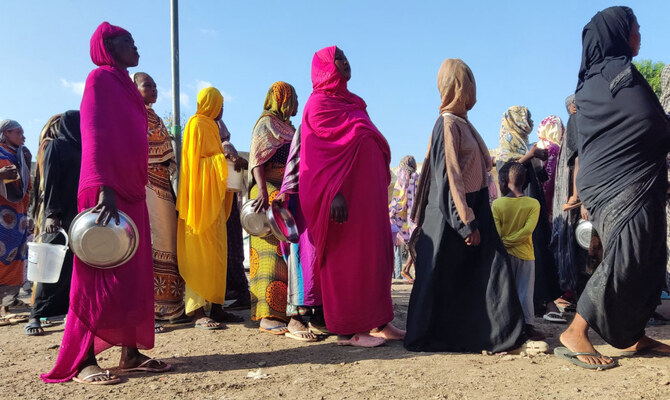
Saudi Arabia has allocated more than $3 billion in aid to the conflict-ravaged country, where almost 26 million people are now facing crisis levels of food insecurity.
About 11 million Sudanese have fled the country following the outbreak of civil war, seeking refuge in neighboring states and beyond.
The Kingdom is employing a twin strategy of peacemaking and aid relief to bring an end to the crisis, but the international response to Sudan has consistently underwhelmed, threatening to condemn millions more to suffering, said Abdullah Al-Rabeeah, supervisor general of Saudi aid agency KSrelief. The UN’s own refugee appeal for Sudan is only 25 percent funded.
The event, “The Cost of Inaction,” was hosted by Saudi Arabia, Egypt, the US, the EU, the African Union and the UN in a bid to draw global attention to the scale of suffering in Sudan and rally support for a worldwide humanitarian appeal.
In his address, Al-Rabeeah said it is a “collective responsibility” to assist Sudan, a “brotherly country whose people are facing great challenges that they’re attempting to overcome, and they deserve our full support.”
Saudi Arabia is “fully aware” of its duty toward Sudan, he added, highlighting the “great efforts” made by the Kingdom to address the crisis since the beginning of the civil war.
These efforts were carried out “in order to find means to bring hope back to Sudan, and this includes the Jeddah Declaration for the protection of civilians as well as humanitarian access,” he said.
“However, the escalation of violence that has recently been seen in a number of regions has caused even further damage, pushing millions of people to flee their homes, leaving behind their families and their possessions.”
Despite Saudi Arabia allocating $3 billion in assistance to Sudan and carrying out a number of relief missions earlier this year, “the worsening of the security situation has impacted the progress that had been made,” Al-Rabeeah said, adding that in response, the Kingdom has “redoubled its efforts” and stepped up its contributions.
“Since April 2023, we’ve launched a number of projects. Together with the UN and other humanitarian organizations, we’ve brought in assistance through land and sea routes. We’re providing support to the government and also carrying out a campaign to assist the Sudanese people with contributions above $125 million,” Al-Rabeeah said.
“However, despite all of these efforts made by our country, challenges remain, and the crisis requires coordinated efforts in order to bring unhindered humanitarian access to the country and provide a sustainable and coordinated response, as well as safe unhindered access to areas affected by conflict.”
Al-Rabeeah urged the international community to look past “political considerations” to formulate a powerful response to the crisis in Sudan.
“This is a humanitarian tragedy that requires us to overcome existing divisions. We must ensure genuine change that will allow the entirety of the Sudanese people to restore their normal lives,” he said, adding that Saudi Arabia “is making significant efforts to make sure that this necessary assistance is delivered to the Sudanese people, who deserve a dignified life.”
Al-Rabeeah’s address was followed by Dr. Obaida El-Dandarawy, Egypt’s deputy assistant foreign minister for UN affairs.
El-Dandarawy highlighted his country’s hosting of more than 1.5 million Sudanese refugees, in addition to the 5 million who already reside in Egypt.
“We’ve opened our doors widely to host our brothers and sisters from Sudan,” he said. “However, Egypt and neighboring countries on their own can’t continue carrying this burden, and that’s why we need to make sure that various countries, organizations and donors need to shoulder their humanitarian responsibility, and they have to help Egypt and the neighboring countries so that we can carry out this task, a heavy one, both in terms of the social and economic dimensions.”
He added: “We need to send a clear message to the sons and daughters of Sudan, and say that the international community is aware of their suffering and will spare no effort.”
The US ambassador to the UN, Linda Thomas-Greenfield, told the chamber: “I feel, as I know all of you must, a sense of shame and embarrassment that this is happening on our watch.”
Filippo Grandi, UN high commissioner for refugees, echoed Al-Rabeeah’s appeal, painting a stark picture of the reality on the ground.
“I went to Sudan twice this year, and as many of you have said, and I want to reiterate, conditions are apocalyptic,” he said.
“If people don’t die because of bullets, they starve to death. If they manage to survive, they must face disease, or floods, or the threat of sexual violence and other horrifying abuse, which if perpetrated in other places would make daily headlines.”
Grandi said humanitarian convoys in Sudan face being held up by closed roads due to flooding, or fired on and shelled by fighters.
“The solution to this crisis lies inside Sudan, but I can assure you its consequences won’t be contained to the region,” he warned.
“Let me just join everybody else on this panel in saying that more than anything else we need a political solution, because this is a crisis that can be solved, and it must be solved now.”


