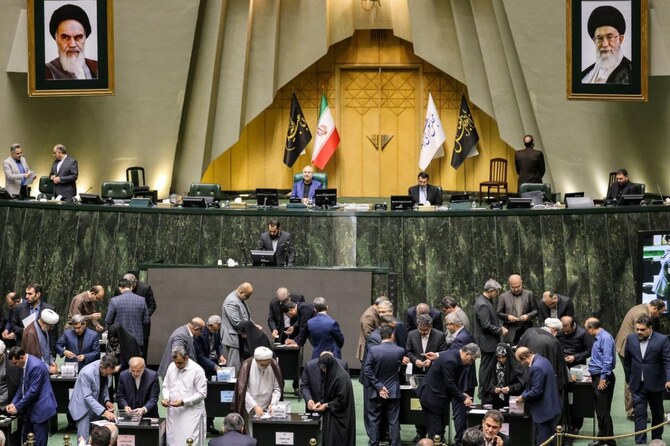
TEHRAN: The Iranian parliament on Wednesday blocked the appointment of a politician from the Sunni minority as vice president, state media reported.
In August, President Masoud Pezeshkian had announced the appointment of Abdolkarim Hosseinzadeh as his vice president for rural development and disadvantaged areas, citing his “valuable experience.”
But on Wednesday lawmakers voted against his resignation from parliament to take up the vice president post, the official IRNA news agency said.
“Parliament members voted 107 in favor, 129 against, and five abstentions out of the 247 representatives present,” it added.
Sunni Muslims account for around 10 percent of Iran’s population, where the vast majority are Shiites and that branch of Islam is the official state religion.
They have very rarely held key positions of power since the Islamic revolution in 1979.
Iran has numerous vice presidents, who are tasked with leading organizations related to presidential affairs in the country.
A 44-year-old reformist, Hosseinzadeh has since 2012 represented the northwestern cities of Naghadeh and Oshnavieh in the Iranian parliament.
He has spoken out publicly on several occasions in defense of the rights of Iran’s Sunnis.
During his election campaign Pezeshkian, himself a reformist, criticized the lack of representation for ethnic and religious minorities, in particular Sunni Kurds, in important positions.

Iran parliament blocks appointment of Sunni to VP post
https://arab.news/jkxcs
Iran parliament blocks appointment of Sunni to VP post
Spain highlights importance of Gaza reconstruction
- Spain officially recognized Palestine as a state in May 2024, in a coordinated move alongside Ireland and Norway
RAMALLAH: The Palestinian prime minister, Mohammed Mustafa, and the Spanish foreign minister, Jose Manuel Albares, on Friday discussed the latest developments in the West Bank and Gaza Strip.
During their telephone conversation they emphasized the need to intensify international efforts to end the Israeli occupation and halt attacks and settler violence, and to secure the release of Palestinian funds held by Israeli authorities.
They affirmed the importance of ongoing efforts relating to plans for the reconstruction of Gaza, and Europe’s significant role in this process. Mustafa and Albares highlighted the need to unify Palestinian institutions in Gaza with those in the West Bank, with the aim of establishing a Palestinian state in line with international resolutions, including last year’s New York Declaration.
They also discussed coordination between their countries, and the strengthening of Spain’s political, diplomatic and financial support for Palestine, and Mustafa thanked Spain for its ongoing support.
Spain officially recognized Palestine as a state in May 2024, in a coordinated move alongside Ireland and Norway. Estephan Salameh, the Palestinian finance and planning minister, is set to visit Spain this month to discuss enhanced cooperation, particularly in the areas of development and reconstruction. Meanwhile, Israel continues operating in the occupied West Bank.
The Palestinian Prisoners media office said on Friday that Israel carried out numerous raids across the territory, including the major cities of Ramallah and Hebron, according to The Associated Press.
Nearly 50 people were detained, following the arrest of at least 50 other Palestinians on Thursday, most of those in the Ramallah area.
As 2026 begins, the shaky 12-week-old ceasefire between Israel and Hamas has largely ended large-scale Israeli bombardment of Gaza.
But Palestinians are still being killed by Israeli fire, especially along the so-called Yellow Line that delineates areas under Israeli control, and the humanitarian crisis is compounded by frequent winter rains and colder temperatures.
On Friday, American actor and film producer Angelina Jolie visited the Rafah border crossing between Egypt and the Gaza Strip.
The only crossing between the territory and a country other than Israel, it remains closed despite Palestinian requests to reopen it to people and aid.
Jolie met with members of the Red Crescent on the Egyptian side of the Rafah border crossing and then visited a hospital in the nearby city of Arish to speak with Palestinian patients on Friday, according to Egyptian officials.
Aid groups say not enough shelter materials are getting into Gaza during the truce.


