Iran’s president names first Sunni governor in 45 years

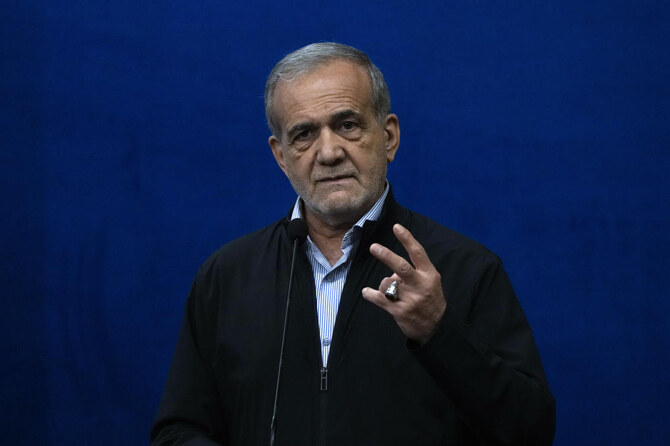
Iranian President Masoud Pezeshkian speaks at the start of his press conference in Tehran, Iran. (File/AP)
Short Url
Updated 18 September 2024
Follow

Iran’s president names first Sunni governor in 45 years

  • Arash Zerehtan was appointed head of the western state
  • He is the first Sunni to be made a regional governor in the predominantly Shiite country

TEHRAN: Iran’s new president, Masoud Pezeshkian, on Wednesday nominated a member of the Sunni Muslim minority to be governor of Kurdistan province, official media reported.
Arash Zerehtan was appointed head of the western state, IRNA news agency said, citing government spokesman Fatemeh MoHajjerani.
He is the first Sunni to be made a regional governor in the predominantly Shiite country since the earliest days of the 1979 Islamic Revolution.
Zerehtan, 48, served as a member of parliament for the city of Paveh between 2020 and this year.
Sunnis account for about 10 percent of Iran’s population, where the vast majority are Shiites and Shiite Islam is the official state religion.
They have very rarely held key positions of power since the revolution.
Pezeshkian, 69, took office in July after an early election following the death of ultraconservative president Ebrahim Raisi in a helicopter crash.
During his election campaign, Pezeshkian criticized the lack of representation for ethnic and religious minorities, in particular Sunni Kurds, in important positions.
In August, he made another member of the Sunni minority, Abdolkarim Hosseinzadeh, one of his vice presidents.


In major policy shift on Syria, UN Security Council lifts sanctions on Hayat Tahrir Al-Sham

Updated 28 February 2026
Follow

In major policy shift on Syria, UN Security Council lifts sanctions on Hayat Tahrir Al-Sham

  • Move reflects evolving Syrian political landscape in the post-Assad era, ending a global freeze on assets, travel ban and arms embargo

NEW YORK CITY: The UN Security Council on Friday removed Al-Nusra Front, the militant group that evolved into Hayat Tahrir Al-Sham, from its so-called Daesh and Al-Qaeda Sanctions List.

The move signals a major shift in international policy toward Syria’s evolving political landscape in the post-Assad era, and ends a global freeze on assets, travel ban and arms embargo that have been imposed on the group since 2014.

Al-Nusra Front and Hayat Tahrir Al-Sham were led by Ahmad Al-Sharaa, formerly Abu Mohammed Al-Julani, who is now Syria’s president and was a leading figure in the offensive that toppled the Assad regime.

The consensus decision by the Security Council’s sanctions committee was announced by the UK, which holds the presidency of the Security Council this month and was acting in the absence of the chair of the committee. It followed a request by the new Syrian authorities to delist “Al-Nusrah Front for the People of the Levant.”

The decision means measures that were applied to Hayat Tahrir Al-Sham under Security Council Resolution 2734, adopted in 2024, no longer apply. As a result, UN member states are notrequired to freeze the group’s funds, restrict the movement of its representatives, or block the supply or transfer of arms and related materiel.

Al-Nusra Front was added to the sanctions list for its ties to Al-Qaeda and involvement in the financing and execution of militant activities during the war in Syria. The UN initially continued to treat the group’s successor organization, Hayat Tahrir Al-Sham, as a listed alias.

Al-Sharaa has said the group severed all prior transnational jihadist links and is now solely focused on local Syrian matters.