Algeria pardons writer Boualem Sansal

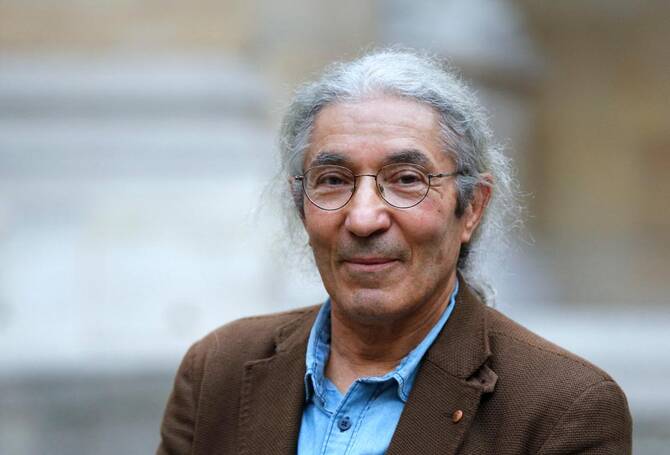
Algerian writer Boualem Sansal. (AFP/File)
Short Url
Updated 12 November 2025
Follow

Algeria pardons writer Boualem Sansal
  • The statement said Germany would take charge of the transfer and treatment of Sansal, who has prostate cancer, according to his family
  • He was arrested in November 2014 at Algiers airport. Because he did not appeal March’s ruling, he was eligible for a presidential pardon

ALGIERS: Algeria has pardoned French-Algerian writer Boualem Sansal after a request from Germany, to where he will be transferred for medical treatment after a year in detention, it was announced Wednesday.
After German President Frank-Walter Steinmeier on Monday urged Algeria to free the 81-year-old, “the president of the republic decided to respond positively,” the Algerian presidency said.
The statement said Germany would take charge of the transfer and treatment of Sansal, who has prostate cancer, according to his family.
Sansal was given a five-year jail term in March, accused of undermining Algeria’s territorial integrity after he told a far-right French outlet last year that France had unjustly transferred Moroccan territory to Algeria during the 1830 to 1962 colonial period.
Algeria views those ideas — which align with longstanding Moroccan territorial claims — as a challenge to its sovereignty.
He was arrested in November 2014 at Algiers airport. Because he did not appeal March’s ruling, he was eligible for a presidential pardon.
Steinmeier urged Algeria to make a humanitarian gesture “given Sansal’s advanced age and fragile health condition” and said Germany would take charge of his “relocation to Germany and subsequent medical care.”

- ‘Mercy and humanity’ -

French President Emmanuel Macron had also urged Tebboune to show “mercy and humanity” by releasing the author.
Sansal’s daughter Sabeha Sansal, 51, told AFP by telephone from her home in the Czech Republic of her relief.
“I was a little pessimistic because he is sick, he is old, and he could have died there,” she said. “I hope we will see each other soon.”
A prize-winning figure in North African modern francophone literature, Sansal is known for his criticism of Algerian authorities as well as of Islamists.
He acquired French nationality in 2024.
Appearing in court without legal counsel on June 24, Sansal had said the case against him “makes no sense” as “the Algerian constitution guarantees freedom of expression and conscience.”
When questioned about his writings, Sansal asked: “Are we holding a trial over literature? Where are we headed?“
His case has become a cause celebre in France, but his past support for Israel and his 2014 visit there have made him largely unpopular in Algeria.
The case has also become entangled in the diplomatic crisis between Paris and Algiers, which has led to the expulsion of officials on both sides, the recall of ambassadors and restrictions on holders of diplomatic visas.
Another point of contention was the sentencing to seven years in prison of French sportswriter Christophe Gleizes in Algiers on accusations of attempting to interview a member of the Movement for the Self-Determination of Kabylie (MAK), designated a terrorist organization by Algeria in 2021.
- Civil servant turned novelist -

An economist by training, Sansal worked as a senior civil servant in his native Algeria, with his first novel appearing in 1999.
“The Barbarians’ Oath” dealt with the rise of fundamentalist Islam in Algeria and was published in the midst of the country’s civil war which left some 200,000 people dead according to official figures.
He was fired from his post in the industry ministry in 2003 for his opposition to the government but continued publishing.
His 2008 work “The German Mujahid” was censored in Algeria for drawing parallels between Islamism and Nazism.
He has received several international prizes for his work, including in France and Germany.
In recent years Germany has offered refuge to several high-profile prisoners from other countries.
The late Russian opposition leader Alexei Navalny was treated at Berlin’s Charite hospital after being poisoned in August 2020.
Last year Germany welcomed several other high-profile Russian dissidents as part of a historic prisoner swap with Moscow.


US transfers thousands of Daesh detainees from Syria to Iraq

Updated 8 sec ago
Follow

US transfers thousands of Daesh detainees from Syria to Iraq

BAGHDAD: The United States Central Command said it has completed the transfer of more than 5,700 detained Daesh group suspects from Syria to Iraq.
The detainees from some 60 countries had for years been held in Syrian prisons run by Kurdish-led forces before the recapture of surrounding territory by Damascus prompted Washington to step in.
CENTCOM said it “completed a transfer mission following a nighttime flight from northeastern Syria to Iraq on Feb 12 to help ensure Daesh detainees remain secure in detention facilities.”
“The 23-day transfer mission began on Jan 21 and resulted in US forces successfully transporting more than 5,700 adult male Daesh fighters from detention facilities in Syria to Iraqi custody,” it added in a statement.
The US had previously announced it would transfer around 7,000 detainees.
Daesh swept across Syria and Iraq in 2014, committing massacres and forcing women and girls into sexual slavery.
Backed by US-led forces, Iraq proclaimed the defeat of Daesh in the country in 2017, and the Kurdish-led Syrian Democratic Forces (SDF) ultimately beat back the group in Syria two years later.
The SDF went on to jail thousands of suspected jihadists and detain tens of thousands of their relatives in camps.

- 61 countries -

Last month, Syrian troops drove Kurdish forces from swathes of northern Syria, sparking questions over the fate of the Daesh prisoners.
Lingering doubts about security pushed Washington to announce it would transfer them to Iraq to prevent “a breakout” that could threaten the region.
“We appreciate Iraq’s leadership and recognition that transferring the detainees is essential to regional security,” said head of CENTCOM Admiral Brad Cooper.
“Job well done to the entire Joint Force team who executed this exceptionally challenging mission on the ground and in the air,” he added.
Iraq’s National Center for International Judicial Cooperation (NCIJC) said 5,704 Daesh detainees of 61 nationalities have arrived in Iraq.
They include 3,543 Syrians, 467 Iraqis, and another 710 detainees from other Arab countries.
There are also more than 980 foreigners including those from Europe, Asia, Australia and the United States.
The NCIJC said Iraq’s judiciary will interrogate the detainees before taking legal action against them.
Many prisons in Iraq are already packed with Daesh suspects.
Iraqi courts have handed down hundreds of death sentences and life terms to those convicted of terrorism offenses, including foreign fighters.
Under Iraqi law, terrorism and murder offenses are punishable by death, and execution decrees must be signed by the president.
The detainees in Syria were transferred to Baghdad’s Al-Karkh prison, once a US Army detention center known as Camp Cropper, where former ruler Saddam Hussein was held before his execution.
To make space for the newcomers, authorities moved thousands of prisoners from the Karkh prison to other facilities, a lawyer and an inmate told AFP on condition of anonymity.

- Repatriation -

Iraq has issued calls for countries to repatriate their nationals among the Daesh detainees, though this appears unlikely.
For years, Syria’s Kurdish forces also called on foreign governments to take back their citizens, but this was done on a small scale limited to women and children held in detention camps.
Most foreign families have left northeast Syria’s Al-Hol camp, which holds relatives of Daesh fighters, since the departure of Kurdish forces who previously guarded it, humanitarian sources told AFP on Thursday.
Last month, the Syrian government took over the camp from Kurdish forces who ceded territory as Damascus extended its control across swathes of Syria’s northeast.

