Pakistan forecasts torrential monsoon rains till Aug. 29 as downpours kill 243 since July 

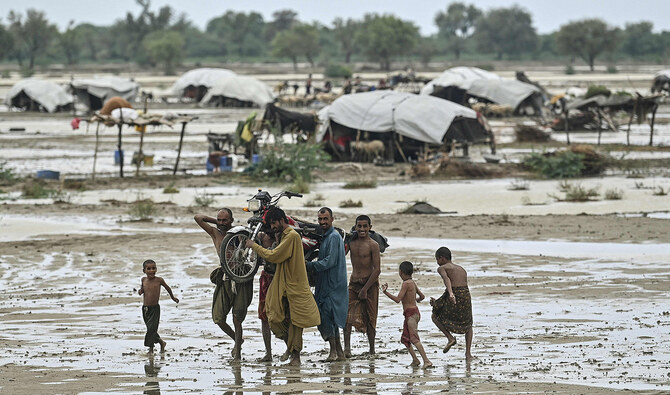
In this photograph taken on August 4, 2024, people carrying a motorcycle, walk across an agricultural land following rain in the aftermath of monsoon floods at Johi, Dadu district in Sindh province. (AFP/File)
Short Url
Updated 25 August 2024
Follow

Pakistan forecasts torrential monsoon rains till Aug. 29 as downpours kill 243 since July 

  • Met department warns of floods in low-lying areas of Sindh, Balochistan and Punjab
  • Pakistan is recognized as one of the most vulnerable countries to climate change effects

ISLAMABAD: The Pakistan Meteorological Department (PMD) this week forecast torrential rains in many parts of the country till Aug. 29, warning they could trigger flash floods and landslides as the nationwide death toll from rain-related incidents since July surged to 243. 

In a press release issued on Friday, the PMD said a low pressure located over west Bengal may approach southern parts of the country on Aug. 25 due to which strong monsoon currents are likely to enter the country, especially its southern parts, from Aug. 25.

“Pluvial flood/inundation may occur in low-lying areas of Sindh, Balochistan and southern Punjab,” the PMD said. 

As per the latest situation report released by the National Disaster Management Authority (NDMA), 243 people have been killed while 447 have been injured in rain-related incidents across the country from Jul. 1-Aug. 24. 

The PMD said it expects rain and thundershowers in Karachi, Hyderabad, Dadu, Thatta, Badin, Sajawal, Shahed Benazirabad, Jamshoro, Tando Allayar, Tando Muhammad Khan, Tharparkar, Nagarparkar, Mithi, Mirpur Khas, Umarkot, Matiari, Sanghar, Sukkur, Ghotki, Shikarpur, Kashmore, Khairpur, Larkana, Jacobabad and Nausheroferoze areas in Sindh from Aug. 25-29 with occasional gaps. 

Meanwhile, it said rain and thundershowers are also expected to take place in Islamabad/Rawalpindi, Murree, Galliyat, Attock, Chakwal, Tala Gang, Jhelum, Mandi Bahauddin, Gujrat, Gujranwala, Hafizabad, Wazirabad, Sahiwal, Jhang, Toba Tek Singh, Nankana Sahib, Chiniot, Faisalabad, Lahore, Sheikhupura, Sialkot, Narowal and Okara areas of Punjab from Aug. 25-28. 

From Aug. 26-30, it said rain and thundershowers are expected in Khuzdar, Kalat, Lasbella, Awaran, Naseerabad, Sibbi, Jaffarbad, Kohlu, Harnai, Dera Bugti, Zhob, Quetta, Ziarat, Sherani, Qila Abdullah, Qila Saifullah, Barkhan, Musa Khel, Loralai, Mastung, Bolan, Jhal Magsi, Kech, Panjgur, Gwadar, Jiwani, Pasni and Ormara in the southwestern Balochistan province. 

The weather department said that rains and thundershowers were also expected to take place in Chitral, Dir, Swat, Kohistan, Malakand, Shangla, Battagram, Buner, Kohat, Bajaur, Mohmand, Khyber, Mansehra, Abbottabad, Haripur, Peshawar, Swabi, Nowshera, Mardan, Charsadda, Hangu, Kurram, Orakzai, Waziristan, Bannu, Lakki Marwat and Dera Ismail Khan areas of the northwestern Khyber Pakhtunkhwa province from Aug. 26-28. 

Pakistan is recognized as one of the most vulnerable countries to climate change effects. This year, the South Asian country recorded its “wettest April since 1961,” with 59.3 millimeters of rainfall while some areas of the country faced a severe heat wave in May and June.
In 2022, unusually heavy rains triggered flash floods in many parts of Pakistan, killing over 1,700 people, inflicting losses of around $30 billion, and affecting at least 30 million people. Scientists have attributed Pakistan’s erratic weather patterns to climate change effects and called on countries around the world to take urgent steps to tackle the crisis.


Pakistan’s Engro executes $475 million Islamic financing deal to expand telecom infrastructure

Updated 6 sec ago
Follow

Pakistan’s Engro executes $475 million Islamic financing deal to expand telecom infrastructure

  • Islamic banking accounts for over a fifth of Pakistan’s banking assets amid a shift toward Shariah-compliant finance
  • The deal brings more than 10,000 telecom towers under Engro’s control, enabling their shared use by multiple operators

KARACHI: Pakistan’s largest conglomerate Engro Corp. has completed a Rs133 billion ($475 million) Islamic financing deal to acquire telecom tower company Deodar, expanding its telecom infrastructure business as the country seeks to strengthen digital connectivity, the company said on Friday.

The transaction, structured entirely through Shariah-compliant financing, brings more than 10,000 telecom towers under Engro’s control and marks one of the largest Islamic financing deals in Pakistan’s infrastructure sector.

Engro, which has major interests in energy, fertilizers, food and petrochemicals, said the acquisition would allow it to scale shared telecom infrastructure, under which a single tower can host multiple mobile network operators, lowering costs and reducing duplication as Pakistan prepares for next-generation digital services.

“My congratulations to the Dawood family and Engro, the Islamic bankers and conventional banks through their Islamic windows on being able to put together a deal of this size,” State Bank of Pakistan Governor Jameel Ahmed said at a ceremony marking the transaction, referring to the company and its chairman. “This is a great achievement which has been supported by the banks.”

The deal was supported by a group of local banks, including United Bank Limited and Meezan Bank, Engro said, highlighting the increasing role of Islamic financing in funding long-term investment in Pakistan.

Islamic banking, which operates without interest and is based on profit-and-loss sharing structures, accounts for more than a fifth of Pakistan’s banking assets, and authorities have said they aim to transition the financial system toward Shariah compliance over the coming years.

The acquisition of Deodar, which was originally carved out of mobile operator Jazz, also aligns with government efforts to digitize the economy by expanding broadband access and supporting digital payments, e-commerce and online public services, though progress has remained uneven due to infrastructure and regulatory challenges.