

Pakistan leaders wish Saudi King Salman well after hospital admission for tests

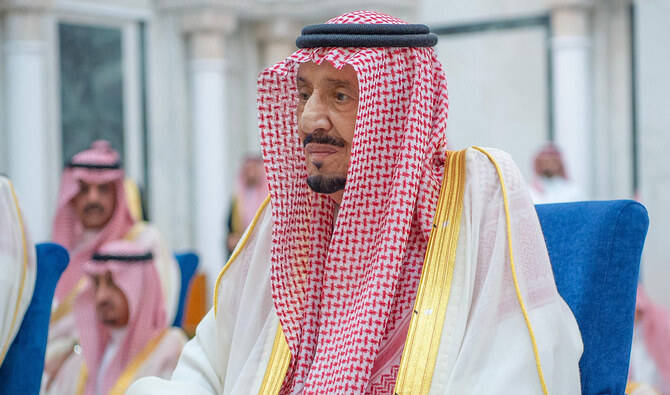
A handout picture provided by the Saudi Press Agency (SPA) shows Saudi King Salman bin Abdulaziz performing the Eid Al-Fitr prayer at the Grand Mosque in the holy city of Mecca on April 10, 2024. (AFP/File)
Short Url
Updated 16 January 2026
Follow

Pakistan leaders wish Saudi King Salman well after hospital admission for tests

  • Pakistani PM and President express concern, pray for the King's swift recovery
  • The official Saudi media has not shared the nature of the King’s visit to the hospital

ISLAMABAD: Pakistan’s prime minister and president on Friday expressed concern over the health of Saudi Arabia’s King Salman bin Abdulaziz, offering prayers and well wishes after state media said he had been admitted to hospital in Riyadh for medical examinations.

The Saudi Press Agency reported the King was undergoing medical tests at King Faisal Specialist Hospital in Riyadh, with no further information regarding the nature of the visit or his medical condition.

In a post on X, Prime Minister Shehbaz Sharif said Pakistanis held the Saudi King in high regard and were praying for his recovery.

“Deeply concerned by the news that Custodian of The Two Holy Mosques His Majesty King Salman bin Abdulaziz Al Saud is admitted in hospital for medical tests,” he said. “The people of Pakistan hold His Majesty in the highest esteem. We join our Saudi brothers and sisters in praying for His Majesty’s swift and complete recovery.”

President Asif Ali Zardari also conveyed his wishes, saying the entire Pakistani nation was praying for the Saudi King’s health and well-being, according to a statement issued by the presidency.

Pakistan has longstanding diplomatic and institutional ties with Saudi Arabia, and its leadership has consistently expressed deep respect for the Saudi royal family, particularly in view of the Kingdom’s religious significance and its role in the Muslim world.


Pakistan court-appointed lawyer flags concerns over Imran Khan’s eye condition in jail report

Updated 36 min 42 sec ago
Follow

Pakistan court-appointed lawyer flags concerns over Imran Khan’s eye condition in jail report

  • Amicus curiae recommends independent ophthalmology review “without delay”
  • PTI party says court-ordered exam vindicates concerns over medical access

ISLAMABAD: A court-appointed lawyer has recommended that jailed ex-premier Imran Khan undergo an independent and urgent ophthalmological examination, warning of the “gravity” of his deteriorating eye condition in a written report submitted to the Supreme Court and seen by Arab News on Thursday.

Barrister Salman Safdar, appointed as amicus curiae earlier this week, visited Khan at Rawalpindi’s Adiala jail and later filed a detailed report on his living conditions and health. The report states that in view of the seriousness of Khan’s ocular condition, “it is imperative that the seriousness of the condition be independently ascertained without delay.”

“The undersigned recommends that the Petitioner be examined at the earliest by a team of expert ophthalmologists,” the report said.

Concerns about Khan’s health have resurfaced in recent weeks after authorities confirmed he had been briefly taken from prison to a hospital in Islamabad for an eye procedure. The government said at the time his condition was stable, while Khan’s family and his Pakistan Tehreek-e-Insaf political party complained they had not been informed in advance and alleged he was being denied timely and independent medical access.

The issue was then taken up by the Supreme Court earlier this week, which appointed Safdar as a “friend of the court” to visit Khan in prison and submit a written report.

According to a medical condition report from the Pakistan Institute of Medical Sciences (PIMS), dated Feb. 6, 2026 and referenced in Safdar’s court filing, Khan was diagnosed with “right central retinal vein occlusion” after reporting reduced vision in his right eye.

The report states that he underwent anti-VEGF intravitreal injection treatment at PIMS and was discharged with follow-up advice.

However, in his interaction with Safdar, Khan said he had experienced “rapid and substantial loss of vision over the preceding three months” and claimed his complaints had not been addressed promptly while in custody. He further stated that despite treatment, he had been left with “only 15 percent vision in his right eye.”

Safdar’s report notes that the former premier appeared “visibly perturbed and deeply distressed by the loss of vision and the absence of timely and specialized medical intervention.”

The amicus also recommended that the Supreme Court consider directing involvement of Khan’s personal physicians or other specialists of his choice, warning that “any further delay poses a serious risk to the Petitioner’s well-being.”

LIVING CONDITIONS 

Beyond medical concerns, the report addressed Khan’s confinement conditions, noting that he expressed “satisfaction regarding his safety and security within the cell-block,” as well as contentment with basic amenities and food provisions.

However, Safdar flagged several areas requiring intervention, including: Independent medical reassessment of his eye condition; restoration of regular access to legal counsel; permission to meet blood relatives and communicate with his sons; and improved mosquito control and provision of a refrigerator for food storage.

The report also recorded that Khan has been in solitary confinement for approximately two years and four months.

PTI REACTION 

Following the submission of the report, Khan’s PTI party said on Thursday that the Supreme Court had ordered a full eye examination to be completed before Feb. 16.

“The Supreme Court’s order for a complete eye check-up of Imran Khan vindicates the party’s longstanding concerns about his deteriorating health and denial of timely, independent medical care in custody,” the party said in a statement.

“This is bigger than one medical test. It is about whether the rule of law applies to political opponents, or only to protect those in power,” it added, demanding “immediate and transparent implementation of the Court’s order” and “unrestricted access to qualified specialists of his choice.”

Khan, 73, has been in custody since August 2023 in connection with multiple cases that he and his party describe as politically motivated. The government denies the allegation.

There was no immediate response from the government on Thursday to the findings and recommendations contained in Safdar’s report.