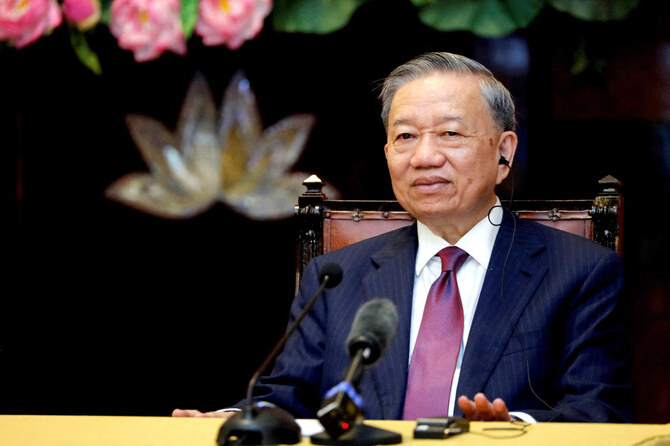
BEIJING: Vietnamese leader To Lam started a three-day visit to China on Sunday in his first overseas trip since assuming his country’s top post about two weeks ago.
Lam arrived in the morning in Guangzhou. an industrial and export hub near Hong Kong, Chinese state media reported. His agenda included visiting sites in the southern China city where former Vietnamese communist leader Ho Chi Minh spent time, the state-owned Global Times newspaper said in a social media post.
He is to meet with Chinese leader Xi Jinping and other senior officials during his trip.
Lam was confirmed as general secretary of Vietnam’s Communist Party, the top leadership position, on Aug. 3. He also has held the largely ceremonial title of the nation’s president since May. Lam succeeded Nguyen Phu Trong, who died on July 19 after 13 years as general secretary.
The new leader is expected to continue his predecessor’s strategy of balancing ties with China, the United States and Russia, Yu Xiangdong, the director of the Institute for Vietnam Studies at China’s Zhengzhou University, wrote Saturday in the Global Times.
“The fact that Lam chose China as his first overseas visit destination since taking office is a sign that Vietnam attaches great importance to its relations with China,” Yu said in an opinion piece. “But at the same time, judging from experience, the country is not by any means going to give the US the cold shoulder.”
Though they have long ties as one-party communist states, Vietnam and China have sparred repeatedly over territory that both claim in the South China Sea. A Vietnamese coast guard ship recently took part in joint drills in the Philippines, which has had a series of violent encounters with China over disputed territory in the same waters.
China also briefly invaded parts of northern Vietnam in 1979.
Still, Vietnam has benefited economically from investment by Chinese manufacturers, which have moved production to the Southeast Asian country in part to skirt US restrictions on solar panels and other exports from China.


![]()

Vietnam’s new leader arrives in China on his first overseas trip
Short Url
https://arab.news/9fctz
Vietnam’s new leader arrives in China on his first overseas trip
- His agenda included visiting sites in the southern China city where former Vietnamese communist leader Ho Chi Minh spent time
- He is to meet with Chinese leader Xi Jinping and other senior officials during his trip


Latest updates




© 2026 SAUDI RESEARCH & PUBLISHING COMPANY, All Rights Reserved And subject to Terms of Use Agreement.