

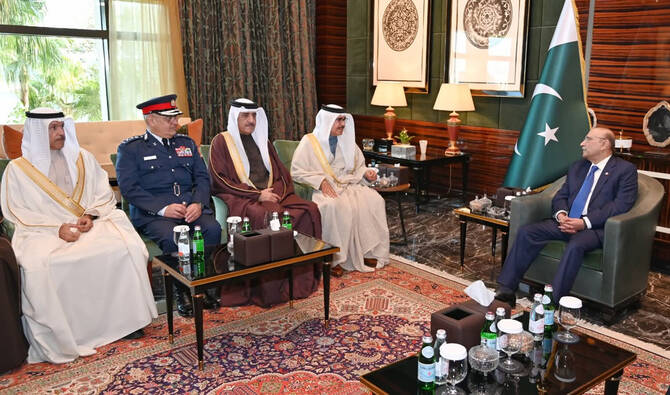
Pakistan, Bahrain step up cooperation against drugs, security threats

Short Url
Updated 15 January 2026
Follow

Pakistan, Bahrain step up cooperation against drugs, security threats

  • Decision taken during President Zardari’s meeting with Bahrain interior minister
  • Pakistan and Bahrain maintain close diplomatic, defense, trade and labor ties

ISLAMABAD: Pakistan and Bahrain agreed to enhance counterterrorism and counternarcotics cooperation in talks between President Asif Ali Zardari and Bahrain Interior Minister Lt Gen Shaikh Rashid bin Abdullah Al Khalifa on Thursday, said an official statement.

The Pakistani president is on a four-day visit to the Gulf country where he met King Hamad bin Isa Al Khalifa a day earlier, with both sides emphasizing closer trade, investment and security collaboration.

Zardari's visit follows Pakistan Interior Minister Mohsin Naqvi's meeting with Al Khalifa in November in which they discussed regional security, law-enforcement and intelligence sharing.

"Both leaders reaffirmed their commitment to deepening collaboration on shared security priorities and agreed to pursue coordinated efforts against threats posed by organized crime, illicit drugs and terrorism," the Presidential Secretariat said in a statement circulated after the meeting in Manama.

"The meeting focused on enhancing bilateral cooperation in security, counternarcotics measures and counterterrorism."

Pakistan and Bahrain maintain close diplomatic, defense and labor ties.

More than 116,000 Pakistanis live in Bahrain, forming one of the kingdom’s largest South Asian communities.

Pakistan has in recent years intensified outreach to Gulf states, viewing closer economic and security ties as central to its long-term stability and reform agenda.


Pakistan stocks fall amid Afghanistan tensions, recover from intraday lows

Updated 4 sec ago
Follow

Pakistan stocks fall amid Afghanistan tensions, recover from intraday lows

  • Index drops as much as 3,081 points before paring losses after no retaliation reported from Kabul
  • Banking and energy stocks drag benchmark lower as regional tensions weigh on investor sentiment 

ISLAMABAD: Pakistan’s benchmark KSE-100 index fell on Friday amid escalating tensions with Afghanistan as Pakistan bombed government targets in Kabul and Kandahar where the Afghan Taliban leadership is based, triggering early selling pressure before the market recovered from sharp intraday losses.

The strikes marked a significant escalation in cross-border tensions between Islamabad and Kabul, raising concerns about potential retaliation and broader regional instability. The development comes at a time when relations between the two sides have been strained for months over security issues along the border and militant attacks in Pakistan that it blames on Afghan-based groups. Kabul denies it harbors such outfits. 

Heightened geopolitical risk tends to weigh on investor sentiment, particularly in emerging markets, as uncertainty over security and diplomatic fallout can prompt risk-off positioning and capital outflows. Traders said investors reacted swiftly to the headlines, pricing in the possibility of further escalation.

“KSE 100 Index opened on a negative note and declined to make an intraday low of -3,081 points (down by -1.82 percent), this negativity can be accredited to regional tension with Afghanistan, where Pakistan targeted key military installation of Afghanistan Taliban regime in Kabul,” brokerage house Topline Securities said in its market review.

The index dropped as much as 3,081 points, or 1.82 percent, during the session before recovering part of the losses after no retaliatory strikes were reported.

It settled at 168,062 points, down 0.49 percent on the day.

Losses were led by United Bank Limited, Fauji Fertilizer Company, Oil and Gas Development Company, Pakistan Petroleum Limited and MCB Bank Limited, which together shaved 658 points off the index.

National Bank of Pakistan, MCB Bank, Pakistan Petroleum Limited, Bank of Punjab and Bank Alfalah led trading by value.

Traded volume and value for the day stood at 533 million shares and 25.5 billion respectively.

Separately, a brokerage house said Pakistan’s headline inflation is likely to rise to around 7.4 percent in February ahead of the State Bank of Pakistan’s March 9 monetary policy meeting.

“Headline inflation is estimated at ~7.4 percent for Feb’26, compared to ~1.5 percent in SPLY and ~5.8 percent in preceding month,” Insight Research said. “The increase in mainly driven by low base effect.”