MANILA: The Philippines sought to assure China on Friday that the presence of a US intermediate range missile system on its territory posed no threat to China and would not be a destabilizing factor in the region.
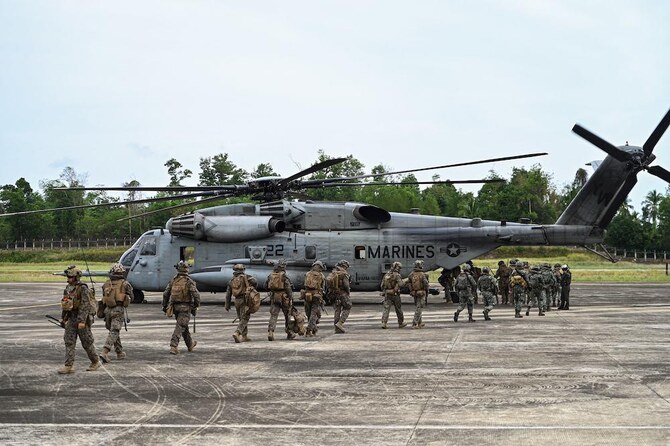
The US deployed its missile system to the Philippines in April as part of the two countries’ joint military drills, the first time it has set up the system in the Indo-Pacific region.
Foreign Affairs Secretary Enrique Manalo said on Friday that Chinese Foreign Minister Wang Yi raised concerns over the missile system’s presence which the Beijing official described as “destabilizing” in bilateral talks in Laos on the sidelines of ASEAN meetings.
Manalo assured Wang that the presence of the system was non-threatening, however.
“He (Wang) said it could be destabilizing, the presence, and I said ‘No, they’re not destabilizing’,” Manalo told a forum with foreign correspondents.
“I believe that (the) particular missiles he’s referring to are only there temporarily,” he added.
Wang had warned that the deployment of the US intermediate-range missile system could fuel regional tensions and lead to an arms race.
The Typhon missile system, capable of firing Tomahawk land attack and SM-6 missiles, was not fired during the drills, but the Philippines said it was shipped to test the feasibility of transporting the 40-tonne weapon system by air.
Security engagements between the Philippines and its treaty ally the United States have intensified as both nations seek to counter what they see as China’s aggressive actions in the South China Sea and near Taiwan.
Tension between China and the Philippines has increased, in particular over disputed territories in the South China Sea.
Last week, the Philippines accused China’s air force of carrying out dangerous maneuvers over the contested Scarborough Shoal. China maintains its aircraft operated lawfully and professionally.
The air incident came after Manila and Beijing have agreed to better manage maritime disputes.
Manalo also said he hoped that China would honor its provisional arrangement with Manila over the latter’s resupply missions to a beached vessel at another contested spot, the Second Thomas Shoal.
Asked whether that arrangement could be replicated in other contested parts of the South China Sea, Manalo said it would depend on the situation.
China has claimed most of the South China Sea as its territory, including the Scarborough and Second Thomas Shoals.
It rejects a 2016 ruling by the Permanent Court of Arbitration in The Hague that Beijing’s expansive claims in the South China Sea had no basis under international law.


![]()

Philippines seeks to assure China missile system deployment not a destabilizing factor
Short Url
https://arab.news/pystd
Philippines seeks to assure China missile system deployment not a destabilizing factor
- The US deployed its missile system to the Philippines in April as part of the two countries’ joint military drills
- The Typhon missile system, capable of firing Tomahawk land attack and SM-6 missiles, was not fired during the drills


Latest updates


© 2026 SAUDI RESEARCH & PUBLISHING COMPANY, All Rights Reserved And subject to Terms of Use Agreement.