

Pakistan opens real-time digital payment system to exchange companies as reserves edge up

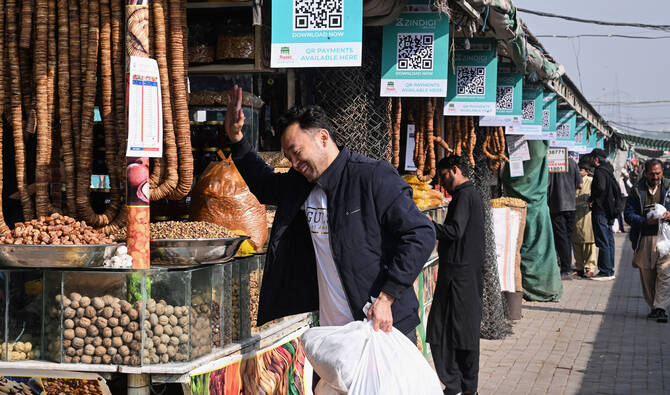
A customer reacts as digital cashless payment QR (quick response) codes are displayed at a market in Islamabad on November 25, 2025. (AFP/File)
Short Url
Updated 15 January 2026
Follow

Pakistan opens real-time digital payment system to exchange companies as reserves edge up

  • Raast enables low-cost transfers between banks, microfinance firms and electronic money wallets
  • Pakistan’s overall foreign reserves stand at $21.25 billion as central bank holdings rise $16 million

KARACHI: Pakistan’s central bank on Thursday allowed exchange companies to route home remittances through its instant payment system, Raast, saying the move aims to promote digital transactions and improve the efficiency of inflows, as the country’s foreign exchange reserves rose modestly in the latest week.

The State Bank of Pakistan (SBP) said in a statement that the country's total liquid foreign reserves stood at $21.25 billion as of Jan. 9, while the central bank’s own reserves rose $16 million to $16.07 billion.

The statement said the decision to extend Raast to exchange companies forms part of the central bank’s broader push to strengthen digital payments infrastructure and support a shift toward a cashless economy.

“Building an innovative and inclusive digital financial services ecosystem is one of the key objectives of State Bank of Pakistan under its Strategic Plan 2023-2028,” the SBP said.

“In furtherance of this vision, SBP has now allowed Exchange Companies (ECs) to utilize ‘Raast,’ a state-of-the-art payment system launched by SBP in 2021, to facilitate remitters and beneficiaries of home remittances,” it added.

Raast, a real-time digital payment system, allows instant and low-cost transfers between banks, microfinance institutions and electronic money wallets.

“Through this enablement, the beneficiaries receiving remittances through ECs can receive their funds in their accounts and wallets ... in a safe and efficient manner,” the statement said.

Pakistan relies heavily on workers’ remittances from abroad and has been seeking to channel more inflows through formal banking systems by strengthening digital and regulated payment networks, as authorities try to curb informal mechanisms such as hawala and hundi, underground value transfer systems that move money outside the banking sector.


Pakistan leaders wish Saudi King Salman well after hospital admission for tests

Updated 16 January 2026
Follow

Pakistan leaders wish Saudi King Salman well after hospital admission for tests

  • Pakistani PM and President express concern, pray for the King's swift recovery
  • The official Saudi media has not shared the nature of the King’s visit to the hospital

ISLAMABAD: Pakistan’s prime minister and president on Friday expressed concern over the health of Saudi Arabia’s King Salman bin Abdulaziz, offering prayers and well wishes after state media said he had been admitted to hospital in Riyadh for medical examinations.

The Saudi Press Agency reported the King was undergoing medical tests at King Faisal Specialist Hospital in Riyadh, with no further information regarding the nature of the visit or his medical condition.

In a post on X, Prime Minister Shehbaz Sharif said Pakistanis held the Saudi King in high regard and were praying for his recovery.

“Deeply concerned by the news that Custodian of The Two Holy Mosques His Majesty King Salman bin Abdulaziz Al Saud is admitted in hospital for medical tests,” he said. “The people of Pakistan hold His Majesty in the highest esteem. We join our Saudi brothers and sisters in praying for His Majesty’s swift and complete recovery.”

President Asif Ali Zardari also conveyed his wishes, saying the entire Pakistani nation was praying for the Saudi King’s health and well-being, according to a statement issued by the presidency.

Pakistan has longstanding diplomatic and institutional ties with Saudi Arabia, and its leadership has consistently expressed deep respect for the Saudi royal family, particularly in view of the Kingdom’s religious significance and its role in the Muslim world.