Polish leader urges Nord Stream patrons to ‘keep quiet’ as pipeline mystery returns to spotlight

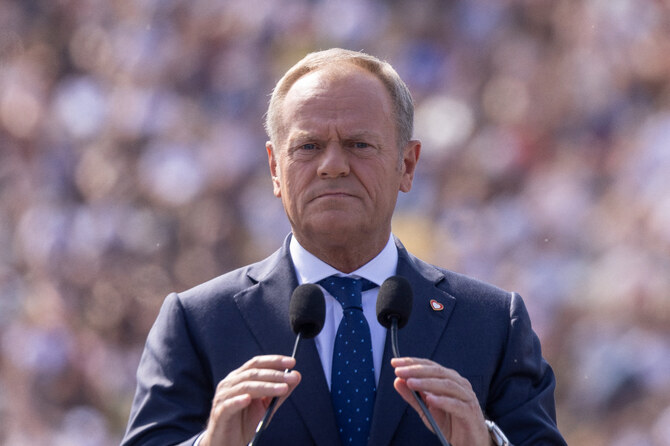
Poland's Prime Minister Donald Tusk. (AFP)
Short Url
Updated 18 August 2024
Follow

Polish leader urges Nord Stream patrons to ‘keep quiet’ as pipeline mystery returns to spotlight

  • Prime Minister Tusk was reacting to a claim by a former German official that the sabotage of the Nord Stream gas pipelines must have had Poland’s support
  • Germany built the pipelines to carry gas from Russia to Europe along the Baltic Sea bed despite opposition from Poland, the US and Ukraine

WARSAW, Poland: Polish Prime Minister Donald Tusk on Saturday reacted to reports that revived questions about who blew up the Nord Stream pipelines in 2022, saying the initiators of the gas pipeline project should “apologize and keep quiet.” That comment came after one of his deputies denied a claim that Warsaw was partly responsible for its damage.
The Wall Street Journal reported on Thursday that Ukrainian authorities were responsible for blowing up the Nord Stream 1 and 2 pipelines in September 2022, a dramatic act of sabotage that cut Germany off from a key source of energy and worsened an energy crisis in Europe.
Germany was a partner with Russia in the pipeline project. Poland has long said its own security interests have been harmed by Nord Stream.
“To all the initiators and patrons of Nord Stream 1 and 2. The only thing you should do today about it is apologize and keep quiet,” Tusk wrote on the social media portal X Saturday.

Tusk appeared to be reacting specifically to a claim by a former head of Germany’s foreign intelligence agency, BND, August Hanning, who told the German daily Die Welt that the attack on the Nord Stream gas pipelines must have had Poland’s support. Hanning said Germany should consider seeking compensation from Poland and Ukraine.

Hanning, who retired from his spy chief job, did not provide any evidence in support of his claim. Some observers noted that he served under former German Chancellor Gerhard Schroeder, who went on to work later for Russian state-owned energy companies, including Nord Stream.
Krzysztof Gawkowski, a deputy Polish prime minister and the minister of digital affairs, strongly denied reports that Poland and Ukraine had damaged the Nord Stream gas pipeline in an interview Friday on the Polsat broadcaster.
Gawkowski alleged that the comments of the former member of the German intelligence service were “inspired by Moscow” and were aimed at destabilizing NATO countries.
“I believe that this is the sound of Russian disinformation,” he added.
On Wednesday, Polish prosecutors confirmed that they had received a warrant for a Ukrainian man wanted by Germany as a suspect in the pipeline attack, but that he left the country before he could be arrested.
The Nord Stream project, with its two pipelines created to carry gas from Russia to Europe along the Baltic Sea bed, went ahead despite opposition from Poland, the US and Ukraine.
They allowed Russia to send gas directly to Western Europe, bypassing Poland and Ukraine. With all gas previously going over land, Warsaw and Kyiv feared losing huge sums in transit fees and political leverage that came with controlling the gas transports.
The Wall Street Journal said in its report published Thursday that it spoke to four senior Ukrainian defense and security officials who either participated in or had direct knowledge of the plot. All of them said the pipelines were a legitimate target in Ukraine’s war of defense against Russia. Ukrainian authorities are denying the claims.
Nord Stream 1 was completed and came online in 2011. Nord Stream 2 was not finished until the fall of 2021 but never became operational due to Russia’s full-scale invasion of Ukraine in February 2022.


Starmer arrives in China to defend ‘pragmatic’ partnership

Updated 4 sec ago
Follow

Starmer arrives in China to defend ‘pragmatic’ partnership

  • British Prime Minister Keir Starmer arrived in Beijing on Wednesday to meet with Chinese leader Xi Jinping, hoping to restore long fraught relations

BEIJING: British Prime Minister Keir Starmer arrived in Beijing on Wednesday to meet with Chinese leader Xi Jinping, hoping to restore long fraught relations.
It is the first visit to China by a UK prime minister since 2018 and follows a string of Western leaders courting Beijing in recent weeks, pivoting from a mercurial United States.
Starmer, who is also expected to visit Shanghai on Friday, will later make a brief stop in Japan to meet with Prime Minister Sanae Takaichi.
For Xi, the trip is an opportunity to show Beijing can be a reliable partner at a time when President Donald Trump’s policies have rattled historic ties between Washington and its Western allies.
Starmer is battling record low popularity polls and hopes the visit can boost Britain’s beleaguered economy.
The trip has been lauded by Downing Street as a chance to boost trade and investment ties while raising thorny issues such as national security and human rights.
Starmer will meet with Xi for lunch on Thursday, followed by a meeting with Premier Li Qiang.
The British leader said on Wednesday this visit to China was “going to be a really important trip for us,” vowing to make “some real progress.”
There are “opportunities” to deepen bilateral relations, Starmer told reporters traveling with him on the plane to China.
“It doesn’t make sense to stick our head in the ground and bury in the sand when it comes to China, it’s in our interests to engage and not compromise on national security,” he added.
China, for its part, “is willing to take this visit as an opportunity to enhance political mutual trust,” foreign ministry spokesman Guo Jiakun reiterated Wednesday during a news briefing.
Starmer is the latest Western leader to be hosted by Beijing in recent months, following visits by Canadian Prime Minister Mark Carney and French President Emmanuel Macron.
Faced with Trump’s threats to impose tariffs on Canada for signing a trade agreement with China, and the US president’s attempts to create a new international institution with his “Board of Peace,” Beijing has been affirming its support for the United Nations to visiting leaders.
Reset ties 
UK-China relations plummeted in 2020 after Beijing imposed a sweeping national security law on Hong Kong, which severely curtailed freedoms in the former British colony.
They soured further since with both powers exchanging accusations of spying.
Starmer, however, was quick to deny fresh claims of Chinese spying after the Telegraph newspaper reported Monday that China had hacked the mobile phones of senior officials in Downing Street for several years.
“There’s no evidence of that. We’ve got robust schemes, security measures in place as you’d expect,” he told reporters on Wednesday.
Since taking the helm in 2024, Starmer has been at pains to reset ties with the world’s second-largest economy and Britain’s third-biggest trade partner.
In China, he will be accompanied by around 60 business leaders from the finance, pharmaceutical, automobile and other sectors, and cultural representatives as he tries to balance attracting vital investment and appearing firm on national security concerns.
The Labour leader also spoke to Xi on the sidelines of the G20 summit in Brazil in November 2024.
Jimmy Lai
The prime minister is also expected to raise the case of Hong Kong media mogul and democracy supporter Jimmy Lai, 78, a British national facing years in prison after being found guilty of collusion charges in December.
When asked by reporters about his plans to discuss Lai’s case, Starmer avoided specifics, but said engaging with Beijing was to ensure that “issues where we disagree can be discussed.”
“You know my practice, which is to raise issues that need to be raised,” added Starmer, who has been accused by the Conservative opposition of being too soft in his approach to Beijing.
Reporters Without Borders urged Starmer in a letter to secure Lai’s release during his visit.
The British government has also faced fierce domestic opposition after it approved this month contentious plans for a new Chinese mega-embassy in London, which critics say could be used to spy on and harass dissidents.
At the end of last year, Starmer acknowledged that China posed a “national security threat” to the UK, drawing flak from Chinese officials.
The countries also disagree on key issues including China’s close ties with Russian President Vladimir Putin amid the war in Ukraine, and accusations of human rights abuses in China.