



KARACHI: Muhammad Afzal was petrified as he watched his house burn to the ground in the Karol Bagh neighborhood of Delhi, the capital of present-day India.
Six years old at the time, Afzal and his family quickly piled into a tonga arranged by a Sikh member of staff to escort them to safety as riots broke out ahead of the partition of the Indian Subcontinent on August 14, 1947.
Britain’s carving out new nations by splitting United India into two as its empire ebbed after World War Two triggered mass sectarian migration in both directions, marred by bloodshed and violence on both sides. About 15 million people changed countries, mainly based on religion, and more than a million were killed in religious riots in the 1947 partition, according to independent estimates.
Afzal, now an 83-year-old businessman in Karachi, is still haunted by the violence, and recalled that the tonga was barely 50 yards away when the rioters entered his family’s house.
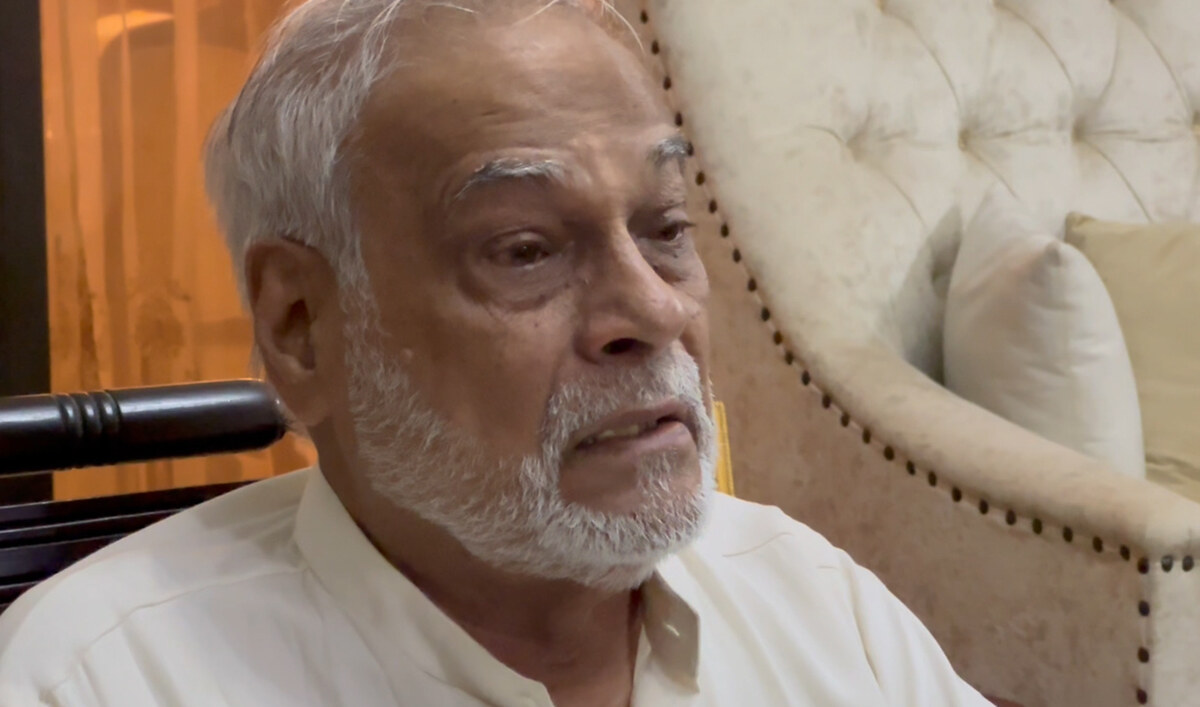
Muhammad Afzal, an 83-year-old businessman, speaks during an interview with Arab News in Karachi on August 12, 2024. (AN Photo)
“It was a matter of just a few moments, otherwise who knows what would have happened to us,” Afzal told Arab News, remembering the day his family started their journey for Pakistan. “We only managed to grab one box, I don’t know what was inside it.”
The Sikh staff member dropped the the family to a fort-like building in Delhi where hundreds of others who had chosen to leave India for Pakistan were staying.
“There was no drinking water, no washroom, and no food. After two or three days, they gave us boiled chickpeas,” he said. “We somehow passed those days.”
The family’s next stop was the Palam airport in Delhi, where they took shelter for two days under the wings of a plane on the tarmac.
“My father was in the armed forces, on the civilian side. [He] was not allowed to come with us. My sister, I, my mother, uncle and grandmother were put on the plane,” Afzal said.
“On the plane, we were given cooked chickpeas to eat. My brother and I were ... so excited eating those because the hunger from the camp was still fresh.”
Afzal and his family landed in Karachi where they were taken to a refugee camp. His father joined the family a few days later, bringing along fresh stories of horror that unfolded on his way to Lahore from Delhi via train.
“According to him, he [father] drank stagnant, dirty water along the way. He was sitting on top of the compartment on a train and saw people being killed all around him,” the octogenarian said. “But as Allah would have it, no one could harm him, and somehow, the train reached Lahore.”
Muhammad Khizar Farooqui, a 91-year-old retired government official, had his own stories to share of the partition, when he choose to stay back in his hometown of Banaras in India’s Uttar Pradesh state, eventually joining his relatives in Karachi in 1954.
While the worst of the violence had subsided by then, the fear of communal clashes persisted for years after 1947, finally convincing Farooqui to migrate to Pakistan in 1954 as his parents and sister stayed behind. He returned to Banaras after his father’s death in 1964 to bring his mother and sister to Pakistan, and sold his house there.
Speaking to Arab News, Farooqui said more than the violence, he remembered the small kindnesses of his Hindu and Sikh friends and neighbors. One Hindu neighbor urged him not to sell all his property in Banaras with the hope that he would return one day.
Farooqui said he regretted not taking the advice.
“He [Hindu neighbor] said this with so much kindness when I was signing the papers in the registrar’s office [for the transfer of property in Banaras], it felt like the ground was slipping from underneath my feet,” he remembered. “I realized he was right. Now I couldn’t go back.”
Afzal too regrets not ever having been able to return to Delhi, largely because of his father’s job in the army.
“When I see pictures and videos brought back by some of our relatives who went there [Delhi], I feel happy seeing them. I know that the Hindus in the area where we lived were not hostile to us at all. In fact, they were very polite and so were the Sikhs there,” he said.
“It was the Sikhs and Hindus who saved us.”


