

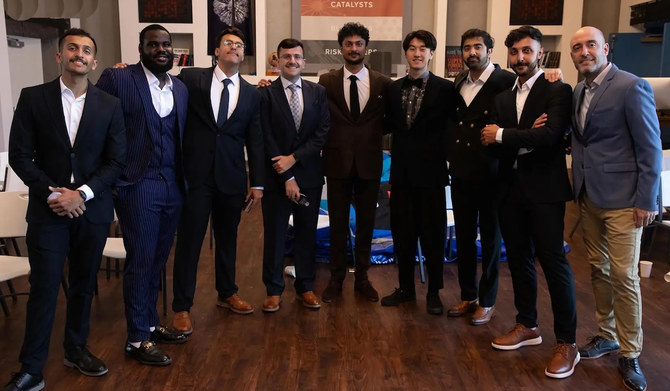
SDAIA concludes training programs for datathon winners in US, UK

The SDAIA said it concluded specialized training programs in the US and UK for the top-two-ranked teams of the Open Data Datathon. (SPA)
Short Url
Updated 10 August 2024
Follow

SDAIA concludes training programs for datathon winners in US, UK

  • Winners received training at Draper University in California, London Business School

RIYADH: The Saudi Data and Artificial Intelligence Authority said on Saturday that it had successfully concluded specialized training programs in the US and UK for the top-two-ranked teams of the Open Data Datathon.

The datathon was held in October last year in Riyadh.

The initiative aims to enhance the knowledge and skills of those excelling in data and artificial intelligence, equipping them with expertise from leading international institutions, the Saudi Press Agency reported.

The first-place team, Traffix AI, received a grant of SR250,000 ($66,600) for participating in the Hero Training Program at Draper University in California.

During the program, the team gained essential skills for launching successful business ventures, developed innovative ideas, and networked with experts and entrepreneurs.

Their project, which predicted damage and error rates in vehicle accidents using data such as images and damage locations, earned them chance to compete at the datathon.

The system aims to improve the identification of liability in traffic accidents and reduce congestion.

The second-placed team, Team 2030, received a grant of SR150,000 for attending the Data Science for Competitive Advantage training program at London Business School.

This program focused on advancing their projects in data and AI, identifying challenges, and discovering data science-based solutions.

Their project developed a system that used driver image data to detect early signs of fatigue, such as eye closure, providing alerts to prevent driving while drowsy and enhancing road safety.

The datathon brought together more than 200 contestants from countries including Saudi Arabia, Pakistan, Yemen, Egypt, Palestine, Bangladesh, Syria, Algeria and Nigeria. The event featured workshops and mentorship sessions with local and international experts to help participants develop solutions using open data.

The initiative is part of SDAIA’s broader efforts to build national capabilities in data and AI, aligning with the goals of Saudi Vision 2030. The authority aims to empower young Saudi talent to excel in these fields, enabling them to compete globally and lead in the technologies of the present and future.


Young photographer highlights Qatif’s natural springs

Updated 8 sec ago
Follow

Young photographer highlights Qatif’s natural springs

RIYADH: Young photographer Redha Al-Hammad is documenting the fading natural springs of Qatif, a landscape shaped by water for thousands of years, before their stories disappear.

His new project, “O Breaker of the Louz,” captures the cultural memory surrounding the springs that once sustained one of the oldest settlements in the Arabian Peninsula.

Alhammad, a 20-year-old visual artist from Qatif and student at the American University of Sharjah, developed the project to preserve his hometown’s identity and share its untold narratives.

Qatif’s springs once fueled its agricultural prosperity, nourished date-palm droves, supported early communities, and served as fathering spaces for trade, social life and storytelling. Today, only one spring — Ayn Al-Labbani — still flows.

With limited written research available, Al-Hammad relied on oral histories from relatives and community elders.

“The good thing about being from a small city is that everyone knows everyone,” he told Arab News. “The stories that we hear … that our parents and our older family members tell us … a lot of the time they can kind of … get drowned out.”

One of his key sources was Abdulrasul Al-Gheryafi, an English teacher and local historian who grew up swimming in the springs and has long studied their disappearance. His firsthand accounts shaped the project and provided the folktale that inspired its title.

Al-Hammad began photographing at Ayn Al-Labbani, where locals still gather. He initially “had no idea” what the work would become until Al-Gheryafi shared the tale of a knight who encountered a mysterious voice while at a spring. The project became centered on the idea that springs are more than water sources; they are magical spaces embedded with communal memory and identity.

Al-Hammad wrote a poem based on the story to accompany the images and express what photography alone could not.

What started out as field notes for his research naturally formed as poetic lines, which luckily earned the seal of approval from poet, friend and collaborator Dalia Mustafa.

“Seeing her develop as a writer as well, that helped me come to terms with what poetry could be within the context of photographic work,” he said.

The project blends documentary photography with lyrical elements, a technique Al-Hammad first explored in “Mahanet” (“Did you not yearn for me?”), created with Mustafa during the Jameel Arts Centre Youth Assembly.

Told through low-contrast, dreamlike images, “Mahanet” maps memories, grief and changing landscapes in Qatif.

“I kind of recreated this experience that I had with my dad whenever I would go back home and he would drive me around,” Al-Hammad said, recounting how his father would explain how a sea once existed where there is now a residential area, or which streets were once fields of palm trees.

His second project, “L3eeb” (“Player”), developed under the Kingdom Photography Award, examines the role of football in transforming overlooked spaces into communal “third spaces” for Saudi youth.

Al-Hammad was mentored by photographer, visual artist and photo book publisher Roi Saade, whose guidance he describes as invaluable: “It fit perfectly, the pairing, because he works in kind of the same realm of narrative-based work. And he was with me every step of the way.

“The Kingdom Photography Award program is very important for people like me who are at the early stages of their artistic journey and have something to say, would definitely benefit from having a platform and … the kind of guidance and mentorship that the professionals around me provided.”

All Al-Hammad’s work centers on his hometown, Qatif. Initially, his photography was personal, helping him reconnect with home after years abroad. Over time, he expanded his focus to share Qatif’s culture and heritage with wider audiences, emphasizing the region has as rich and vibrant a voice as other parts of the Kingdom. 

Al-Hammad and Mustafa plan to turn “Mahanet” into a book next year, continuing their collaboration. 

Citing Saudi Arabia’s rich cultural diversity, Al-Hammad hopes similar opportunities expand to other artistic mediums. Through his work, he seeks to inspire others to document their communities, preserve local heritage and contribute to a broader understanding of the Kingdom’s identity.