

Pakistan moves to digitize payments for 10 million women under flagship poverty initiative

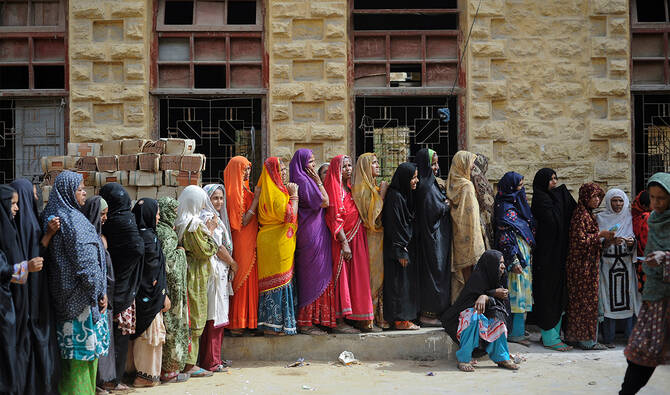
Women line up to receive money from a charity organization, Benazir Income Support Program, at an assistance center setup at a local school building in Karachi on March 5, 2012. (REUTERS/ file)
Short Url
Updated 10 December 2025
Follow

Pakistan moves to digitize payments for 10 million women under flagship poverty initiative

  • BISP Official says accounts will be linked to phones to boost financial inclusion and curb payment deductions
  • Over 1.9 million SIMs issued as the nationwide rollout continues across provinces ahead of the March deadline

ISLAMABAD: Pakistan’s flagship poverty alleviation initiative, the Benazir Income Support Program (BISP), plans to equip 10 million women with digital bank accounts linked to their phone numbers within four months in one of the largest such exercises in the world, one of its top officials said on Wednesday.

Launched in 2008, the initiative is named after the late former prime minister Benazir Bhutto and has a budget of Rs716 billion ($2.5 billion) during the current fiscal year. Through its Benazir Kafaalat — or financial assistance — program, BISP provides quarterly stipends of Rs13,500 ($48) to around 10 million women.

In an exclusive interview with Arab News, BISP Secretary Amir Ali Ahmed said the opening of digital bank accounts for the beneficiaries was part of Prime Minister Shehbaz Sharif’s initiative related to a cashless economy and digital transformation of the country.

“I’m glad to share that 10 million bank accounts, wallet accounts were created,” he said. “This is a follow-up of the same exercise whereby now 10 million SIMs are being distributed.

“It is significant to share that the entire beneficiary network that we have is female-centric,” he continued. “So these are 10 million female accounts that have been created.”

Ahmed said the process of issuing mobile phone SIM cards to BISP beneficiaries had started on November 17 and would be completed by March next year.

“Let me share that this is one of the largest such exercises to be conducted in the world which is female-centric, linked with financial inclusion and financial empowerment.”

The BISP official added that out of the more than 10 million beneficiaries, only five to 10 percent had bank accounts, but nearly 90 to 95 percent were excluded from the system.

He said they were being linked to the banking system with cellphone SIMs that are being distributed with the help of the IT ministry, Pakistan Telecommunication Authority, National Database and Registration Authority and telecom companies across the country.

“We feel that this initiative of the government of Pakistan will not only result in financial empowerment of our beneficiaries, it will also result in financial inclusion of a segment which was not part of the banking sector in Pakistan,” he said, adding that the move will also lead to transparency.

In the past, there have been complaints of women not getting their full payment from bank officials in the absence of their own accounts, but Ahmed said this was going to change.

“They will be free from any exploitation at the agent networks, the queues that one would witness, the complaints of corruption or deductions that would emerge,” he continued.

According to official data, more than 1.9 million SIMs have so far been issued for BISP beneficiaries across the country.

The province of Punjab leads the rollout with 810,597 SIMs, followed by Sindh with 523,629 and Khyber Pakhtunkhwa with 371,427 SIMs.

In other regions, Azad Jammu and Kashmir has received 59,617, Balochistan 82,826, Gilgit-Baltistan 45,184, and Islamabad 4,508 SIMs.


Pakistan engages Saudi Arabia, China in bid to ease surging Middle East tensions 

Updated 10 March 2026
Follow

Pakistan engages Saudi Arabia, China in bid to ease surging Middle East tensions 

  • Pakistan’s foreign minister stresses need for de-escalation in conversations with Chinese, Saudi counterparts
  • Tensions in the Middle East continue to remain high as conflict between US, Israel and Iran intensifies

ISLAMABAD: Pakistan’s Deputy Prime Minister Ishaq Dar spoke to the foreign ministers of Saudi Arabia and China on Tuesday, stressing the importance of diplomatic engagement to de-escalate tensions in the Middle East as the Iran war intensifies. 

Pakistan has constantly engaged regional countries in efforts to broker a ceasefire in the Middle East, after the US and Isreal launched coordinated strikes against Iran on Feb. 28. 

Iran launched fresh attacks on Gulf countries on Tuesday morning, where it has targeted US military bases in recent weeks. In addition to firing missiles and drones at Israel and American bases in the region, Iran has also been targeting energy infrastructure which, combined with its stranglehold on the Strait of Hormuz, has sent oil prices soaring worldwide. 

Dar spoke to Saudi Foreign Minister Prince Faisal bin Farhan to discuss developments in the Middle East and ongoing deliberations at the UN Security Council, Pakistan’s foreign office said in a statement. 

“DPM/FM shared Pakistan’s perspective, underscoring the importance of continued coordination and diplomatic engagement to support de-escalation and promote peace and stability across the region and beyond,” the statement said. 

Dar, who also serves as Pakistan’s foreign minister, spoke to Chinese foreign minister Wang Yi over the telephone separately. The two discussed the evolving regional situation and broader global developments.

Dar underscored the need to ease tensions in the Middle East and the wider region during the conversation, the foreign office said. 

Yi appreciated Pakistan’s constructive efforts aimed at promoting de-escalation and stability in the region, it added. 

“The two leaders stressed the importance of de-escalation and emphasized the need to pursue dialogue and diplomacy in accordance with the principles of the UN Charter,” the foreign office’s statement said. 

The conflict in the Middle East has hit Pakistan hard as well, forcing Islamabad to hike petrol and diesel prices by Rs55 per liter last Friday. 

Pakistan’s government has also announced a set of austerity measures, which include closing schools and cutting down on government expenditures, as it evaluates petrol stocks and looks for alternative supply routes.