

Royal reserve launches satellite tracking of endangered Red Sea turtles

1 / 7
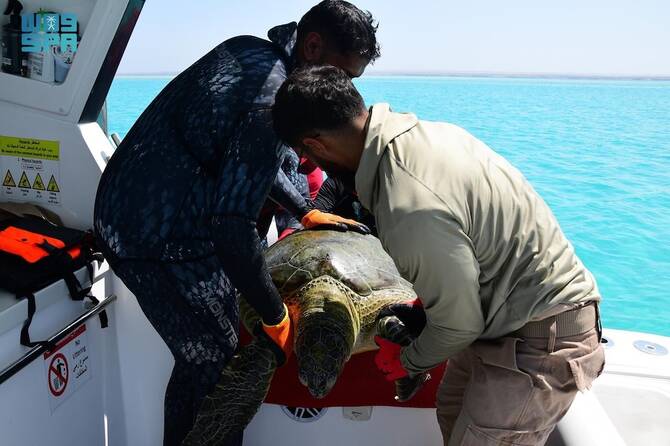
The program continues the reserve’s long-term commitment to marine conservation. (SPA)
2 / 7
The program continues the reserve’s long-term commitment to marine conservation. (SPA)
3 / 7
The program continues the reserve’s long-term commitment to marine conservation. (SPA)
4 / 7
The program continues the reserve’s long-term commitment to marine conservation. (SPA)
5 / 7
The program continues the reserve’s long-term commitment to marine conservation. (SPA)
6 / 7
The program continues the reserve’s long-term commitment to marine conservation. (SPA)
7 / 7
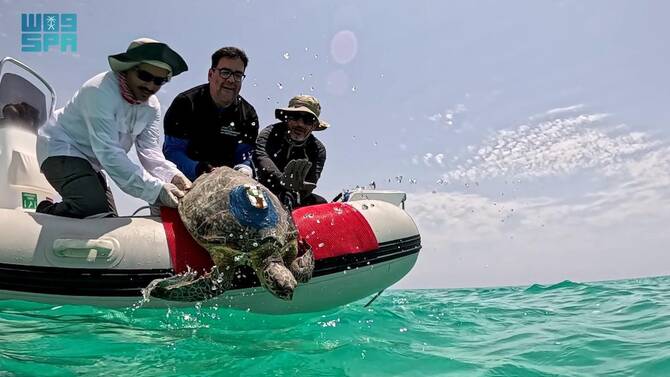
The program continues the reserve’s long-term commitment to marine conservation. (SPA)
Short Url
Updated 10 December 2025
Follow

Royal reserve launches satellite tracking of endangered Red Sea turtles

  • Critical for survival, says reserve CEO Andrew Zaloumis
  • Tags to find nesting, foraging, migratory areas in Red Sea

TABUK: In a milestone for marine conservation, the Prince Mohammed bin Salman Royal Reserve has launched a live satellite-tracking program for hawksbill and green turtles, including the first known tagging of a pre-nesting, egg-carrying green turtle in the Red Sea.

This data will fill a critical regional knowledge gap and drive unified, cross-border conservation strategies for these globally endangered species, the Saudi Press Agency reported on Wednesday.

The team is led by the reserve’s senior marine ecologist Ahmed Mohammed and Hector Barrios-Garrido, the King Abdullah University of Science and Technology’s Beacon Development’s senior marine megafauna specialist.

The two experts recently captured and tagged three critically endangered hawksbill turtles and seven green turtles, the SPA reported.

The tags transmit real-time movement data, identifying foraging grounds, migratory corridors, and, most crucially, the nesting site of the egg-carrying green turtle, ensuring proper protection and management.

The program continues the reserve’s long-term commitment to marine conservation, expanding its turtle nest-monitoring and protection efforts in place since 2023, the SPA added.

The reserve protects 4,000 sq. km of Red Sea waters — 1.8 percent of the Kingdom’s marine area — and a 170 km coastline, the longest managed by a single entity in the Kingdom. Linking Neom and Red Sea Global, it forms an 800 km corridor of protected Red Sea coastline.

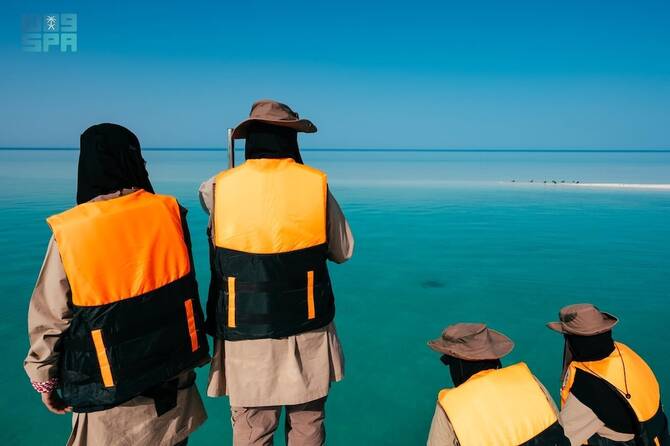
It is a refuge for five of the world’s seven turtle species and a breeding ground for green and hawksbill turtles. Ranger teams monitor turtle activity on land and at sea, protecting nesting sites critical to natal homing, the instinct that drives turtles to return to the beaches where they were born.

Andrew Zaloumis, CEO of the reserve, said: “Critically endangered hawksbill turtles face an extremely high risk of extinction in the wild within our lifetime.

“With fewer than 200 breeding-age females remaining in the Red Sea, their survival depends on closing vital knowledge gaps to enable effective conservation.”

He added: “Hawksbill turtles hatching on the reserve’s protected beaches range across 438,000 sq. km of open sea bordered by eight MENA (Middle East North Africa) countries, returning some three decades later to the same sandy beach to lay their eggs.

“Our satellite tagging and tracking program is a game-changer, providing real-time data to identify their critical staging, foraging, and rookery areas across the Red Sea.

“This data will support national and regional efforts to drive a unified, ecosystem-wide turtle conservation management plan.”

The reserve’s turtle conservation program supports Saudi Arabia’s commitments under the UN Environment Programme’s Convention on Migratory Species and the Indian Ocean’s South-East Asian Marine Turtle Memorandum of Understanding.

Mohammed said: “These state-of-the-art, lightweight tags operate for at least 12 months, providing continuous data for detailed analysis of seasonal patterns and developmental habitats, contributing valuable insights to regional and global sea turtle research.

“Additionally, depth sensors reveal seagrass meadows, essential foraging grounds for green turtles and critical blue carbon sinks.”

Despite the recent global reclassification of green turtles by the International Union for Conservation of Nature, they are still considered vulnerable and conservation-dependent regionally.

All five marine turtle species in the Red Sea are listed under the Convention on Migratory Species, which Saudi Arabia joined in 1979.


Swedish king awards American Saudi scientist, Omar Yaghi, Nobel Prize in Chemistry 2025

Nobel Prize in Chemistry 2025 laureate US-Saudi chemist Omar M. Yaghi poses with award during the award ceremony in Stockholm.
Updated 10 December 2025
Follow

Swedish king awards American Saudi scientist, Omar Yaghi, Nobel Prize in Chemistry 2025

  • Yaghi will share $1.2m prize with British Australian and Japanese scientists Richard Robson and Susumu Kitagawa
  • He is the 1st Saudi national to be awarded the Nobel Prize and 2nd Arab-born to win in the chemistry category since 1999

STOCKHOLM: King Carl XVI Gustaf of Sweden on Wednesday awarded American Saudi scientist Omar Yaghi the Nobel Prize in Chemistry for his breakthrough development of metal-organic frameworks, a sponge-like structure that could store CO2 or harvest water from the air, alongside the British Australian and Japanese scientists Richard Robson and Susumu Kitagawa.

Yaghi, Robson and Kitagawa have each contributed over the past 50 years to developing scalable, reliable MOF models that can be deployed in industry to address climate-related issues and deliver clean air and water. They will share the $1.2 million prize.

Yaghi, 60, who grew up in a refugee camp in Jordan to a Palestinian family expelled from their property by Zionist militias in 1948, is the second Arab-born laureate to be awarded the Nobel Prize in Chemistry by the Royal Swedish Academy of Sciences.

The Nobel Foundation said that MOFs, which are structures with large internal spaces, “can be used to harvest water from desert air, capture carbon dioxide, store toxic gases or catalyze chemical reactions.”

In 2015, Yaghi received the King Faisal International Prize for Chemistry, and in 2021, King Salman granted him Saudi citizenship for his scientific achievements. He holds the James and Neeltje Tretter Chair in Chemistry at UC Berkeley and is the founding director of the Berkeley Global Science Institute. In addition, Yaghi has branched into entrepreneurial activity since 2018, founding Atoco, which works on water harvesting and carbon capture, and co-founding H2MOF for hydrogen storage and WaHa Inc. for water harvesting with projects in the Middle East.

His focus on harvesting water from the air in arid conditions stems from his upbringing in Jordan, where water reached homes every 14 days. He began field tests in the Arizona desert in the 1990s to capture water from the air using the MOF-303 model he had developed.

Yaghi is the first Saudi national to be awarded the Nobel Prize and the second Arab-born to win in the chemistry category since the Egyptian American chemist and scientist Ahmed Zewail was honored in 1999.

Zewail’s model of the “femtochemistry apparatus” is on display at the Nobel Prize Museum. He used the apparatus to demonstrate the principle behind his method of studying chemical reactions using laser technology, capturing it in a femtosecond, which is to a second what a second is to 32 million years.

He is one of dozens of laureates who donated objects to the museum since its foundation in 2001 to mark the 100th anniversary of the Nobel Prize, which began in 1901, five years after the death of the Swedish chemist Alfred Nobel. Since 2001, it has become tradition that each December the winners of that year bring an item to be displayed that reflects their work, personal life or inspiration, Karl Johan, a curator at the museum, told Arab News.

“Zewail wanted to donate an object that could visualize his work and his experiment. He constructed (the interactive apparatus) specifically for the museum. As one of the first objects to be displayed after 2001, it got lots of attention,” Johan said.

The award ceremony in the Swedish capital is the latest event to wrap up Nobel Week, which, since Friday, has featured Nobel laureates in the fields of literature, chemistry, physics, medicine and economic sciences engaging in public events. The Nobel Peace Prize was awarded in the Norwegian capital of Oslo on Wednesday, where the daughter of the Venezuelan opposition leader, Maria Corina Machado, accepted it in her mother’s name after authorities prevented her from leaving early to attend the ceremony.