

Fears mount in Lebanon of a wider war as Hezbollah vows retaliation 

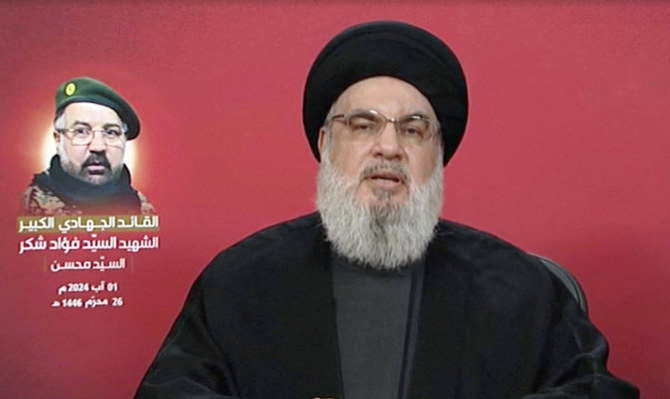
Hezbollah leader Sayyed Hassan Nasrallah gives a televised address, during the funeral of Fuad Shukr, a senior Hezbollah commander who was killed in an Israeli strike in Beirut's southern suburbs on Tuesday August 1, 2024. (Reuters)
Short Url
Updated 01 August 2024
Follow

Fears mount in Lebanon of a wider war as Hezbollah vows retaliation 

  • Political assassination approach is extremely dangerous, says envoy
  • In talks with British ministerial delegation, Mikati urges international community to press Israel to stop aggression

BEIRUT: Security measures in Lebanon increased on Thursday following the assassination of Hamas leader Ismail Haniyeh in Tehran on Wednesday morning.

This, in turn, came after the assassination of senior Hezbollah military commander Fouad Shukr on Tuesday night in Beirut’s southern suburbs.

Hezbollah asked those in southern towns not to film security events and to disconnect fixed surveillance cameras from the internet, which it claimed was “infiltrated by Israel.”

Caution prevailed on the southern front, interrupted by Israeli raids and shelling on border towns.

In an effort to contain any deterioration in security, British Foreign Secretary David Lammy and Defense Secretary John Healey arrived in Beirut for talks with Parliament Speaker Nabih Berri, Prime Minister Najib Mikati, and Foreign Minister Abdullah Bou Habib.

Lammy called on “all parties to respect and implement Resolution 1701 and all its provisions and stipulations.”

Healy commended “the partnership between the Lebanese and British armies” and called for “addressing all conflicts through dialogue and diplomatic means, as the violence will have dire consequences for everyone.”

Berri informed the British delegation “that Lebanon does not want war but is ready to defend itself, and Israeli arrogance is dragging the region toward unpredictable dangers.”

Mikati said Lebanon appreciated the message of support from British Prime Minister Keir Starmer, conveyed by the two secretaries of state.

He stressed that “Israel has violated Lebanese sovereignty and attacked our land, in violation of international laws, and it assaults civilians blatantly every day” and added: “The solution can only be political by implementing international resolutions, including UN Resolution 1701.”

He called on Britain and the international community to “put pressure on Israel to stop its aggression.”

Mikati’s appeal came as the Ministry of Foreign Affairs filed a complaint with the UN Security Council and the UN secretary-general through its permanent mission in New York.

The ministry called on Security Council members “to condemn the Israeli cyberattacks on Lebanon, which pose a serious threat to civil aviation services and endanger the security and safety of communication networks, devices, applications, and electronic data in vital Lebanese facilities.” 

The ministry’s actions are based on a report from the Lebanese Ministry of Telecommunications, which revealed: “The source of GPS jamming is in northern Israel and caused a decline in the accuracy of positioning in Lebanon, affecting transport and communication services.

“Repeated warnings from the Network Time Protocol server were reported, showing the frequent loss of GPS signals and a decline in the quality of service and user experience for mobile network operators.”

The Ministry of Foreign Affairs has also requested its permanent mission in Geneva to file a complaint with the International Telecommunication Union, calling for necessary technical measures to stop such attacks and assist Lebanon in ensuring proper functioning of its communication networks.

Also on Thursday, Egyptian Ambassador to Lebanon Alaa Moussa discussed the latest developments with Berri.

The envoy affirmed Egypt’s rejection of any aggression against Lebanon and highlighted Egypt’s support.

Moussa stressed the importance of calm as expansion of the conflict would result in dire consequences for both Lebanon and the entire region.

He said: “We have already warned that the Israeli aggression against Gaza will expand the cycle of violence circle and confrontations on many and multiple fronts, which actually happened in the past days.”

The ambassador conveyed a message from Egypt that warned “resorting to political assassinations and the consequences resulting of this approach that will lead us into a vicious circle.”

Moussa added the international community must assume their responsibilities through the UN Security Council by issuing a binding resolution to reach a ceasefire in Gaza, achieving de-escalation on all fronts and especially in south Lebanon.

The body of Hezbollah’s Fouad Shukr was found under the debris of a residential building in Haret Hreik, along with a second body that was identified as Iranian adviser Milad Bedi. The bodies of Hanaa Bashire and her daughter, Dr. Salwa Zuhair Al-Bitar, who lived in the targeted building, were also recovered. This brings the total number of Israeli airstrike victims to eight, two of whom were children.

Iranian news agencies reported that Bedi was a “military adviser of Al-Quds Force, the overseas arm of the Revolutionary Guards.

Shortly before Shukr’s funeral, Hezbollah hung giant portraits of him bearing the words “Fuad Al-Muqawama” — Arabic for “the heart of resilience” — on roads to the south.

The Lebanese people held their breath on Thursday amid fears of retaliation from Hezbollah and Iran.

Private institutions in Beirut shortened working hours for employees to 4 p.m., an hour before Hezbollah chief Hassan Nasrallah’s speech at Shukr’s funeral procession.

Nasrallah warned the group was bound to respond to the killing and said the deaths of both Shukr and the Hamas leader “crossed red lines.”


Volatile security blocks UN from Syria Daesh-linked camp

Updated 6 sec ago
Follow

Volatile security blocks UN from Syria Daesh-linked camp

  • Schmitt said: “UNHCR was able to reach Al-Hol for the past three days but has not yet been able to enter inside the camp due to the volatile security situation“
  • A former employee said most associations withdrew on Tuesday “due to the deteriorating security situation“

RAQQA, Syria: Poor security at a camp in Syria housing thousands of suspected relatives of Daesh group militants has prevented UN agency staff from entering, days after Kurdish forces withdrew and the army deployed at the site.
Two former employees at the Al-Hol desert camp told AFP on Friday that some of its residents had escaped during an hours-long security vacuum.
Thousands of suspected militants and their families, including foreigners, have been held in prisons and camps in northeast Syria since 2019, when the Kurdish-led Syrian Democratic Forces (SDF) defeated Daesh with the support of a US-led coalition.
This year, the SDF had to relinquish to Syrian government control swathes of territory they had seized during their fight against Daesh, and on Tuesday withdrew from Al-Hol.
In Raqqa province, Kurdish forces who formerly controlled a prison housing Daesh detainees were bussed out on Friday under a deal with the government, as a four-day truce neared expiry.

- Returning today -

Celine Schmitt, the UN refugee agency’s spokesperson in Syria, told AFP that “UNHCR was able to reach Al-Hol for the past three days but has not yet been able to enter inside the camp due to the volatile security situation.”
“UNHCR is returning to Al-Hol today, with the hope of resuming the bread delivery that had stopped for the past three days,” she said.
On Sunday, Syrian President Ahmed Al-Sharaa announced a deal with SDF chief Mazloum Abdi that included a ceasefire and the integration of the Kurds’ administration into the state, which will take responsibility for Daesh prisoners.
A former employee of a local humanitarian organization that operated in Al-Hol told AFP on condition of anonymity that most associations withdrew on Tuesday “due to the deteriorating security situation.”
Some camp residents fled during the “security vacuum” between when the SDF withdrew and the army took control, they said, without providing a number.
A former employee at another organization working there said “escapes were reported, but the exact number is unknown.”
“The camp is fenced, but without security, anyone can easily cross it and flee,” they said, also requesting anonymity.
Both ex-employees said camp residents torched centers belonging to aid organizations operating in the camp, where humanitarian conditions are dire.
Before the turmoil, the camp housed some 23,000 people — mostly Syrians but also including around 2,200 Iraqis and 6,200 other foreign women and children of various nationalities, the camp’s former administration told AFP.
Roj, a smaller camp in the northeast still under Kurdish control, holds some 2,300 people, mostly foreigners.
The Kurds and the United States have repeatedly urged countries to repatriate their citizens but foreign governments have generally allowed home only a trickle.

- Al-Aqtan prison -

The SDF has withdrawn to parts of Hasakah province, its stronghold in northeast Syria.
A fresh four-day ceasefire was announced on Tuesday, while the following day the United States said it had launched an operation that could see 7,000 Daesh militant detainees moved from Syria to Iraq, with 150 transferred so far.
US envoy Tom Barrack, who has said the purpose of Washington’s alliance with SDF has now largely expired, held talks this week with Abdi and senior Kurdish official Elham Ahmad.
On Friday, Syria transferred Kurdish fighters away from the Al-Aqtan prison on the outskirts of Raqqa city.
An AFP correspondent in Raqqa saw buses and cars heading away from the Al-Aqtan prison, escorted by government vehicles.
Syrian state television reported the transfer came “after five days of negotiations” and that the fighters would go to the Kurdish-held city of Ain Al-Arab, also known as Kobani, on the northern border with Turkiye.
The SDF later said that with coalition support, all the fighters had been transferred “to safe locations,” while the interior ministry said authorities had taken control of the facility.
A government source told state television that around 800 SDF fighters were to leave, while Daesh detainees would be managed “according to Syrian law.”
The army said the Al-Aqtan transfer was “the first step in implementing the January 18 agreement.”