

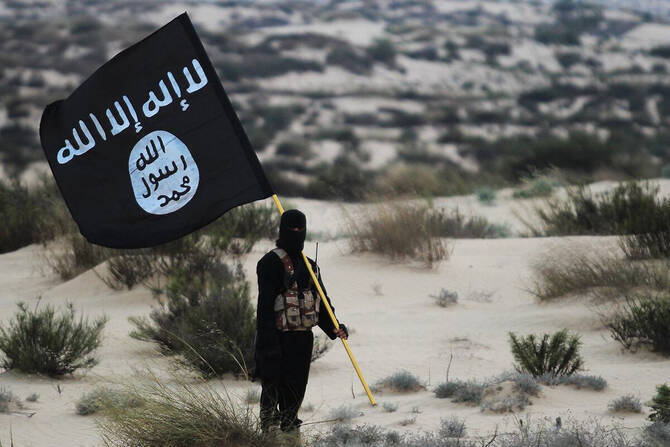
Europeans among 150 Daesh detainees transferred from Syria to Iraq

The EU said Friday that alleged breakouts by detained foreign fighters from the Daesh group in Syria were of “paramount concern,” and it was monitoring the transfer of prisoners to Iraq. (X: @DHBruxelles)
Short Url
Updated 23 January 2026
Follow

Europeans among 150 Daesh detainees transferred from Syria to Iraq

  • They were among an estimated 7,000 militants due to be moved across the border to Iraq
  • The EU said Friday that alleged breakouts by detained Daesh foreign fighters in Syria were of “paramount concern”

RAQQA, Syria: Europeans were among 150 senior Daesh group detainees transferred this week by the US military from Kurdish custody in Syria to Iraq, whose premier urged EU countries to repatriate their nationals.
They were among an estimated 7,000 militants due to be moved across the border to Iraq as the Kurdish-led force that has held them for years relinquishes swathes of territory to the advancing Syrian army.
In 2014, Daesh swept across Syria and Iraq, committing massacres and forcing women and girls into sexual slavery, but backed by a US-led coalition, the Kurdish-led Syrian Democratic Forces (SDF) ultimately defeated the militants in Syria five years later.
This month, the United States said the purpose of its alliance with the Kurds had largely expired, as Syria’s new authorities pressed an offensive to take back territory long held by the SDF, which agreed to withdraw from swathes of territory in the north and east.
The EU said Friday that alleged breakouts by detained Daesh foreign fighters in Syria were of “paramount concern” and was monitoring the transfer of prisoners to Iraq, “including foreign terrorist fighters.”
An Iraqi security official said the 150 detainees, which the US military transferred to Iraq on Wednesday, were “all leaders of the Daesh group, and some of the most notorious criminals,” and included “Europeans, Asians, Arabs and Iraqis.”
Another Iraqi security source said the group included “85 Iraqis and 65 others of various nationalities, including Europeans, Sudanese, Somalis, and people from the Caucasus region.”
They “all participated in Daesh operations in Iraq,” including the 2014 offensive that saw the militant group seize large areas of Iraq and neighboring Syria “are all at the level of emirs,” he said.
They are now held at a prison in Baghdad.

- ‘Take responsibility’ -

US Secretary of State Marco Rubio has said that “non-Iraqi terrorists will be in Iraq temporarily.”
In a telephone call Friday with French President Emmanuel Macron, Iraqi Prime Minister Mohammed Shia Al-Sudani urged European countries to take back and prosecute their nationals.
The SDF jailed thousands of suspected militants and detained tens of thousands of their relatives in camps as it pushed out Daesh.
The militant group’s onslaught came during the peak of Syria’s civil war, which was sparked by longtime ruler Bashar Assad’s crackdown on pro-democracy protests.
After toppling Assad just over a year ago, President Ahmed Al-Sharaa is now seeking to consolidate the government’s control over all of Syria.
Despite repeated Kurdish and US appeals, foreign governments have generally avoided repatriating their nationals, fearing security threats and political backlash.
US President Donald Trump told the New York Post on Tuesday that he had helped stop a prison break of European militants in Syria, a day after the army accused the SDF of releasing Daesh detainees from the Shadadi prison.
The Kurds said they lost control of the facility after an attack by Damascus.
Syrian authorities later said they had arrested “81 of the fugitives.”
In north Syria’s Raqqa province, an AFP correspondent saw Kurdish forces who formerly controlled the Al-Aqtan prison housing Daesh detainees being bussed out Friday under a deal with the government.

- Al-Hol camp -

In northeast Syria, UN refugee agency (UNHCR) spokesperson Celine Schmitt said it had been unable to enter Al-Hol camp — the biggest facility housing suspected Daesh relatives including foreigners — for three days due to “the volatile security situation.”
Kurdish forces withdrew from Al-Hol on Tuesday and the following day Syria’s army entered the camp where thousands of men, women and children have lived in squalid conditions for years.
“UNHCR is returning to Al-Hol today, with the hope of resuming the bread delivery that had stopped for the past three days,” Schmitt told AFP.
The camp houses some 23,000 people — mostly Syrians but also including around 2,200 Iraqis and 6,200 other foreign women and children of various nationalities, according to the camp’s former administration.
Two former employees of organizations working at the site said an unspecified number of its residents fled during an hours-long security vacuum between when the SDF withdrew and the army took control, without saying how many people.
“The camp is fenced, but without security, anyone can easily cross it and flee,” one of the employees said, requesting anonymity.
On Sunday, Sharaa announced a deal with SDF chief Mazloum Abdi that included a ceasefire and the integration of the Kurds’ administration into the state, which will take responsibility for Daesh prisoners.
A fresh four-day ceasefire agreed after tensions escalated is set to expire on Saturday evening.


Court records raise doubts that ICE is detaining the ‘worst of the worst’ in Maine

Updated 4 sec ago
Follow

Court records raise doubts that ICE is detaining the ‘worst of the worst’ in Maine

  • Federal officials say more than 100 people have been detained statewide enforcement ‘Operation Catch of the Day’
  • ICE has said the operation is targeting about 1,400 immigrants in a state of about 1.4 million people
PORTLAND, Maine: Immigration and Customs Enforcement has highlighted the detention of people whom it called some of Maine’s most dangerous criminals during operations this past week, but court records paint a more complicated picture.
Federal officials say more than 100 people have been detained statewide in what ICE dubbed “Operation Catch of the Day,” a reference to the fishing industry. ICE said in a statement that it was arresting the “worst of the worst,” including “child abusers and hostage takers.”
Court records show some were violent felons. But they also show other detainees with unresolved immigration proceedings or who were arrested but never convicted of a crime.
Immigration attorneys and local officials say similar concerns have surfaced in other cities where ICE has conducted enforcement surges and many of those targeted lacked criminal records.
One case highlighted by ICE that involves serious felony offenses and criminal convictions is that of Sudan native Dominic Ali. ICE said Ali was convicted of false imprisonment, aggravated assault, assault, obstructing justice and violating a protective order.
Court records show Ali was convicted in 2004 of violating a protective order and in 2008 of second-degree assault, false imprisonment and obstructing the reporting of a crime. In the latter case, prosecutors said he threw his girlfriend to the floor of her New Hampshire apartment, kicked her and broke her collarbone.
“His conduct amounted to nothing less than torture,” Judge James Barry said in 2009 before sentencing Ali to five to 10 years in prison.
Ali was later paroled to ICE custody, and in 2013 an immigration judge ordered his removal. No further information was available from the Executive Office for Immigration Review, and it remains unclear what happened after that order.
Other cases were more nuanced, like that of Elmara Correia, an Angola native whom ICE highlighted in its public promotion of the operation, saying she was “arrested previously for endangering the welfare of a child.”
Maine court records show someone with that name was charged in 2023 with violating a law related to learner’s permits for new drivers, a case that was later dismissed.
Correia filed a petition Wednesday challenging her detention, and a judge issued a temporary emergency order barring authorities from transferring her from Massachusetts, where she is being held. Her attorney said she entered the United States legally on a student visa about eight years ago and has never been subject to expedited removal proceedings.
“Was she found not guilty, or are we just going to be satisfied that she was arrested?” Portland Mayor Mark Dion said during a news conference in which he raised concerns that ICE failed to distinguish between arrests and convictions or explain whether sentences were served.
Dion also pointed to another person named in the release: Dany Lopez-Cortez, whom ICE said is a “criminal illegal alien” from Guatemala who was convicted of operating under the influence.
ICE highlighted Lopez-Cortez’s case among a small group of examples it said reflected the types of arrests made during the operation. Dion questioned whether an operating-under-the-influence conviction, a serious offense but one commonly seen in Maine, should rise to the level of ICE’s “worst of the worst” public narrative.
Boston immigration attorney Caitlyn Burgess said her office filed habeas petitions Thursday on behalf of four clients who were detained in Maine and transferred to Massachusetts.
The most serious charge any of them faced was driving without a license, Burgess said, and all had pending immigration court cases or applications.
“Habeas petitions are often the only tool available to stop rapid transfers that sever access to counsel and disrupt pending immigration proceedings,” she said.
Attorney Samantha McHugh said she filed five habeas petitions on behalf of Maine detainees Thursday and expected to file three more soon.
“None of these individuals have any criminal record,” said McHugh, who is representing a total of eight detainees. “They were simply at work, eating lunch, when unmarked vehicles arrived and immigration agents trespassed on private property to detain them.”
Federal court records show that immigration cases involving criminal convictions can remain unresolved or be revisited years later.
Another whose mug shot was included in materials on “the worst of the worst” of those detained in Maine is Ambessa Berhe.
Berhe was convicted of cocaine possession and assaulting a police officer in 1996 and cocaine possession in 2003.
In 2006 a federal appeals court in Boston vacated a removal order for him and sent the case back to the Board of Immigration Appeals for further consideration.
According to the ruling, Berhe was born in Ethiopia and later taken to Sudan by his adoptive parents. The family was admitted to the United States as refugees in 1987, when he was about 9.
ICE has said the operation is targeting about 1,400 immigrants in a state of about 1.4 million people, roughly four percent of whom are foreign-born.