

Hezbollah leader’s body found in rubble following airstrike

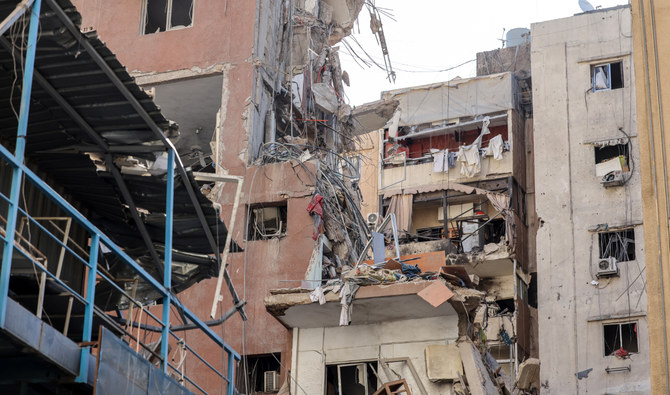
This pictured shows the aftermath of an Israeli military strike on a building in Beirut's southern suberbs on July 31, 2024. (AFP)
Short Url
Updated 01 August 2024
Follow

Hezbollah leader’s body found in rubble following airstrike

  • Lebanon urges international community to act to halt further escalation

BEIRUT: Hezbollah civil defense teams on Wednesday found the body of senior commander Fouad Shukr, who was killed in an Israeli drone strike the previous night in the southern suburbs of Beirut.

The militant group had confirmed Shukr’s presence in the targeted building earlier in the day after a blackout that lasted throughout Tuesday night.

Conflicting reports emerged regarding the fate of the prominent Hezbollah leader. Security information shared at the site of the attack suggested that Shukr was the main target of the airstrike.

Diplomatic communications with Lebanon intensified in the wake of Shukr’s death. Political observers linked the scale of the response to the attack with the killing of Ismail Haniyeh, the Hamas political bureau chief, in Tehran early on Wednesday.

Relief and civil defense teams continued to remove debris from the upper floors of the Beirut residential building, which partially collapsed after it was struck by three missiles fired by the Israeli combat drone.

Journalists and photographers were not allowed near the site, which was cordoned off by Hezbollah members. Debris was cleared from the surrounding streets, and roads were reopened.

At least four other people are though to have died in the attack: Wasila Baydoun from the southern town of Chehabiyeh; and Hanan Hakim and her two children, Sarah, 6, and Hassan Fadlallah,10, from the southern town of Aainata.

Most of those injured in the blast were discharged from hospital after receiving treatment, with a few remaining under medical care.

In its morning statement, Hezbollah said that “civil defense teams have been diligently working to remove the debris since the incident occurred, but progress is slow due to the condition of the destroyed floors. We are still awaiting the outcome of this operation concerning the fate of the esteemed leader and other citizens at this location, so that the necessary action can be taken.”

The Israeli attack on Beirut’s southern suburbs was widely condemned by Lebanese politicians and parties, with demands for “urgent international, regional, and UN action to stop the Israeli killing machine.”

A ministerial delegation visited the site after an extraordinary Cabinet session chaired by Najib Mikati, the caretaker prime minister, who strongly condemned the attack, warning that “matters will escalate for the worse if the enemy continues with its recklessness and murderous, criminal insanity, and if the concerned countries and the international community do not quickly intervene to curb this dangerous escalation.”

Mikati also condemned the killing of Haniyeh, describing it as a “serious threat that could expand the circle of global concern in the region.”

Ziad Makary, the caretaker information minister, said that the Lebanese Cabinet “remains in open session to monitor any developments.”

He added that the prime minister’s office is making “vigorous diplomatic efforts aimed at promoting peace transparently and unequivocally.”

Makary added: “It is natural for everyone to fear the possibility of war.”

Separately, the UN Under-Secretary-General for Peace Operations, Jean-Pierre Lacroix; UN Special Coordinator for Lebanon, Jeanine Hennis-Plasschaert; and the UNIFIL Commander, Gen. Aroldo Lazaro, discussed with Parliament Speaker Nabih Berri and Foreign Minister Abdullah Bou Habib “ways to contain the escalation to prevent the expansion of the war.”

Meanwhile, the attack on Beirut’s southern suburbs sparked concern and confusion among travelers at Beirut-Rafic Hariri International Airport.

Travel and tourism companies said that many scheduled trips to Lebanon next week had been canceled.

The head of the Association of Travel and Tourism Agents, Jean Abboud, said that a week ago Lebanon was receiving around 14,000 passenger arrivals daily, with at least 85 flights per day. However, yesterday the number of passenger arrivals dropped to 9,500. 


US military launches strikes in Syria against Daesh fighters after American deaths

Updated 20 December 2025
Follow

US military launches strikes in Syria against Daesh fighters after American deaths

  • “This is not the beginning of a war — it is a declaration of vengeance,” Defense Secretary Pete Hegseth says
  • President Trump earlier pledged “very serious retaliation” but stressed that Syria was fighting alongside US troops

WASHINGTON: The Trump administration launched military strikes Friday in Syria to “eliminate” Daesh group fighters and weapons sites in retaliation for an ambush attack that killed two US troops and an American interpreter almost a week ago.
A US official described it as “a large-scale” strike that hit 70 targets in areas across central Syria that had Daesh (also known as Islamic State or IS) infrastructure and weapons. Another US official, who also spoke on condition of anonymity to discuss sensitive operations, said more strikes should be expected.
The attack was conducted using F-15 Eagle jets, A-10 Thunderbolt ground attack aircraft and AH-64 Apache helicopters, the officials said. F-16 fighter jets from Jordan and HIMARS rocket artillery also were used, one official said.
“This is not the beginning of a war — it is a declaration of vengeance. The United States of America, under President Trump’s leadership, will never hesitate and never relent to defend our people,” Defense Secretary Pete Hegseth said on social media.


President Donald Trump had pledged “very serious retaliation” after the shooting in the Syrian desert, for which he blamed Daesh. The troops were among hundreds of US troops deployed in eastern Syria as part of a coalition fighting the terrorist group.
Trump in a social media post said the strikes were targeting Daesh “strongholds.” He reiterated his support for Syrian President Ahmad Al-Sharaa, who he said was “fully in support” of the US effort to target the militant group.
Trump also offered an all-caps threat, warning the group against attacking US personnel again.
“All terrorists who are evil enough to attack Americans are hereby warned — YOU WILL BE HIT HARDER THAN YOU HAVE EVER BEEN HIT BEFORE IF YOU, IN ANY WAY, ATTACK OR THREATEN THE USA.,” the president added.
The attack was a major test for the warming ties between the United States and Syria since the ouster of autocratic leader Bashar Assad a year ago. Trump has stressed that Syria was fighting alongside US troops and said Al-Sharaa was “extremely angry and disturbed by this attack,” which came as the US military is expanding its cooperation with Syrian security forces.
Syria’s foreign ministry in a statement on X following the launch of US strikes said that last week’s attack “underscores the urgent necessity of strengthening international cooperation to combat terrorism in all its forms” and that Syria is committed “to fighting Daesh and ensuring that it has no safe havens on Syrian territory and will continue to intensify military operations against it wherever it poses a threat.”


Daesh has not claimed responsibility for the attack on the US service members, but the group has claimed responsibility for two attacks on Syrian security forces since, one of which killed four Syrian soldiers in Idlib province. The group in its statements described Al-Sharaa’s government and army as “apostates.” While Al-Sharaa once led a group affiliated with Al-Qaeda, he has had a long-running enmity with Daesh.
Syrian state television reported that the US strikes hit targets in rural areas of Deir ez-Zor and Raqqa provinces and in the Jabal Al-Amour area near Palmyra. It said they targeted “weapons storage sites and headquarters used by Daesh as launching points for its operations in the region.”

Trump this week met privately with the families of the slain Americans at Dover Air Force Base in Delaware before he joined top military officials and other dignitaries on the tarmac for the dignified transfer, a solemn and largely silent ritual honoring US service members killed in action.

President Donald Trump, from left, Defense Secretary Pete Hegseth and Chairman of the Joint Chiefs Air Force Gen. Dan Caine attend a casualty return ceremony at Dover Air Force Base, Delaware, on Dec. 17, 2025,of soldiers who were killed in an attack in Syria last week. (AP)

The guardsmen killed in Syria last Saturday were Sgt. Edgar Brian Torres-Tovar, 25, of Des Moines, and Sgt. William Nathaniel Howard, 29, of Marshalltown, according to the US Army. Ayad Mansoor Sakat, of Macomb, Michigan, a US civilian working as an interpreter, was also killed.
The shooting nearly a week ago near the historic city of Palmyra also wounded three other US troops as well as members of Syria’s security forces, and the gunman was killed. The assailant had joined Syria’s internal security forces as a base security guard two months ago and recently was reassigned because of suspicions that he might be affiliated with Daesh, Interior Ministry spokesperson Nour Al-Din Al-Baba has said.
The man stormed a meeting between US and Syrian security officials who were having lunch together and opened fire after clashing with Syrian guards.
When asked for further information, the Pentagon referred AP to Hegseth’s social media post.