

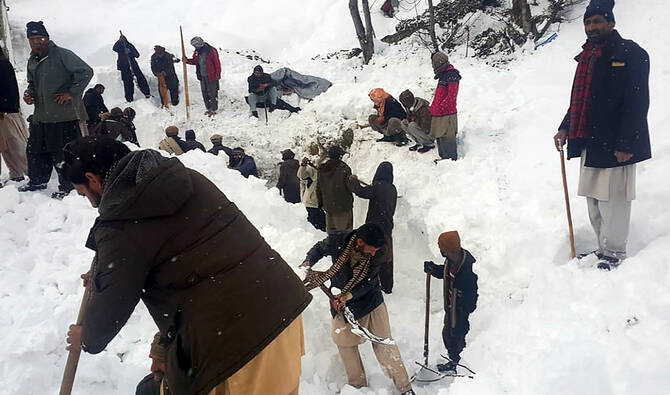

PESHAWAR/QUETTA: At least nine people were killed while an injured child was rescued alive when an avalanche struck a house in a mountainous district of northwestern Khyber Pakhtunkhwa province, officials said on Friday, as the Pakistan Meteorological Department (PMD) warned of more rain and snowfall in the area along with southwestern Pakistan.
The incident occurred in the Arandu region of Lower Chitral district, affecting members of the same family, as the PMD urged tourists to avoid unnecessary travel while authorities worked to prevent weather-related emergencies.
Rescuers evacuated dozens of residents and tourists as heavy snow blocked roads in Khyber, South Waziristan and Swat districts, where authorities cleared routes and provided food, clothing and bedding, the Rescue 1122 service said.
“An avalanche fell in Sarigal village of Arandu, a far-flung area in subdivision Drosh,” Deputy Commissioner of Lower Chitral Rao Hashim Azeem told Arab News over the phone.
“Ten people from the same family came under the avalanche in which nine were found dead and one child was rescued alive,” he added. “Police, Chitral scouts, rescue and local administration took part in the operation.”
Azeem said the rescue efforts were hampered by heavy snowfall and the area’s remote location, adding that the bodies were taken to Drosh for burial.
Heavy snow hit Azad Kashmir, Gilgit-Baltistan, Murree, and Galiyat, stranding vehicles and causing power outages, local media reported.
“The system causing rain/snowfall is active over northern parts of the country,” the PMD said in its advisory on Friday at noon, predicting more showers and snow in the next few hours.
“Tourists [are] advised to stay vigilant and avoid unnecessary travel during rain and snowfall,” it added.
TEMPERATURE DROP IN BALOCHISTAN
The PMD said temperatures in several in districts southwestern Balochistan province dropped to –9°C as a snowstorm with strong winds hit Quetta, Kalat, Chaman, Killa Saifullah, Nushki and Loralai, disrupting daily life.
“Dozens of vehicles including passenger buses have been stranded at N-50 highway near Muslim Bagh due to heavy snowfall since Thursday night,” Assistant Commissioner Muslim Bagh Dheeraj Kalra told Arab News.
“District administration accompanied by PDMA [Provincial Disaster Management Authority] Balochistan removed the snow from the N-50 highway and opened the roads for traffic on Friday morning.”
Meanwhile, PMD Balochistan Deputy Director Muhammad Afzal said the next spell of snowfall and rain would hit the southwestern parts of the country from Jan. 25 to 27 but will not be as harsh as the first one.
“The recent system of snowstorm entered Balochistan through the Iran-Afghan border which dropped the mercury to –9°C and this freezing temperature will continue till tomorrow evening,” he said.
Weather authorities this week forecast intermittent rains and snowfall in northern regions of the country between Jan. 21 and Jan. 24, with heavy snowfall likely in upper and hilly areas of the province.
Tens of thousands of tourists flock to Pakistan’s scenic north every winter to witness snowfall, often neglecting warnings from disaster management authorities.
In Jan. 2022, at least 21 people, including children, died after they were stuck in freezing temperatures during a snowstorm in the Pakistani hill station of Murree.
In view of the situation, Federal Minister Abdul Aleem Khan on Friday directed the National Highway Authority (NHA) to ensure that all highways remain open and fully operational under all circumstances.
“The minister has instructed NHA field staff to remain on high alert and to maintain 24/7 monitoring of weather conditions on highways in snowfall-affected areas,” the Pakistani information ministry said.
“He emphasized that ensuring uninterrupted traffic flow on national highways, particularly in upper regions, is a top priority.”


