WASHINGTON: Khalid Sheikh Mohammed, accused as the mastermind of Al-Qaeda’s Sept. 11, 2001, attacks on the United States, has agreed to plead guilty, the Defense Department said Wednesday. The development points to a long-delayed resolution in an attack that killed thousands and altered the course of the United States and much of the Middle East.
Mohammed and two accomplices, Walid Bin Attash and Mustafa Al-Hawsawi, are expected to enter the pleas at the military commission at Guantanamo Bay, Cuba, as soon as next week.
Defense lawyers have requested the men receive life sentences in exchange for the guilty pleas, according to letters from the federal government received by relatives of some of the nearly 3,000 people killed outright on the morning of Sept. 11.
Terry Strada, the head of one group of families of the nearly 3,000 direct victims of the 9/11 attacks, invoked the dozens of relatives who have died while awaiting justice for the killings when she heard news of the plea agreement.
“They were cowards when they planned the attack,” she said of the defendants. “And they’re cowards today.”
Pentagon officials declined to immediately release the full terms of the plea bargains.
The US agreement with the men comes more than 16 years after their prosecution began for Al-Qaeda’s attack. It comes more than 20 years after militants commandeered four commercial airliners to use as fuel-filled missiles, flying them into the World Trade Center in New York and the Pentagon.
Al-Qaeda hijackers headed a fourth plane to Washington, but crew members and passengers tried to storm the cockpit, and the plane crashed into a Pennsylvania field.
The attack triggered what President George W. Bush’s administration called its war on terror, prompting the US military invasions of Afghanistan and Iraq and years of US operations against armed extremist groups elsewhere in the Middle East.
The attack and US retaliation brought the overthrow of two governments outright, devastated communities and countries caught in the battle, and played a role in inspiring the 2011 Arab Spring popular uprisings against authoritarian Middle East governments.
At home, the attacks inspired a sharply more militaristic and nationalist turn to American society and culture.
US authorities point to Mohammed as the source of the idea to use planes as weapons. He allegedly received approval from Al-Qaeda leader Osama bin Laden, whom US forces killed in 2011, to craft what became the 9/11 hijackings and killings.
Authorities captured Mohammed in 2003. Mohammed was subjected to waterboarding 183 times while in CIA custody before coming to Guantanamo, and targeted by other forms of torture and coercive questioning.
The use of torture has proven one of the most formidable obstacles in US efforts to try the men in the military commission at Guantanamo, owing to the inadmissibility of evidence linked to abuse. Torture has accounted for much of the delay of the proceedings, along with the courtroom’s location a plane ride away from the United States.
Daphne Eviatar, a director at the Amnesty International USA rights group, said Wednesday she welcomed news of some accountability in the attacks.
She urged the Biden administration to close the Guantanamo Bay detention center, which holds people taken into custody in the so-called war on terror. Many have since been cleared, but are awaiting approval to leave for other countries.
Additionally, Eviatar said, “the Biden administration must also take all necessary measures to ensure that a program of state-sanctioned enforced disappearance, torture and other ill-treatment will never be perpetrated by the United States again.”
Strada, national chairperson of a group of families of victims called 9/11 Families United, had been at Manhattan federal court for a hearing on one of many civil lawsuits when she heard news of the plea agreement.
Strada said many families have just wanted to see the men admit guilt.
“For me personally, I wanted to see a trial,” she said. “And they just took away the justice I was expecting, a trial and the punishment.”
Michael Burke, one of the family members receiving the government notice of the plea bargain, condemned the long wait for justice, and the outcome.
“It took months or a year at the Nuremberg trials,” said Burke, whose fire captain brother Billy died in the collapse of the World Trade Center’s North Tower. “To me, it always been disgraceful that these guys, 23 years later, have not been convicted and punished for their attacks, or the crime. I never understood how it took so long.”
“I think people would be shocked if you could go back in time and tell the people who just watched the towers go down, ‘Oh, hey, in 23 years, these guys who are responsible for this crime we just witnessed are going to be getting plea deals so they can avoid death and serve life in prison,” he said.
Burke’s brother, New York City fire captain Billy Burke, ordered his men out but remained on the 27th floor of the North Tower with two men who’d stayed behind: a quadriplegic who, because the elevators had gone out, was essentially stuck there in his wheelchair and that man’s friend.


![]()

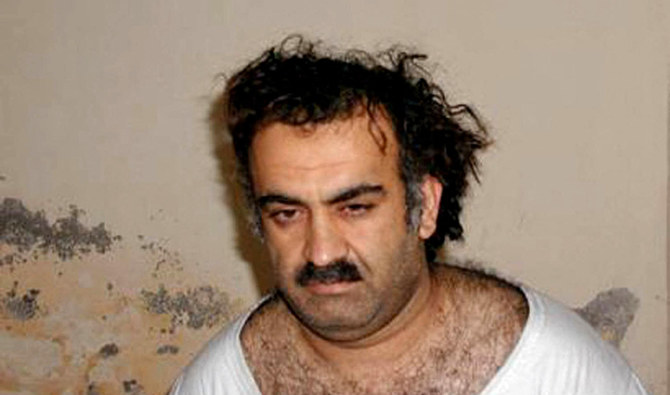
Khalid Sheikh Mohammed, accused as the main plotter of 9/11 attacks, agrees to plead guilty
Short Url
https://arab.news/g2f8h
Khalid Sheikh Mohammed, accused as the main plotter of 9/11 attacks, agrees to plead guilty
- Pentagon says ‘The specific terms and conditions of the pretrial agreements are not available to the public at this time’


Latest updates





© 2026 SAUDI RESEARCH & PUBLISHING COMPANY, All Rights Reserved And subject to Terms of Use Agreement.