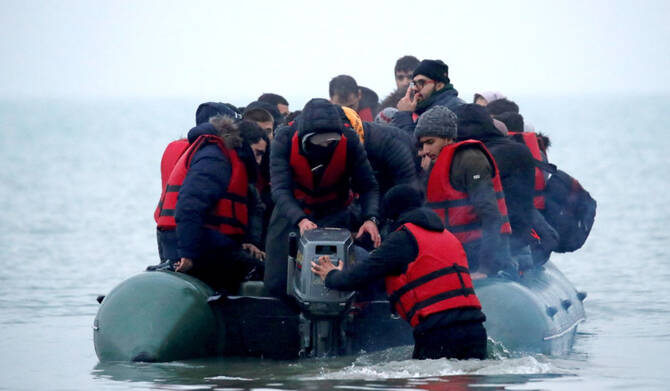
Britain toughens tactics to cut boat crossings

The law has created new criminal offenses, such as supplying boat engines to bring migrants to the UK, punishable by up to 14 years in jail. (Reuters)
Short Url
Updated 05 January 2026
Follow

Britain toughens tactics to cut boat crossings

  • Over 41,000 people made the perilous sea journey across the Channel last year

LONDON: UK authorities have deployed new counter-terror style powers to seize the phones of migrants who arrive by small boats from northern France, to tackle criminal gangs behind the crossings.

The initiative is part of Labour Prime Minister Keir Starmer’s attempts to slash the number of migrant arrivals, and stem a surge in support for Brexit figurehead Nigel Farage’s anti-immigration party Reform UK.
Over 41,000 people made the perilous sea journey across the Channel last year — the second highest tally since records began in 2018.
Police and immigration enforcement officers will confiscate phones and SIM cards from migrants at the Manston processing center, near Ramsgate, on the southeast coast of England.

FASTFACTS

• Authorities hope the seizures will enable them to access information on phones, such as contacts and maps to help disrupt the people smuggling networks.

• The opposition Conservative Party’s home affairs spokesperson Chris Philp dismissed the measures as ‘cosmetic tweaks.’

The seizures will be allowed without the need to make an arrest under new legislation — the Border Security, Asylum and Immigration Bill — passed by Parliament last year.
Authorities hope the seizures will enable them to access information on phones such as contacts and maps to help disrupt the people smuggling networks and prosecute the ringleaders.
“We promised to restore order and control to our borders, which means taking on the people smuggling networks behind this deadly trade,” Border Security Minister Alex Norris said.
“That is exactly why we are implementing robust new laws with powerful offenses to intercept, disrupt and dismantle these vile gangs faster than ever before and cut off their supply chains,” he added.
Charities representing migrants have condemned the new measures.
“This new law is anti-refugee. It’s another attack on rights, and further criminalizes people seeking safety,” said Refugee Action last month when the legislation received final approval.
The opposition Conservative Party’s home affairs spokesperson Chris Philp dismissed the measures as “cosmetic tweaks.”
He urged the government to get a “proper grip on the situation” by quitting the European Convention on Human Rights.
The law has also created new criminal offenses such as storing or supplying boat engines to bring migrants to the UK, punishable by up to 14 years in jail.
In November, UK Interior Minister Shabana Mahmood announced a number of proposals to deter migrants, including making refugee status temporary and reviewing it every 30 months.
Migrants will also need to wait longer than the current five years before they can apply for permanent residency. Depending on their circumstances, it could take from 10 to 30 years.
Mahmood described the proposals, modelled on Denmark’s strict asylum system, as “the most significant changes to our asylum system in modern times.”



UK pays Guantanamo detainee ‘substantial’ compensation over US torture questions

Updated 5 sec ago
Follow

UK pays Guantanamo detainee ‘substantial’ compensation over US torture questions

  • Abu Zubaydah has been held at Guantanamo Bay without charge for 20 years
  • British security services knew he was subjected to ‘enhanced interrogation’ but failed to raise concerns for 4 years

LONDON: A Saudi-born Palestinian being held without trial by the US has received a “substantial” compensation payment from the UK government, the BBC reported.

Abu Zubaydah has been imprisoned at Guantanamo Bay in Cuba for almost 20 years following his capture in Pakistan in 2002, and was subjected to “enhanced interrogation” techniques by the CIA.

He was accused of being a senior member of Al-Qaeda in the aftermath of the Sept. 11 terror attacks on the US. The allegations were later dropped but he remains in detention.

The compensation follows revelations that UK security services submitted questions to the US to be put to Abu Zubaydah by their US counterparts despite knowledge of his mistreatment.

He alleged that MI5 and MI6 had been “complicit” in torture, leading to a legal case and the subsequent compensation.

Dominic Grieve, the UK’s former attorney general, chaired a panel reviewing Abu Zubaydah’s case.

He described the compensation as “very unusual” but said the treatment of Abu Zubaydah had been “plainly” wrong, the BBC reported.

Grieve added that the security services had evidence that the “Americans were behaving in a way that should have given us cause for real concern,” and that “we (UK authorities) should have raised it with the US and, if necessary, closed down co-operation, but we failed to do that for a considerable period of time.”

Abu Zubaydah’s international legal counsel, Prof. Helen Duffy, said: “The compensation is important, it’s significant, but it’s insufficient.”

She added that more needs to be done to secure his release, stating: “These violations of his rights are not historic, they are ongoing.”

Duffy said Abu Zubaydah would continue to fight for his freedom, adding: “I am hopeful that the payment of the substantial sums will enable him to do that and to support himself when he’s in the outside world.”

He is one of 15 people still being held at Guantanamo, many without charge. Following his initial detention, he arrived at the prison camp having been the first person to be taken to a so-called CIA “black site.”

He spent time at six such locations, including in Lithuania and Poland, outside of US legal jurisdiction. 

Internal MI6 messages revealed that the “enhanced interrogation” techniques he was subjected to would have “broken” the resolve of an estimated 98 percent of US special forces members had they been subjected to them.

CIA officers later decided he would be permanently cut off from the outside world, with then-President George W. Bush publicly saying Abu Zubaydah had been “plotting and planning murder.”

However, the US has since withdrawn the allegations and no longer says he was a member of Al-Qaeda.

A report by the US Senate Select Committee on Intelligence said Abu Zubaydah had been waterboarded at least 83 times, was locked in a coffin-like box for extended periods, and had been regularly assaulted. Much of his treatment would be considered torture under UK law.

Despite knowledge of his treatment, it was four years before British security services raised concerns with their American counterparts, and their submission of questions within that period had “created a market” for the torture of detainees, Duffy said.

A 2018 report by the UK Parliament’s Intelligence and Security Committee was deeply critical of the behavior of MI5 and MI6 in relation to Abu Zubaydah. 

It also criticized conduct relating to Guantanamo detainee Khalid Sheikh Mohammed, widely regarded as a key architect of the Sept. 11 attacks, warning that the precedent set by Abu Zubaydah’s legal action could be used by Mohammed to bring a separate case against the UK.

MI5 and MI6 failed to comment on Abu Zubaydah’s case. Neither the UK government nor Mohammed’s legal team would comment on a possible case over his treatment.