
BEIRUT: As Lebanon enters 2026, the national mood is defined less by a sense of recovery than by the daunting task of managing overlapping crises.
While the past year provided the first cautious stirrings of renewal, politicians and analysts alike describe 2026 as the pivotal year that will determine if these fragile foundations can support a permanent state.
For former MP Fares Saeed, the coming year is one where Lebanon must continue the deep soul-searching required to enter a true recovery phase.

Despite the political transition, peace remains a delicate prospect. (AFP)
“The year 2025 can be considered a year of rebuilding trust between the state and its citizens,” he told Arab News.
“Lebanon and the region are going through a transitional phase, which complicates internal solutions, and getting out of the situation we are in requires listening to the project that Pope Leo XIV brought to Lebanon to make peace. But Lebanon must first redefine its very raison d’etre if it is to truly recover.”
Khaldoun Al-Sharif, another prominent political figure, views 2025 through the lens of regional upheaval — specifically the power vacuum left by the fall of Bashar Assad in neighboring Syria and the sustained Israeli pressure on Iranian proxies.
He warns that the path to stability this year depends on two unresolved issues. “Hezbollah’s disarmament and genuine reform. We saw neither this year,” he told Arab News, setting a high bar for the government’s performance in the months to follow.

President Joseph Aoun enters 2026 committed to the state’s monopoly on the use of force. (Lebanese parliament/AFP)
The optimism that marked the start of the previous year remains the primary fuel for the current administration.
After years of paralysis, the 2025 agenda was driven by the leadership of President Joseph Aoun and the government of veteran diplomat Nawaf Salam. Their twin appointments ended the deadlock that had left Lebanon leaderless during the 2024 war.
Their administration is focused on the Aoun’s inaugural pledge of “positive neutrality.”

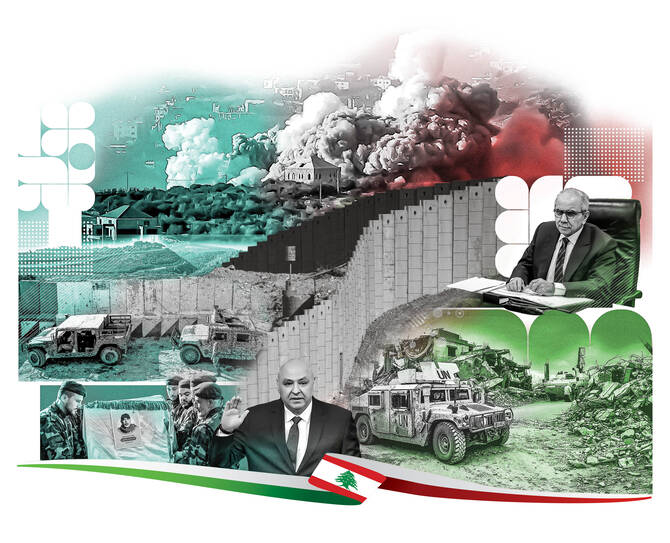
Aoun enters 2026 committed to the state’s monopoly on the use of force. His mandate for the year ahead is clear: “We will build a homeland and we will all be under the rule of law and the judiciary with no immunity for criminals or corrupt individuals, and no mafia, drug smuggling or money laundering.”
Despite the political transition, peace remains a delicate prospect. As 2026 begins, more than 70,000 residents of the south have yet to return home, haunted by the threat of resumed hostilities.
The central tension of the coming year remains the enforcement of the ceasefire’s key condition: disarming Hezbollah and relocating its fighters north of the Litani River.

After years of paralysis, the 2025 agenda was driven by the leadership of President Joseph Aoun and the government of veteran diplomat Nawaf Salam. (Lebanese Presidency/AFP)
The government faces a historic implementation phase. An American-drafted roadmap calls for the group’s disarmament and the removal of all illegal weapons by the end of 2025 — a deadline that has now arrived.
While a compromise was reached to hand over weapons south of the Litani, 2026 will see the much more contentious task of addressing arms elsewhere. This standoff continues to strain ties with Tehran. As Iranian officials criticize the policy, Beirut must continue to insist that Iran respect Lebanon’s sovereignty and refrain from interference.
A significant diplomatic milestone will continue to unfold in 2026. Lebanese civilian envoys are expected to continue meeting with Israeli representatives to review ceasefire implementation. These talks, involving former ambassador Simon Karam, Israeli official Yuri Resnick, and US envoy Morgan Ortagus, have emboldened negotiators to push for broader reconciliation — an idea that will remain a sensitive third rail in Lebanese politics throughout the year.
The pressure on the state is further intensified by a looming deadline: the UN Security Council has extended the mandate of UNIFIL troops only until the end of 2026, with the intention to withdraw them permanently thereafter. This gives the Lebanese Army exactly twelve months to prove it can secure the south independently.

Mourners carry the coffin of top Hezbollah military chief Haytham Ali Tabatabai. (AFP)
The ripple effects of the collapse of the Assad regime will continue to dominate the 2026 outlook. With regional supply routes severed, Hezbollah’s isolation is expected to deepen. Simultaneously, the issue of Syrian refugees remains a priority; following the return of over 378,000 people last year, 2026 will see increased pressure to ease the refugee burden further.
On the domestic front, the state’s war on drugs is expected to intensify.
Having targeted major networks and traffickers like Noah Zaiter in 2025, security forces must now prove they can dismantle production sites without triggering renewed internal strife with the political patrons who once protected these militias.
The economic forecast for 2026 remains a point of contention. Economy Minister Amer Bisat is projecting 5 percent growth, citing a rebound in tourism and services.

Lebanese army members in Alma Al-Shaab, near the border with Israel, southern Lebanon, November 28, 2025. (Reuters/File)
However, the World Bank maintains a more cautious stance, and noted economist Louis Hobeika has warned that the improvement in some sectors cannot yet be called recovery — Lebanon’s economy remains hostage to politics and security.
As 2026 begins, the bridges built over the last year remain fragile. Lebanon has reawakened to the ideas of sovereignty and reform, but as it looks ahead, it remains a nation haunted by its neighbors, its history, and its internal ruptures.