

AFC U-23 Asian Cup sets tone for flagship AFC Asian Cup 2027

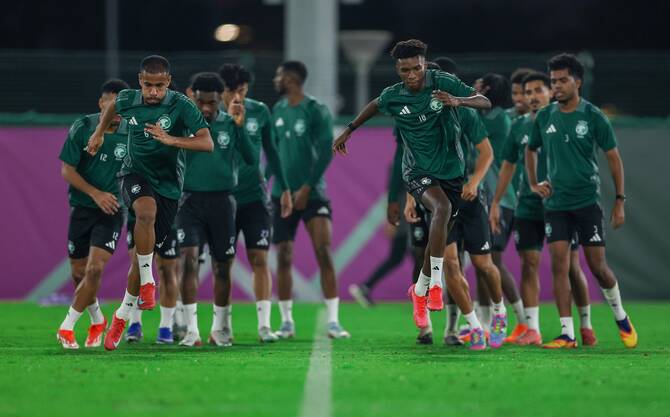
Saudi Arabia kick off their AFC U-23 Asian Cup against Kyrgyzstan on Tuesday in Jeddah. (X/@SaudiNT)
Short Url
Updated 05 January 2026
Follow

AFC U-23 Asian Cup sets tone for flagship AFC Asian Cup 2027

  • The tournament, exactly a year before the first AFC Asian Cup in Saudi Araba, will run from Jan. 6-24 in Jeddah and Riyadh

RIYADH: The 2026 AFC U-23 Asian Cup makes its way to Saudi Arabia this week, with 16 countries battling for the continent’s most prestigious youth prize. The seventh edition of the tournament will be hosted by the Kingdom for the first time, after Qatar’s hosting of the most recent edition in 2024.

Saudi Arabia’s U-23 side has a storied history in the competition, reaching the final in its inaugural edition in 2013 before lifting the trophy nine years later in Uzbekistan. Only Japan and Uzbekistan rank higher than the Green Falcons when it comes to overall performance at the tournament.

While Saudi Arabia enters as one of the favorites, the AFC U23 Asian Cup is far more than a standalone competition. The Kingdom has also secured the rights to host the AFC U-17 Asian Cup for four consecutive editions, with the first held in April last year and the second scheduled for this May.

Taken together, this forms part of a calculated strategy on Saudi Arabia’s road to hosting major international sporting events, with the AFC Asian Cup 2027 — set to kick off in January of next year — representing a central milestone in that journey.

Arab News spoke to Paul Williams, co-founding editor of The Asian Game platform and a freelance journalist who has covered Asian football for more than 15 years, spoke of Saudi Arabia’s hosting strategy and what it could mean for the future.

Williams believes that tournaments such as the AFC U-23 Asian Cup function more as capacity-building exercises than as standalone events.

“It’s about building infrastructure around the tournament, understanding the appropriate level of training facilities required, while also developing the right human capacity for individuals to be able to deliver events of this scale,” he said.

Uzbekistan, he said, is a prime of example of how sequencing tournaments can support long-term ambitions.

“Uzbekistan are now bidding for the 2031 and 2035 AFC Asian Cups, and if you look at their progress over the last few years, they built that capacity by hosting lower-profile tournaments, such as the AFC U-17, U-20 and U-23 Men’s Asian Cups and the AFC U-20 Women’s Asian Cup,” Williams said.

“If you can iron out any kinks by hosting lower-profile tournaments, by the time you come to host the bigger tournaments — the Asian Cups and the World Cups — you have already built capacity and proven yourself as a host,” he added.

Williams also pointed to Qatar’s recent hosting pathway as another example. “We saw Qatar do the same with the Arab Cup before the World Cup, and even without the World Cup as an end goal now, they have that proven ability to host tournaments,” he said.

The Australian believes this approach is crucial in the build-up to the AFC Asian Cup in 2027, but also with the 2034 FIFA World Cup in mind.

“Everything Saudi Arabia does is a stepping stone towards that,” he said. “This tournament may not receive the same level of attention with no Olympic qualification at stake, but from a Saudi point of view, it’s a way to show the world how they host these events.”

Beyond infrastructure, Williams also highlighted the cultural dimension of hosting.

“What we’re seeing is the federation and the Kingdom getting people comfortable with the idea of coming to Saudi Arabia for football tourism, while also familiarising them with the host cities and Saudi culture,” he said.

While the benefits of this tournament may not immediately translate into high attendance figures or viewership, Williams stressed that its importance should be measured by how it contributes to the wider ecosystem. And yet, from a footballing perspective, its significance is undeniable.

“These are the players that are going to be hitting their prime by the 2034 World Cup,” he told Arab News. “Hence, these tournaments are important opportunities for Saudi Arabia to demonstrate its on-field ability.”

Williams also referred to comments from senior national team manager Herve Renard, who has previously raised concerns about the amount of playing time local players receive in the Saudi Pro League.

“Saudi have a strong record at underage level, making the finals of the U-20 and U-23 Asian Cups on multiple occasions,” Williams said. “But if some of these players are expected to be carrying the torch toward 2034, it’s absolutely important that they deliver.”

The AFC U23 Asian Cup kicks off on Jan. 6 in Jeddah, with Vietnam against Jordan, followed by hosts Saudi Arabia against Kyrgyzstan. Riyadh welcomes its first games on Jan. 7 as it hosts Groups C and D. The knockout stage begins on Jan. 16, with all games from the quarter-finals on to be hosted in Jeddah.


Al-Ahli topple Al-Ittihad in Sea Derby as late Al-Hilal rout sees off Al-Najma

Photo: (@ALAHLI_FCEN @ittihad_en)
Updated 8 sec ago
Follow

Al-Ahli topple Al-Ittihad in Sea Derby as late Al-Hilal rout sees off Al-Najma

  • Al-Ahli defeat rivals Al-Ittihad 3-1 in thrilling derby at Al-Inma Stadium
  • Al-Hilal struggle against Al-Najma but three goals in final 10 minutes leads them to 4-0 victory

JEDDAH: The Saudi Pro League title race showed no signs of slowing on Friday as Al-Ahli and Al-Hilal played simultaneously in search of staying within touching distance of league leaders Al-Nassr, who play on Saturday.

While Al-Hilal took on Al-Najma, Al-Ahli’s weekend was about more than just three points. Waiting for them at Al-Inma Stadium were city rivals and defending champions Al-Ittihad.

For Al-Ittihad, this fixture was largely about pride. Their title defence has all but come to an end, with 19 points separating them and the summit heading into the Sea Derby.

Yet as shown in their 1-1 draw weeks prior against Al-Hilal while playing with a man down, Al-Ittihad tend to rise to the occasion in the bigger games regardless of their position on the table.

Al-Ahli did take control of proceedings through their high press, but the Tigers responded with confidence and urgency. A difficult season does not mean allowing your archrivals to take three points with ease, after all.

Matthias Jaissle, however, has converted Al-Ahli into one of the league’s most cohesive sides over the past three years. Some would even argue that despite never holding first place this season, they have indeed been the best team in the league.

That showed in the 23rd minute. Galeno was released into the space behind Muhannad Al-Shanqiti before delivering a low cross to Ivan Toney, who continued his prolific campaign with his 24th goal of the season.

Calls for a VAR review followed, as Houssem Aouar was brought down in the box prior to the goal. Referee Nikola Dabanovic ruled there was no infringement, and Al-Ahli led 1-0.

Al-Ittihad emerged after the interval with renewed vigour. Steven Bergwijn calmly held Zakaria Hawsawi on the edge of the box, tempting him into a foul that Dabanovic judged worthy of a penalty.

Fabinho stepped up and powered the ball past Edouard Mendy to equalise for The Tigers in the 51st minute. For a brief moment, there was hope. If Al-Ittihad could derail Al-Ahli’s title push and go on to win the AFC Champions League Elite later this season, this match could yet prove significant.

Those hopes lasted less than 10 minutes. Al-Ahli’s trademark pass into the channel released Galeno once again, and his low cross rolled across the face of goal to Riyad Mahrez.

The Algerian — who had repeatedly troubled the defence with his movement inside — made no mistake this time, restoring the hosts’ lead in the 59th minute.

Al-Ittihad came close on several occasions, but the match rarely felt out of Al-Ahli’s control for long. Their relentless press ultimately sealed the result when substitute Feras Al-Brikan disposessed Predrag Rajkovic and slotted home into an open net in the 84th minute.

Al-Hilal, meanwhile, endured a far more difficult night against bottom-placed Al-Najma. A glance at the scoreline suggests total dominance for Al-Hilal, but the reality was quite different.

Make no mistake, Al-Hilal created several openings, yet repeatedly lacked the decisive final touch. Salem Al-Dawsari’s decision to square the ball to Karim Benzema while through on goal summed up their struggles in front of the net.

It wasn’t until Nasser Al-Haleel received a red card in the 39th minute for pulling down Al-Dawsari as the last defender that Al-Hilal began to shift gears.

Four minutes later, Al-Dawsari made amends for his earlier mistake by setting up Benzema for first goal at Kingdom Arena.

Even with the numerical advantage, Al-Hilal produced one of their least convincing performances of the season. Fortunately for them, Al-Najma offered little attacking threat, registering just one shot across the 90 minutes.

They eventually collapsed in the final 10 minutes, as Benzema, Malcom and Sergej Milinkovic-Savic all scored within a six-minute spell, lifting Al-Hilal’s goal difference to +43 — a vital factor in a tital race where Al-Nassr sit on +46.

The victories move Al-Ahli and Al-Hilal to 62 and 61 points respectively, with Al-Nassr sandwiched between them on 61 ahead of their clash against NEOM.

Elsewhere, Al-Taawoun defeated Al-Fateh 3-2 in a match that saw the visitors mount a late rally but ultimately fall short of completing the comeback. Meanwhile, Greek duo Giorgos Masouras and Kostas Fortounis both found the net as Al-Khaleej secured a 2-1 victory over Al-Hazem.

Saudi Pro League action resumes on Saturday, with four clashes kicking off at 10:00pm. Al-Ettifaq host Al-Shabab, Al-Kholood take on Al-Qadsiah, Al-Okhdood welcome Al-Fayha, and Al-Nassr aim to maintain their spot at the top against NEOM.