

Saudi POS spending hits $3.5bn; hotel sector sees greatest increase

Short Url
Updated 10 July 2024
Follow

Saudi POS spending hits $3.5bn; hotel sector sees greatest increase

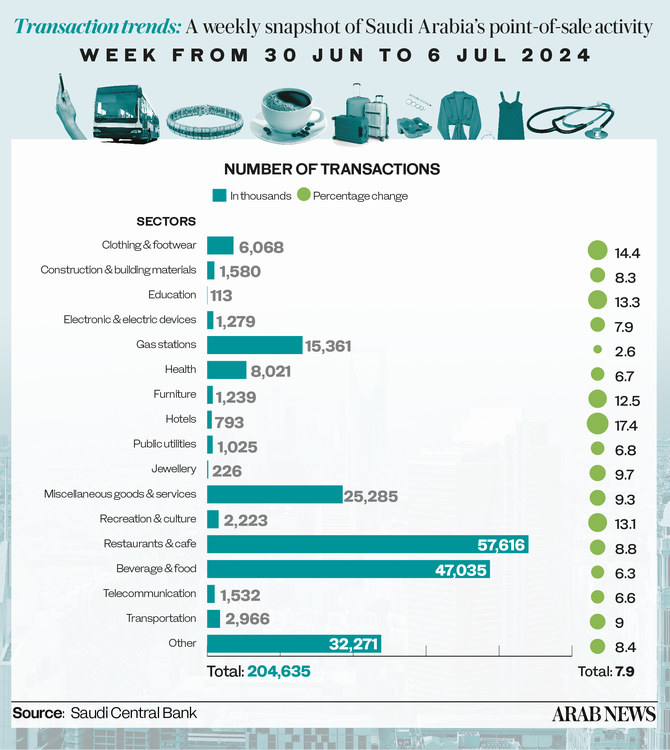
RIYADH: Saudi Arabia’s point-of-sale spending increased by 7.7 percent to reach SR13.2 billion ($3.51 billion) from June 30 to July 6, with the greatest rise coming in hotel payments, according to official data.

The latest release from the Saudi Central Bank, also known as SAMA, revealed that the transaction value in this sector, which accounts for only 0.39 percent of the total number of payments, saw a 17.9 percent surge reaching SR259.7 million.

POS spending in the Kingdom regained momentum in the week commencing June 23, after dipping in the previous seven-day period to SR8.34 billion – coinciding with the Eid al-Adha vacation period.

Saudi-based economist Talat Hafiz explained in an interview with Arab News that “spending is usually less during such vacations,” as Saudis go to perform Hajj compared to normal days when they visit shopping malls and restaurants for entertainment.

Data from SAMA for the week beginning June 30 showed that spending on education surged by 14.1 percent to reach SR113 million, the second-highest increase compared to the previous week. 

Spending on miscellaneous goods and services came in third place and took over the third-highest share of the POS, recording a 10.1 percent surge, reaching SR1.76 billion.

Saudi spending on food and beverages constituted the highest share of the POS and witnessed an 8.8 percent rise, reaching SR2.05 billion compared to SR1.88 billion in the previous week. 

This came alongside spending in restaurants and cafes, reaching SR1.96 billion, and constituting the second-largest share with a surge of 9 percent compared to the previous week.

POS spending on public utilities witnessed the smallest climb this week, recording a 3.2 percent increase, reaching SR74.7 million. 

Gas stations experienced the second-smallest rise in POS transaction value, increasing by 4.2 percent to SR869.6 million. Spending on electronics and electric devices witnessed the third-smallest surge, with a 4.3 percent increase, reaching SR229.9 million.

According to data from SAMA, 32.09 percent of POS spending occurred in Riyadh, with the total transaction value reaching SR4.26 billion, representing a 7.5 percent increase from the previous week, when it was SR3.96 billion.

Riyadh has expanded into a major growth hub, with Spinneys recently debuting its flagship 43,520 sq. ft. outlet at La Strada Yard, marking the start of its expansion in Riyadh and Jeddah to meet increasing demand for high-quality groceries in Saudi Arabia. 

Spending in Jeddah followed, accounting for 14 percent of the total and reaching SR1.86 billion, marking a 8.9 percent weekly positive change.

Moreover, spending in Dammam surged by 7.5 percent to reach SR623.6 million, the third-largest share of this week’s POS. 

The most significant positive change was spotted in Abha, with a 13.5 percent surge, reaching SR235.5 million. 

This week, Makkah saw no decrease; spending increased by 8 percent to SR479.4 million, following a 1.1 percent decline the previous week.


SABIC sells European petrochemicals, engineering plastics units in $950m portfolio restructuring 

Updated 08 January 2026
Follow

SABIC sells European petrochemicals, engineering plastics units in $950m portfolio restructuring 

RIYADH: Saudi Basic Industries Corp. is selling two overseas businesses for a combined $950 million as the world’s biggest petrochemicals maker continues to streamline its portfolio and redeploy capital toward higher-return segments. 

The Riyadh-based company agreed to sell its European petrochemicals business to investment firm AEQUITA for $500 million and its engineering thermoplastics operations in the Americas and Europe to turnaround specialist Mutares for $450 million, SABIC said in a release.

The plastics deal includes an earn-out linked to future cash flow and a potential resale. 

The transactions are part of SABIC’s portfolio optimization program launched in 2022, which has already seen divestments including Functional Forms, Hadeed and Alba. The company aims to sharpen its focus, improve returns, and free up capital for higher-growth opportunities. 

Abdulrahman Al-Fageeh, CEO of SABIC, said: “This strategic approach allows us to actively reshape our portfolio and sharpen our focus on areas where SABIC has clear and sustainable competitive advantages in a rapidly changing landscape.” 

He added: “I am pleased that both AEQUITA and Mutares will work with us in the future to ensure that we continue to serve our global customers in a seamless manner.” 

The European petrochemicals business produces ethylene, propylene, various grades of polyethylene, polypropylene and polymer compounds. Its manufacturing footprint includes sites in the UK, the Netherlands, Germany and Belgium. 

The engineering thermoplastics business in the Americas and Europe produces polycarbonate, polybutylene terephthalate and acrylonitrile butadiene styrene. Its facilities are located in the US, Mexico, Brazil, Spain and the Netherlands. 

“The Board endeavored to achieve these transactions, which represent a significant milestone in the execution of our strategy to further optimize our portfolio and maximize shareholder value by enhancing the Company’s cash generation capacity and achieving the highest possible return on our global businesses,” said Khalid Al-Dabbagh, chairman of the board of directors of SABIC. 

Chief Financial Officer Salah Al-Hareky said the transactions demonstrate a “disciplined approach” to capital allocation and active portfolio management, aimed at improving return on capital employed and free cash flow. 

Despite the divestments, SABIC said it will maintain strategic market access through exports to Europe and the Americas, while preserving its focus on technology, innovation and customer service. 

Both buyers have committed to ensuring business continuity, retaining workforce expertise and maintaining high safety and customer service standards during the transition. 

Axel Geuer, president and co-CEO of AEQUITA, said: “This transaction represents a further step in the expansion of our European chemicals platform.” 

He added: “The assets are highly synergistic with the olefins and polyolefins business we recently acquired from LYB; with complementary markets, infrastructure and operational capabilities, we see substantial potential to realize synergies and drive operational improvements across both businesses.” 

Geuer, noted that under AEQUITA’s active ownership model, the focus will be on supporting the teams on the ground, ensuring a seamless integration, and building a scaled, competitive platform positioned for long-term, sustainable value creation. 

Robin Laik, co-founder and CEO of MUTARES, said: “The Engineering Thermoplastics (ETP) business in the Americas and Europe has a highly skilled workforce and strong customer relationships.” 

He added: “Under focused ownership, our priority is to ensure continuity, support employees through the transition, and unlock the full potential of our asset base as a standalone ETP platform.” 

The deals are subject to customary closing conditions, regulatory approvals, and, where applicable, employee consultation processes.