

Muslim pilgrims converge at Mount Arafat for daylong worship as Hajj reaches its peak

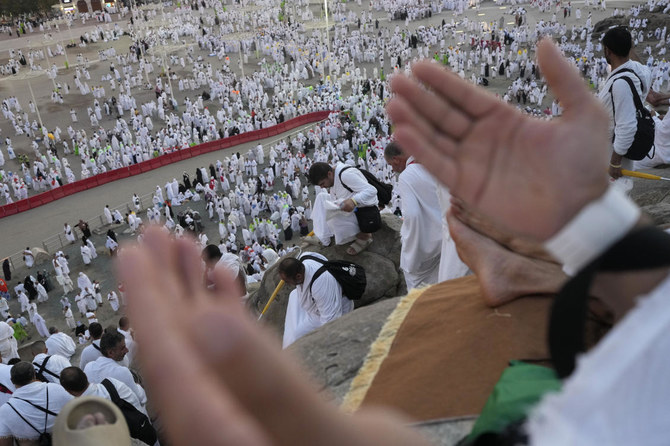
Muslim pilgrims gather at top of the rocky hill known as the Mountain of Mercy, on the Plain of Arafat, during the annual Hajj pilgrimage, near the holy city of Mecca, Saudi Arabia, Saturday, June 15, 2024. (AP)
Short Url
Updated 15 June 2024
Follow

Muslim pilgrims converge at Mount Arafat for daylong worship as Hajj reaches its peak

  • Hajj officially started Friday when pilgrims moved from Makkah’s Grand Mosque to Mina
  • Saudi authorities expect the number of pilgrims this year to exceed 2 million

MOUNT ARAFAT, Saudi Arabia: Following the footsteps of prophets beneath a burning sun, Muslims from around the world congregated Saturday at a sacred hill in Saudi Arabia for intense, daylong worship and reflection.
The ritual at Mount Arafat, known as the hill of mercy, is considered the peak of the Hajj pilgrimage. It is often the most memorable for pilgrims, who stand shoulder to shoulder, feet to feet, asking God for mercy, blessings, prosperity and good health. The mount is about 20 kilometers (12 miles) southeast of Makkah.
It’s believed that Prophet Muhammad delivered his final speech, known as the Farewell Sermon, at the sacred mount 1,435 years ago. In the sermon, the prophet called for equality and unity among Muslims.
“It’s indescribable,” Ahmed Tukeyia, an Egyptian pilgrim, said on his arrival Friday evening at a tent camp at the foot of Mount Arafat.


Muslim pilgrims gather at top of the rocky hill known as the Mountain of Mercy, on the Plain of Arafat, during the annual Hajj pilgrimage, near the holy city of Mecca, Saudi Arabia, Saturday, June 15, 2024.  (AP)


Hajj is one of the largest religious gatherings on earth. The rituals officially started Friday when pilgrims moved from Makkah’s Grand Mosque to Mina, a desert plain just outside the city.
Saudi authorities expect the number of pilgrims this year to exceed 2 million, approaching pre-coronavirus pandemic levels.
The pilgrimage is one of the Five Pillars of Islam. All Muslims are required to make the five-day Hajj at least once in their lives if they are physically and financially able to make the demanding pilgrimage.

GALLERY: Hajj 2024: Muslims converge at Mount Arafat as pilgrimage reaches peak
The rituals largely commemorate the Qur’an’s accounts of Prophet Ibrahim, his son Prophet Ismail and Ismail’s mother Hajjar — or Abraham and Ismael as they are named in the Bible.
The time of year when the Hajj takes place varies, given that it is set for five days in the second week of Dhu Al-Hijjah, the last month in the Islamic lunar calendar.
Most of the Hajj rituals are held outdoors with little if any shade. When it falls in the summer months, temperatures can soar to over 40 Celsius (104 Fahrenheit). The Health Ministry has cautioned that temperatures at the holy sites could reach 48 C (118 F). It urged pilgrims to use umbrellas and drink more water to stay hydrated.


Muslim pilgrims arrive at the Mountain of Mercy, on the Plain of Arafat, during the annual Hajj pilgrimage, near the holy city of Makkah, Saudi Arabia, Saturday, June 15, 2024. (AP)


After Saturday’s worship in Arafat, pilgrims will travel a few kilometers (miles) to a site known as Muzdalifa to collect pebbles that they will use in the symbolic stoning of pillars representing the devil back in Mina.
Pilgrims then return to Mina for three days, coinciding with the festive Eid Al-Adha holiday, when financially able Muslims around the world slaughter livestock and distribute the meat to poor people. Afterward, they return to Makkah for a final circumambulation, known as Farewell Tawaf.
Once the Hajj is over, men are expected to shave their heads, and women to snip a lock of hair in a sign of renewal. Most of the pilgrims then leave Makkah for the city of Medina, some 340 kilometers (210 miles) away, to pray in Prophet Muhammad’s tomb, the Sacred Chamber. The tomb is part of the prophet’s mosque, which is one of the three holiest sites in Islam, along with the Grand Mosque in Makkah and the Al Aqsa Mosque in Jerusalem.
In recent years, Saudi authorities have made significant efforts to improve access and avoid deadly accidents. Tens of thousands of security personnel were deployed across the city, especially around the holy sites, to control the crowds, and the government built a high-speed rail link to ferry people between holy sites in the city, which has been jammed with traffic during the Hajj season. Pilgrims enter through special electronic gates.
Saudi authorities have also expanded and renovated the Grand Mosque where cranes are seen around some of its seven minarets as construction was underway in the holy site.


Saudi reserve given ‘dark sky’ listing in boost to astrotourism ambitions 

Updated 15 December 2025
Follow

Saudi reserve given ‘dark sky’ listing in boost to astrotourism ambitions 

  • Imam Turki bin Abdullah Royal Reserve Development Authority announced on Monday that the desert received official accreditation from DarkSky International

RIYADH: Saudi Arabia’s Nafud Desert has been listed as one of more than 250 Dark Sky Sites worldwide, which authorities say marks a commitment to protecting the environment from light pollution. 

Imam Turki bin Abdullah Royal Reserve Development Authority announced on Monday that the desert received official accreditation from DarkSky International, the global body committed to tackling light pollution in urban and rural areas. 

Welcoming the accreditation, Ahmed Al-Qarni, official spokesperson at the royal reserve, told Arab News: “It’s a new achievement in the journey of protecting nature and astronomy in Saudi Arabia. 

“The adoption of the Great Nafud Desert in Imam Turki bin Abdullah Royal Reserve by the International DarkSky Association, as the largest site in the Middle East, (represents) a culmination of a precise scientific path, and another step that enhances the Kingdom’s position as a leading destination in sustainability, nature protection, and astronomical tourism.” 

Abouazza El-Mhamdi, associate professor in the physics and astronomy department at King Saud University’s College of Science, said that the announcement is a “a major achievement for both science and tourism. 

“This accreditation protects the pristine night sky from light pollution, creating an invaluable natural laboratory for astronomers,” he added. 

“It provides an ideal Saudi location for adequate Earth-based telescopes and is a prime candidate for detailed site surveys, enabling sensitive observations of stars and galaxies. 

“At the same time, it establishes the reserve as a premier global destination for stargazing and astrotourism, supporting sustainable economic growth.” 

The reserve development authority also posted on X: “Away from the clamor of the lights ... there is a darkness that shines. 

“We are proud of the adoption of the Great Nafud Desert within the Imam Turki bin Abdullah Royal Reserve as one of the dark sky places certified by the DarkSky International.” 

Located within the reserve east of the Hail-Al Jawf road, the Great Nafud Desert covers an area of about 13,416 sq. km, making it one of the largest accredited Dark Sky Sites in the region and one of the least light-polluted sites in the Kingdom, the Saudi Press Agency reported. 

Fulfilling the organization’s criteria was the result of comprehensive scientific work that included field studies, precise astronomical observations, advanced nighttime analyses, and the implementation of specialized engineering practices for managing nighttime lighting and controlling light pollution sources. 

These efforts, undertaken by the authority, are part of its commitment to protecting the desert’s natural nighttime landscapes, enhancing the sustainability of ecosystems and preparing the site to serve as a global model for preserving the natural sky. 

CEO of the Imam Turki bin Abdullah Royal Reserve Development Authority, Engineer Mohammed Al-Shaalan, said in a statement that the accreditation is a culmination of the interest of the country’s leadership in the environment and the protection of natural sites. 

It also reflects the support of Prince Turki bin Mohammed bin Fahd bin Abdulaziz, chairman of the authority’s board of directors, he added. 

Al-Shaalan said that the accreditation represents a significant step that enhances the reserve’s presence on the international map and contributes to the development of astronomical tourism, scientific research, and specialized environmental experiments. 

The area provides visitors and researchers with unique opportunities to observe the night sky and to monitor astronomical phenomena in a natural environment with low light pollution. 

He added that the authority has developed tourism facilities in the desert such as “The Leaf” camp located near the dark sky zone.