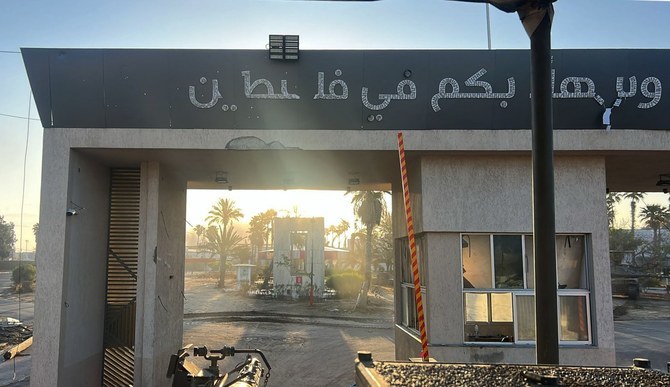
GAZA: The Israeli army said it took control on Wednesday of a vital Gaza-Egypt corridor suspected of aiding weapons smuggling as it intensified its offensive against Hamas in the border city of Rafah.
The UN Security Council was set to meet for a second day of emergency talks after a strike at the weekend ignited a fire that Gaza officials said killed 45 people and injured about 250.
United Nations Secretary-General Antonio Guterres was among the many leaders to voice revulsion at the bloodshed, demanding that “this horror must stop.”
Israel’s National Security Adviser Tzachi Hanegbi said, however, that the war could go on until the year’s end.
“We may have another seven months of fighting to consolidate our success and achieve what we have defined as the destruction of Hamas’s power and military capabilities,” Hanegbi said.
An Israeli military official later told reporters the army had taken “operational control” of the strategic, 14-kilometer (8.5-mile) Philadelphi corridor along the Gaza-Egypt border.
The corridor had served as a buffer between Gaza and Egypt, but since Israel withdrew from Gaza in 2005, there were fears it was being used to channel weapons to armed groups in the Palestinian territory.
Its seizure comes weeks after Israeli forces took the Palestinian side of the Rafah border crossing with Egypt, which alleged Wednesday Israel was using claims of cross-border tunnels as cover for its Rafah offensive.
“Israel is using these allegations to justify continuing the operation on the Palestinian city of Rafah and prolonging the war for political purposes,” a high-level Egyptian source was quoted as saying by state-linked Al-Qahera News.
In besieged Rafah, witnesses reported escalated fighting with helicopters intensifying attacks, supported by artillery and smoke grenades.
Hamas’s military wing said it was firing rockets at Israeli troops.
AFPTV footage showed Palestinians with bloodied midriffs and bandaged limbs after being wounded in strikes near Khan Yunis, close to Rafah, being taken to the European Hospital on makeshift gurneys.
“The rockets fell directly on us. I was hurled three meters (yards)... I don’t know how I managed to get up on my feet,” said one who did not give his name.
Gaza’s civil defense said three bodies were recovered from a Khan Yunis house after it was shelled.
The United States has been among the countries urging Israel to refrain from a full-scale offensive into Rafah, the last Gaza city to see ground fighting, because of the risk to civilians.
However, the White House said Tuesday that so far it had not seen Israel cross President Joe Biden’s “red lines,” with National Security Council spokesman John Kirby saying: “We have not seen them smash into Rafah.”
On Wednesday, US Secretary of State Antony Blinken called on Israel to quickly devise a post-war strategy for Gaza, stressing: “In the absence of a plan for the day after, there won’t be a day after.”
A steady stream of civilians has been fleeing Rafah, the new hotspot in the gruelling war, many carrying belongings on their shoulders, in cars or on donkey-drawn carts.
Before the Rafah offensive began on May 7, the United Nations had warned that up to 1.4 million people were sheltering there. Since then, one million have fled the area, the UN agency for Palestinian refugees (UNRWA) has said.
Israeli Prime Minister Benjamin Netanyahu called Sunday’s strike and ensuing fire a “tragic accident.” The army said it had targeted a Hamas compound and killed two senior members of the group.
Israel’s military said it was investigating the strike, and its spokesman Daniel Hagari said on Tuesday that “our munition alone could not have ignited a fire of this size.”
Gaza civil defense agency official Mohammad Al-Mughayyir said 21 more people were killed in a similar strike Tuesday “targeting the tents of displaced people” in western Rafah.
The army denied this, saying it “did not strike in the humanitarian area in Al-Mawasi,” an area it had designated for displaced people from Rafah to shelter.
New fighting also hit other areas of the besieged Palestinian territory of 2.4 million people.
In the north, Israeli military vehicles unleashed intense gunfire east of Gaza City, an AFP reporter said, and residents reported strikes on Jabalia.
The Gaza war was sparked by Hamas’s October 7 attack on southern Israel, which resulted in the deaths of 1,189 people, mostly civilians, according to an AFP tally based on Israeli official figures.
Militants also took 252 hostages, 121 of whom remain in Gaza, including 37 the army says are dead.
Israel’s retaliatory offensive has killed at least 36,171 people in Gaza, mostly civilians, according to the Hamas-run territory’s health ministry.
Nearly eight months into the deadliest Gaza war, Israel has faced ever louder opposition and cases before two Netherlands-based international courts.
At the UN Security Council, Algeria has presented a draft resolution that “demands an immediate ceasefire respected by all parties” and the release of all hostages.
Algeria’s UN ambassador Amar Bendjama has not specified when he hopes to put the draft to a vote.
Chinese ambassador Fu Cong expressed hope for a vote this week as President Xi Jinping told Egyptian President Abdel Fattah El-Sisi in Beijing he was “deeply pained” by the situation in Gaza.
French UN ambassador Nicolas de Riviere said “it’s high time for this council to take action. This is a matter of life and death. This is a matter of emergency.”
US ambassador Linda Thomas-Greenfield, when asked about the draft resolution, said: “We’re waiting to see it and then we’ll react to it.”
Brazil, whose ties with Israel have soured over the war, on Wednesday recalled its ambassador, further raising tensions between the two.
Meanwhile, the World Central Kitchen nonprofit organization said it was stopping its operations in Rafah because of “ongoing attacks” in the southern city.


Israel says it seizes key Gaza-Egypt corridor
https://arab.news/2bqw4
Israel says it seizes key Gaza-Egypt corridor

- “Israel is using these allegations to justify continuing the operation on the Palestinian city of Rafah and prolonging the war for political purposes,” Egyptian source said
- Israel’s National Security Adviser Tzachi Hanegbi said, however, that the war could go on until the year’s end


Ceasefire with Kurdish-led force extended for another 15 days, Syrian army says
- The defense ministry said the extension was in support of an operation by US forces to transfer accused Daesh militants to Iraq
- The Kurdish-led Syrian Democratic Forces confirmed the ceasefire extension
RAQQA, Syria: Hours after the expiration of a four-day truce between the Syrian government and Kurdish-led fighters Saturday, Syria’s defense ministry announced the ceasefire had been extended by another 15 days.
The defense ministry said in a statement that the extension was in support of an operation by US forces to transfer accused Daesh militants who had been held in prisons in northeastern Syria to detention centers in Iraq.
The Kurdish-led Syrian Democratic Forces confirmed the ceasefire extension.
“Our forces affirm their commitment to the agreement and their dedication to respecting it, which contributes to de-escalation, the protection of civilians, and the creation of the necessary conditions for stability,” the group said in a statement.
Over the past three weeks, there have been intense clashes between government forces and the SDF, in which the SDF lost large parts of the area they once controlled.
Earlier in the day, the Kurdish-led force called on the international community to prevent any escalation.
The end of the truce came as government forces have been sending reinforcements to Syria’s northeast.
Syria’s interim government signed an agreement last March with the SDF for it to hand over territory and to eventually merge its fighters with government forces. In early January, a new round of talks failed to make progress over the merger, leading to renewed fighting between the two sides.
A new version of the accord was signed last weekend, and a four-day ceasefire was declared Tuesday. Part of the new deal is that SDF members will have to merge into the army and police forces as individuals.
The SDF said in a statement Saturday that military buildups and logistical movements by government forces have been observed, “clearly indicating an intent to escalate and push the region toward a new confrontation.” The SDF said it will continue to abide by the truce.
On Saturday, state TV said authorities on Saturday released 126 boys under the age of 18 who were held at the Al-Aqtan prison near the northern city of Raqqa that was taken by government forces Friday. The teenagers were taken to the city of Raqqa where they were handed over to their families, the TV station said.
The prison is also home to some of the 9,000 members of the Daesh group who are held in northeastern Syria. Most of them remain held in jails run by the SDF. Government forces have so far taken control of two prisons while the rest are still run by the SDF.
Earlier this week, the US military said that some 7,000 Daesh detainees will be transferred to detention centers in neighboring Iraq.
On Wednesday, the US military said that 150 prisoners have been taken to Iraq.


